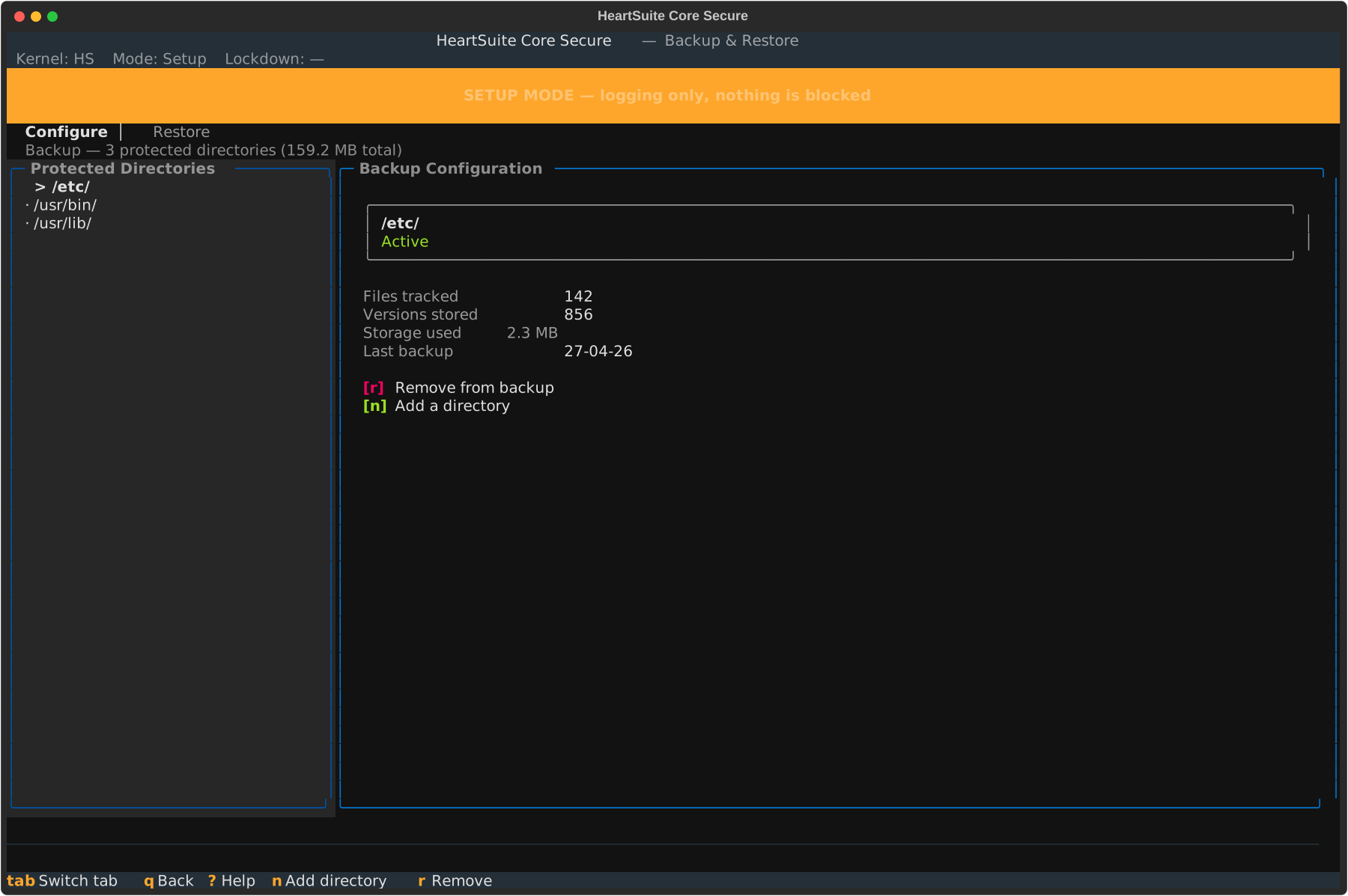
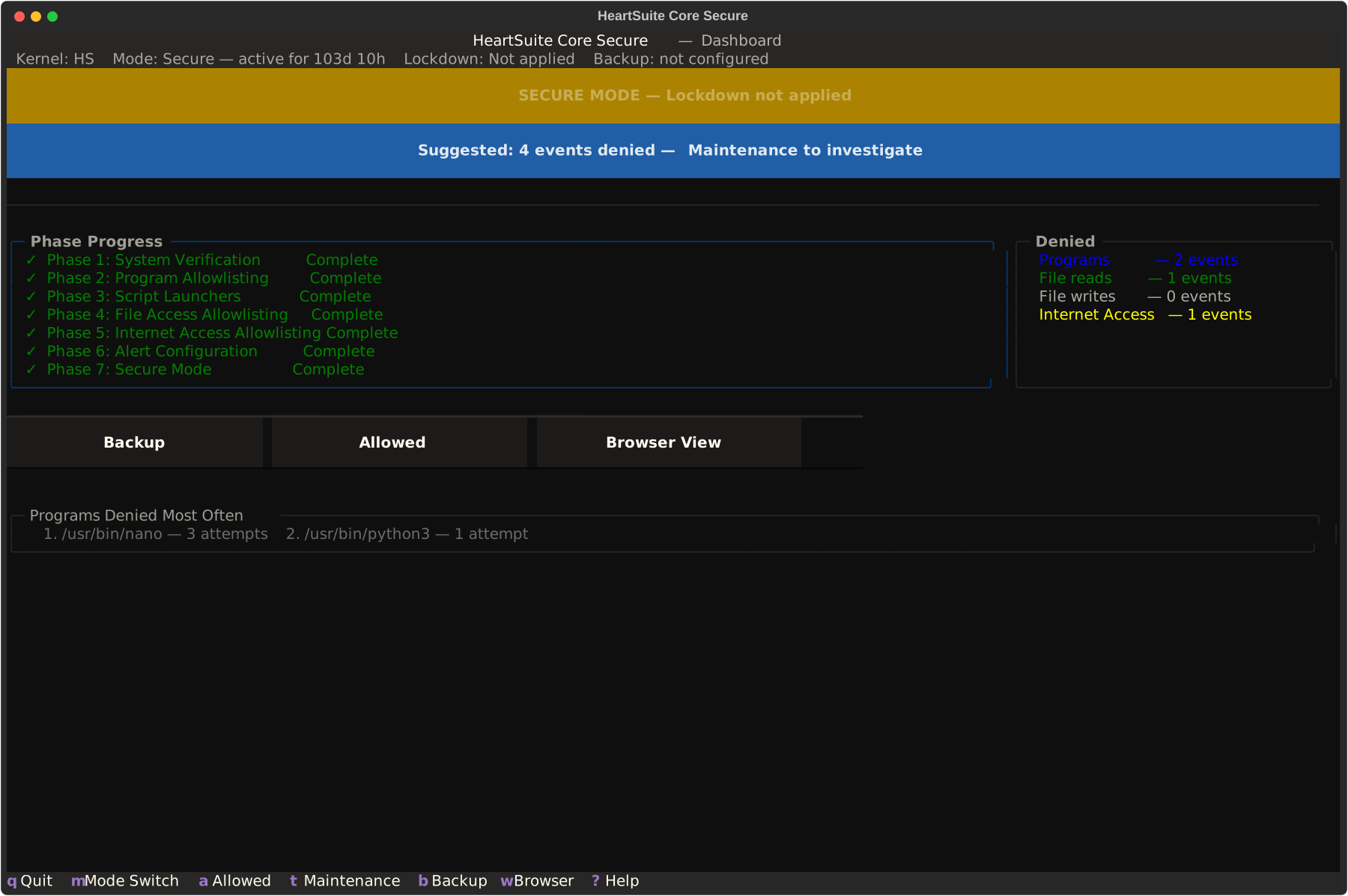
14 - Kernel Security Transparency
CVE status for the Root Lock by HeartSuite kernel — precise status and technical rationale for each relevant vulnerability, including Not Affected entries where the vulnerable code path is absent by design.
Root Lock by HeartSuite was designed to contain only what is necessary.
Everything else was never there to begin with.
153 high and critical CVEs — Score on HeartSuite 0.0.
Every kernel CVE relevant to Root Lock by HeartSuite — what it can do, what it cannot, and why.
The Score on HeartSuite column shows the CVSS v3.1 Environmental Score for a Root Lock by HeartSuite deployment — the actual risk on your system, not the theoretical worst case. Where the attack surface is absent — hardware not present, trigger not installed — the Score on HeartSuite is 0.0 regardless of Base Score. Where the code path is reachable, MI is reduced from High to Low: Lockdown’s allowlist refuses new code execution and blocks allowlist modification. Scores are computed using CR=M, IR=M, AR=M with no Temporal adjustments.
CVE Status
153
High & Critical CVEs reduced to Score on HeartSuite 0.0
Attack surface absent by design.
34
CVEs with reachable code paths
Even with root, the system refuses new code. No persistence. No survival after reboot.
1046
Additional CVEs
Kernel features never compiled in.
Understanding CVE Scores in HeartSuite
CVEs are rated by severity (e.g., HIGH means a score of 7+). A “0.0” score here means HeartSuite fully neutralizes the vulnerability—it’s not reachable. A “non-zero” score means the flaw can still be exploited in HS, but its impact is limited, often to temporary effects that a reboot clears. This helps you see real risks clearly.
What malware can and cannot do on this system
Across every reachable CVE in this document, the answer is the same — and short.
Blocked
- Persistence across reboot. No service, cron job, init script running new code, or kernel module added by the attacker survives a reboot. The allowlist is populated only at boot from your authorized sources; any in-memory tampering is wiped on the next boot.
Supply-chain compromise: contained, not prevented.
If malware arrives inside a trusted update, HeartSuite does not block it from running — it was authorized. What HeartSuite does enforce is the blast radius. The malware cannot launch processes outside the allowlist, cannot reach unallowlisted network destinations, and cannot install additional code. A compromised supplier gets one program slot, not the system.
- New program execution. The kernel refuses to run any program not in the Lockdown allowlist, regardless of root privilege. Backdoors, custom exploit tools, droppers, and post-exploitation frameworks cannot run.
- Kernel module loading post-boot. On Debian 12,
modprobe and insmod are symlinks to kmod, which is added to the allowlist during standard Setup Mode via systemd-modules-load.service. Lockdown’s file-access enforcement denies kmod access to /usr/lib/modprobe.d/ by default — module loading fails at the file-read stage before any module can be loaded. Module-based rootkits cannot be installed. - Allowlist modification at runtime. The runtime allowlist lives in kernel memory and is not modifiable post-boot. The on-disk allowlist file is
chattr +i immutable; Lockdown blocks FS_IOC_SETFLAGS so root cannot strip the immutable flag. - Mounting new filesystems. Lockdown blocks
mount(), fsmount(), and move_mount() after boot. Bind-mounts and remounts to shadow allowlisted paths are refused.
Bounded by allowlist composition
- Data exfiltration. Reading data is not constrained — root with kernel-context primitives can read any file. Sending data off-host is bounded by which networked utilities are in your allowlist. Deployments with no outbound networking utilities allowlisted have no in-band exfiltration path.
- Service disruption. Root can panic the kernel via syscall primitives or
kill -9 allowlisted services. Availability hardening is a separate control; HS does not prevent denial-of-service. - Lateral movement. Attackers can pivot through whatever the allowlisted process tree permits, but cannot extend that tree. New processes outside the allowlist do not run.
Under Lockdown, the kernel controls three things per program — whether it can execute, which files it can read or write, and which network destinations it can reach — and holds those controls regardless of user privilege, including root. The allowlist is sealed — immutable on disk, refused at runtime by the kernel itself: no program or user, including root, can modify it while the machine is running.
Out of scope
- Sensitive-data disclosure during the live session. A root attacker can read disk content while the session is active. Confidentiality during the breach is the role of disk encryption, not Lockdown.
- Hardware-level and pre-boot threats. Firmware compromise, baseboard management exploits, and physical attacks on the boot chain are outside the HS attack surface.
- Misconfigured allowlists. If you allowlist tools you should not —
modprobe, bpftool, networked exfiltration utilities — outcomes move from “Blocked” to “Bounded” and from “Bounded” to “Allowed.” See the deployment-tuning note.
The reason the answer is the same for every reachable CVE in this document is that HeartSuite’s enforcement is structural, not state-based. Most kernel hardening products gate enforcement on a state variable that an attacker with arbitrary kernel write can clear in a single instruction. Lockdown’s allowlist is consulted on every execve regardless of any state variable. There is no kill-switch.
| CVE | Component | Base Score | Score on HeartSuite | Status |
|---|
| CVE-2024-47685 | nf_reject_ipv6 | 9.1 CRITICAL | 0.0 | Score on HeartSuite 0.0 — trigger not present in default configuration |
| CVE-2022-41674, CVE-2022-42719, CVE-2022-42720 | mac80211 | 8.8 / 8.1 / 7.8 HIGH | 0.0 | Hardware absent on server deployments |
| CVE-2026-23193 | Linux iSCSI target (CONFIG_ISCSI_TARGET) | 8.8 HIGH | 0.0 | Not Affected — CONFIG_ISCSI_TARGET not compiled |
| CVE-2026-43284 | XFRM/IPv6 ESP (CONFIG_XFRM, CONFIG_INET6_ESP) | 8.8 HIGH | 0.0 | Not exploitable — esp_output unreachable; no XFRM SA can be established; IPsec management tools absent from HS allowlist; Dirty Frag chain broken (rxrpc absent) |
| CVE-2023-0266 | ALSA PCM | 7.9 HIGH | 0.0 | Hardware absent on server deployments |
| CVE-2026-31431 | algif_aead (AF_ALG) | 7.8 HIGH | 0.0 | Code not compiled in |
| CVE-2026-43500 | rxrpc (CONFIG_AF_RXRPC) | 7.8 HIGH | 0.0 | Not Affected — CONFIG_AF_RXRPC not compiled; Dirty Frag chain cannot execute on Root Lock by HeartSuite |
| CVE-2022-4139 | i915 GPU | 7.8 HIGH | 0.0 | Hardware absent on server deployments |
| CVE-2023-2236, CVE-2022-3910 | io_uring | 7.8 HIGH | 7.1–7.3 HIGH | Affected — Lockdown reduces persistence and integrity impact; confidentiality and availability remain HIGH |
| CVE-2023-52530 | mac80211 wireless stack (CONFIG_MAC80211) | 7.8 HIGH | 0.0 | No WiFi NIC present |
| CVE-2023-52612 | kernel crypto framework — scomp interface (CONFIG_CRYPTO) | 7.8 HIGH | 0.0 | Not exploitable — CONFIG_INET_IPCOMP not compiled; no compression algorithm registered; scomp_acomp_comp_decomp() unreachable |
| CVE-2024-26704 | ext4 filesystem — online defragmentation (CONFIG_EXT4_FS) | 7.8 HIGH | 0.0 | Not exploitable — EXT4_IOC_MOVE_EXT ioctl only reached by defrag tools; none in HS allowlist |
| CVE-2024-26842 | SCSI subsystem (CONFIG_SCSI) | 7.8 HIGH | 0.0 | UFS flash storage absent on x86 server |
| CVE-2022-48662 | Intel i915 DRM driver (CONFIG_DRM_I915) | 7.8 HIGH | 0.0 | No Intel display GPU present |
| CVE-2024-26934 | USB core (CONFIG_USB) | 7.8 HIGH | 0.0 | Not exploitable — no USB interface device on headless server; race condition unreachable |
| CVE-2022-48702 | EMU10K1 audio driver (CONFIG_SND_EMU10K1) | 7.8 HIGH | 0.0 | CONFIG_SND_EMU10K1 not set |
| CVE-2022-48695 | mpt3sas SCSI driver (CONFIG_SCSI_MPT3SAS) | 7.8 HIGH | 0.0 | CONFIG_SCSI_MPT3SAS not set |
| CVE-2024-35789 | mac80211 wireless stack (CONFIG_MAC80211) | 7.8 HIGH | 0.0 | No WiFi NIC present |
| CVE-2024-35886 | IPv6 networking stack (CONFIG_IPV6) | 7.8 HIGH | 7.3 HIGH | Affected — CONFIG_IPV6=y; Lockdown limits post-exploitation |
| CVE-2023-52835 | perf events subsystem (CONFIG_PERF_EVENTS) | 7.8 HIGH | 0.0 | Not exploitable — perf_event_paranoid=3; no perf tooling in allowlist |
| CVE-2023-52868 | thermal management (CONFIG_THERMAL) | 7.8 HIGH | 0.0 | Not exploitable — thermal sysfs not in allowlist; Lockdown prevents modification |
| CVE-2024-38588 | kprobes (CONFIG_KPROBES) | 7.8 HIGH | 0.0 | Not exploitable — kprobe registration not in allowlist; Lockdown prevents modification |
| CVE-2024-40901 | LSI/Avago mpt3sas SCSI driver (CONFIG_SCSI_MPT3SAS) | 7.8 HIGH | 0.0 | Not Affected — CONFIG_SCSI_MPT3SAS not set |
| CVE-2024-41092 | Intel i915 DRM driver (CONFIG_DRM_I915) | 7.8 HIGH | 0.0 | No Intel display GPU present |
| CVE-2024-42136 | CD-ROM subsystem (CONFIG_CDROM) | 7.8 HIGH | 0.0 | CD-ROM drive absent on server |
| CVE-2024-44985 | IPv6 networking stack (CONFIG_IPV6) | 7.8 HIGH | 7.3 HIGH | Affected — CONFIG_IPV6=y; Lockdown limits post-exploitation |
| CVE-2024-44986 | IPv6 networking stack (CONFIG_IPV6) | 7.8 HIGH | 7.3 HIGH | Affected — CONFIG_IPV6=y; Lockdown limits post-exploitation |
| CVE-2024-44987 | IPv6 networking stack (CONFIG_IPV6) | 7.8 HIGH | 7.3 HIGH | Affected — CONFIG_IPV6=y; Lockdown limits post-exploitation |
| CVE-2024-46673 | Adaptec aacraid SCSI driver (CONFIG_SCSI_AACRAID) | 7.8 HIGH | 0.0 | Not Affected — CONFIG_SCSI_AACRAID not set |
| CVE-2024-46746 | AMD SFH HID driver (CONFIG_AMD_SFH_HID) | 7.8 HIGH | 0.0 | Not Affected — CONFIG_AMD_SFH_HID not set |
| CVE-2024-46798 | ALSA rawmidi subsystem (CONFIG_SND_RAWMIDI) | 7.8 HIGH | 0.0 | Not Affected — CONFIG_SND_RAWMIDI not compiled |
| CVE-2024-46849 | Amlogic Meson ASoC driver (CONFIG_SND_MESON_CARD_UTILS) | 7.8 HIGH | 0.0 | Not Affected — driver not compiled in |
| CVE-2024-47682 | SCSI subsystem (CONFIG_SCSI) | 7.8 HIGH | 0.0 | Not exploitable — non-conformant VPD firmware absent; standard SAS/SATA drives conform to SCSI spec |
| CVE-2024-47701 | ext4 filesystem (CONFIG_EXT4_FS) | 7.8 HIGH | 7.3 HIGH | Affected — CONFIG_EXT4_FS=y; Lockdown limits post-exploitation |
| CVE-2024-49852 | Emulex EFC FC driver (CONFIG_SCSI_EFCT) | 7.8 HIGH | 0.0 | Not Affected — CONFIG_SCSI_EFCT not compiled |
| CVE-2024-49882 | ext4 filesystem (CONFIG_EXT4_FS) | 7.8 HIGH | 7.3 HIGH | Affected — CONFIG_EXT4_FS=y; Lockdown limits post-exploitation |
| CVE-2024-49883 | ext4 filesystem (CONFIG_EXT4_FS) | 7.8 HIGH | 7.3 HIGH | Affected — CONFIG_EXT4_FS=y; Lockdown limits post-exploitation |
| CVE-2024-49884 | ext4 filesystem (CONFIG_EXT4_FS) | 7.8 HIGH | 7.3 HIGH | Affected — CONFIG_EXT4_FS=y; Lockdown limits post-exploitation |
| CVE-2024-49889 | ext4 filesystem (CONFIG_EXT4_FS) | 7.8 HIGH | 7.3 HIGH | Affected — CONFIG_EXT4_FS=y; Lockdown limits post-exploitation |
| CVE-2024-49960 | ext4 filesystem (CONFIG_EXT4_FS) | 7.8 HIGH | 0.0 | Not exploitable — mount() blocked by Lockdown |
| CVE-2024-49983 | ext4 filesystem (CONFIG_EXT4_FS) | 7.8 HIGH | 0.0 | Not exploitable — mount() blocked by Lockdown |
| CVE-2024-50007 | ASIHPI soundcard driver (CONFIG_SND_ASIHPI) | 7.8 HIGH | 0.0 | Not Affected — CONFIG_SND_ASIHPI not compiled |
| CVE-2022-48951 | ALSA SoC layer (CONFIG_SND_SOC) | 7.8 HIGH | 0.0 | Not Affected — CONFIG_SND_SOC not compiled |
| CVE-2022-48956 | IPv6 networking stack (CONFIG_IPV6) | 7.8 HIGH | 7.3 HIGH | Affected — CONFIG_IPV6=y; Lockdown limits post-exploitation |
| CVE-2022-49022 | mac80211 wireless stack (CONFIG_MAC80211) | 7.8 HIGH | 0.0 | No WiFi NIC present |
| CVE-2022-49023 | cfg80211 wireless framework (CONFIG_CFG80211) | 7.8 HIGH | 0.0 | No WiFi NIC present |
| CVE-2024-53170 | SCSI subsystem (CONFIG_SCSI) | 7.8 HIGH | 7.3 HIGH | Affected — CONFIG_SCSI=y; Lockdown limits post-exploitation |
| CVE-2024-53173 | NFS v4 client (CONFIG_NFS_V4) | 7.8 HIGH | 0.0 | Not exploitable — mount() blocked by Lockdown; no NFS v4 share reachable on HS |
| CVE-2024-53214 | VFIO subsystem (CONFIG_VFIO) | 7.8 HIGH | 0.0 | Not Affected — CONFIG_VFIO not compiled |
| CVE-2024-53227 | Brocade bfa FC driver (CONFIG_SCSI_BFA_FC) | 7.8 HIGH | 0.0 | Not Affected — CONFIG_SCSI_BFA_FC not compiled |
| CVE-2024-53239 | 6fire USB audio driver (CONFIG_SND_USB_6FIRE) | 7.8 HIGH | 0.0 | Not Affected — CONFIG_SND_USB_6FIRE not compiled |
| CVE-2024-56609 | Realtek rtw88 WiFi driver (CONFIG_RTW88) | 7.8 HIGH | 0.0 | Not Affected — CONFIG_RTW88 not compiled |
| CVE-2024-56631 | SCSI generic driver (CONFIG_CHR_DEV_SG) | 7.8 HIGH | 0.0 | Not exploitable — /dev/sg* not in allowlist; Lockdown prevents modification |
| CVE-2024-57899 | mac80211 wireless stack (CONFIG_MAC80211) | 7.8 HIGH | 0.0 | Not Affected — 32-bit-specific vulnerability; HS kernel is x86_64 |
| CVE-2025-21863 | io_uring (CONFIG_IO_URING) | 7.8 HIGH | 7.3 HIGH | Affected — CONFIG_IO_URING=y; Lockdown limits post-exploitation |
| CVE-2023-52930 | Intel i915 DRM driver (CONFIG_DRM_I915) | 7.8 HIGH | 0.0 | No Intel display GPU present |
| CVE-2023-52988 | Intel HDA audio driver (CONFIG_SND_HDA_INTEL) | 7.8 HIGH | 0.0 | Not exploitable — no audio hardware present |
| CVE-2025-22083 | vhost-SCSI driver (CONFIG_VHOST_SCSI) | 7.8 HIGH | 0.0 | Not Affected — CONFIG_VHOST_SCSI not compiled |
| CVE-2025-40364 | io_uring (CONFIG_IO_URING) | 7.8 HIGH | 7.3 HIGH | Affected — CONFIG_IO_URING=y; Lockdown limits post-exploitation |
| CVE-2025-37738 | ext4 filesystem (CONFIG_EXT4_FS) | 7.8 HIGH | 0.0 | Not exploitable — mount() blocked by Lockdown; crafted xattr image cannot be mounted |
| CVE-2022-49789 | IBM Z Fibre Channel driver (CONFIG_ZFCP) | 7.8 HIGH | 0.0 | Not Affected — CONFIG_ZFCP not compiled |
| CVE-2022-49842 | ALSA sound subsystem (CONFIG_SND) | 7.8 HIGH | 0.0 | No audio hardware present |
| CVE-2023-53037 | Broadcom mpi3mr SAS driver (CONFIG_SCSI_MPI3MR) | 7.8 HIGH | 0.0 | Not Affected — CONFIG_SCSI_MPI3MR not set |
| CVE-2023-53039 | Intel ISH HID driver (CONFIG_INTEL_ISH_HID) | 7.8 HIGH | 0.0 | Not Affected — CONFIG_INTEL_ISH_HID not compiled |
| CVE-2023-53065 | perf events subsystem (CONFIG_PERF_EVENTS) | 7.8 HIGH | 0.0 | Not exploitable — perf_event_paranoid=3; no perf tooling in allowlist |
| CVE-2025-37861 | Broadcom mpi3mr SAS driver (CONFIG_SCSI_MPI3MR) | 7.8 HIGH | 0.0 | Not Affected — CONFIG_SCSI_MPI3MR not set |
| CVE-2025-37979 | Qualcomm sc7280 ASoC driver (CONFIG_SND_SOC_SC7280) | 7.8 HIGH | 0.0 | Not Affected — CONFIG_SND_SOC_SC7280 not compiled |
| CVE-2022-49934 | mac80211 wireless stack (CONFIG_MAC80211) | 7.8 HIGH | 0.0 | No WiFi NIC present |
| CVE-2025-38206 | exFAT filesystem (CONFIG_EXFAT_FS) | 7.8 HIGH | 0.0 | Not Affected — CONFIG_EXFAT_FS not compiled |
| CVE-2025-38239 | LSI MegaRAID SAS driver (CONFIG_MEGARAID_SAS) | 7.8 HIGH | 0.0 | Not Affected — CONFIG_MEGARAID_SAS not set |
| CVE-2025-38389 | Intel i915 DRM driver (CONFIG_DRM_I915) | 7.8 HIGH | 0.0 | No Intel display GPU present |
| CVE-2025-38494 | HID subsystem (CONFIG_HID) | 7.8 HIGH | 0.0 | No USB HID input devices on headless server |
| CVE-2025-38550 | IPv6 networking stack (CONFIG_IPV6) | 7.8 HIGH | 7.3 HIGH | Affected — CONFIG_IPV6=y; Lockdown limits post-exploitation |
| CVE-2025-38563 | perf events subsystem (CONFIG_PERF_EVENTS) | 7.8 HIGH | 0.0 | Not exploitable — perf_event_paranoid=3; no perf tooling in allowlist |
| CVE-2025-38565 | perf events subsystem (CONFIG_PERF_EVENTS) | 7.8 HIGH | 0.0 | Not exploitable — perf_event_paranoid=3; no perf tooling in allowlist |
| CVE-2025-38572 | IPv6 networking stack (CONFIG_IPV6) | 7.8 HIGH | 7.3 HIGH | Affected — CONFIG_IPV6=y; Lockdown limits post-exploitation |
| CVE-2025-38699 | Brocade bfa FC driver (CONFIG_SCSI_BFA_FC) | 7.8 HIGH | 0.0 | Not Affected — CONFIG_SCSI_BFA_FC not compiled |
| CVE-2025-38729 | ALSA sound subsystem (CONFIG_SND) | 7.8 HIGH | 0.0 | No audio hardware present |
| CVE-2025-39788 | SCSI subsystem (CONFIG_SCSI) | 7.8 HIGH | 0.0 | UFS flash storage absent on x86 server |
| CVE-2023-53257 | mac80211 wireless stack (CONFIG_MAC80211) | 7.8 HIGH | 0.0 | No WiFi NIC present |
| CVE-2023-53282 | Emulex lpfc FC driver (CONFIG_SCSI_LPFC) | 7.8 HIGH | 0.0 | Not Affected — CONFIG_SCSI_LPFC not compiled |
| CVE-2023-53285 | ext4 filesystem (CONFIG_EXT4_FS) | 7.8 HIGH | 0.0 | Not exploitable — raw block device write tool absent from HS allowlist |
| CVE-2023-53320 | Broadcom mpi3mr SAS driver (CONFIG_SCSI_MPI3MR) | 7.8 HIGH | 0.0 | Not Affected — CONFIG_SCSI_MPI3MR not set |
| CVE-2023-53322 | QLogic qla2xxx FC driver (CONFIG_SCSI_QLA_FC) | 7.8 HIGH | 0.0 | Not Affected — CONFIG_SCSI_QLA_FC not compiled |
| CVE-2022-50378 | DRM subsystem (CONFIG_DRM) | 7.8 HIGH | 0.0 | Amlogic Meson ARM SoC GPU absent |
| CVE-2025-39841 | Emulex lpfc FC driver (CONFIG_SCSI_LPFC) | 7.8 HIGH | 0.0 | Not Affected — CONFIG_SCSI_LPFC not compiled |
| CVE-2025-39864 | cfg80211 wireless framework (CONFIG_CFG80211) | 7.8 HIGH | 0.0 | No WiFi NIC present |
| CVE-2025-39866 | VFS writeback subsystem | 7.8 HIGH | 7.3 HIGH | Affected — writeback always active; Lockdown limits post-exploitation |
| CVE-2022-50422 | SAS libsas library (CONFIG_SCSI_SAS_LIBSAS) | 7.8 HIGH | 0.0 | Not Affected — CONFIG_SCSI_SAS_LIBSAS not set |
| CVE-2022-50432 | kernfs subsystem (CONFIG_KERNFS) | 7.8 HIGH | 7.3 HIGH | Affected — CONFIG_KERNFS=y; Lockdown limits post-exploitation |
| CVE-2023-53473 | ext4 filesystem (CONFIG_EXT4_FS) | 7.8 HIGH | 7.3 HIGH | Affected — CONFIG_EXT4_FS=y; Lockdown limits post-exploitation |
| CVE-2023-53510 | SCSI subsystem (CONFIG_SCSI) | 7.8 HIGH | 0.0 | UFS flash storage absent on x86 server |
| CVE-2022-50488 | BFQ I/O scheduler (CONFIG_IOSCHED_BFQ) | 7.8 HIGH | 0.0 | Not Affected — CONFIG_IOSCHED_BFQ not compiled |
| CVE-2022-50496 | device mapper (CONFIG_BLK_DEV_DM) | 7.8 HIGH | 7.3 HIGH | Affected — CONFIG_BLK_DEV_DM=y; Lockdown limits post-exploitation |
| CVE-2022-50546 | ext4 filesystem (CONFIG_EXT4_FS) | 7.8 HIGH | 7.3 HIGH | Affected — CONFIG_EXT4_FS=y; Lockdown limits post-exploitation |
| CVE-2023-53640 | ALSA sound subsystem (CONFIG_SND) | 7.8 HIGH | 0.0 | No audio hardware present |
| CVE-2023-53676 | Linux iSCSI target (CONFIG_ISCSI_TARGET) | 7.8 HIGH | 0.0 | Not Affected — CONFIG_ISCSI_TARGET not compiled |
| CVE-2025-71075 | Adaptec aic94xx SAS driver (CONFIG_SCSI_AIC94XX) | 7.8 HIGH | 0.0 | Not Affected — CONFIG_SCSI_AIC94XX not set |
| CVE-2026-23078 | ALSA sound subsystem (CONFIG_SND) | 7.8 HIGH | 0.0 | No audio hardware present |
| CVE-2026-23089 | ALSA sound subsystem (CONFIG_SND) | 7.8 HIGH | 0.0 | No audio hardware present |
| CVE-2026-23191 | ALSA sound subsystem (CONFIG_SND) | 7.8 HIGH | 0.0 | No audio hardware present |
| CVE-2026-23208 | ALSA sound subsystem (CONFIG_SND) | 7.8 HIGH | 0.0 | No audio hardware present |
| CVE-2026-23216 | Linux iSCSI target (CONFIG_ISCSI_TARGET) | 7.8 HIGH | 0.0 | Not Affected — CONFIG_ISCSI_TARGET not compiled |
| CVE-2025-71238 | QLogic qla2xxx FC driver (CONFIG_SCSI_QLA_FC) | 7.8 HIGH | 0.0 | Not Affected — CONFIG_SCSI_QLA_FC not compiled |
| CVE-2026-31581 | ALSA sound subsystem (CONFIG_SND) | 7.8 HIGH | 0.0 | No audio hardware present |
| CVE-2024-38586 | Realtek r8169 Ethernet driver (CONFIG_R8169) | 7.8 HIGH | 7.3 HIGH | Affected — CONFIG_R8169=y; Lockdown limits post-exploitation |
| CVE-2024-38630 | watchdog timer subsystem (CONFIG_WATCHDOG) | 7.8 HIGH | 0.0 | Not exploitable — watchdog daemon not in allowlist; Lockdown prevents modification |
| CVE-2024-39463 | Plan 9 filesystem (9P) (CONFIG_9P_FS) | 7.8 HIGH | 0.0 | Not exploitable — mount() blocked by Lockdown; no 9P filesystem on HS deployments |
| CVE-2024-40956 | DMA engine framework (CONFIG_DMA_ENGINE) | 7.8 HIGH | 0.0 | Intel IAX/DSA accelerator hardware absent |
| CVE-2022-48867 | DMA engine framework (CONFIG_DMA_ENGINE) | 7.8 HIGH | 0.0 | Intel IAX/DSA accelerator hardware absent |
| CVE-2024-46759 | hardware monitoring subsystem (CONFIG_HWMON) | 7.8 HIGH | 0.0 | ADC128D818 I2C ADC chip absent |
| CVE-2022-49029 | hardware monitoring subsystem (CONFIG_HWMON) | 7.8 HIGH | 0.0 | IBM Power Management Extension hardware absent |
| CVE-2024-50127 | network traffic scheduler (CONFIG_NET_SCHED) | 7.8 HIGH | 0.0 | Not exploitable — tc not in allowlist; Lockdown prevents modification |
| CVE-2024-50131 | kernel tracing (CONFIG_TRACING) | 7.8 HIGH | 0.0 | Not exploitable — tracefs not in allowlist; Lockdown prevents modification |
| CVE-2024-53057 | network traffic scheduler (CONFIG_NET_SCHED) | 7.8 HIGH | 0.0 | Not exploitable — tc not in allowlist; Lockdown prevents modification |
| CVE-2024-56606 | AF_PACKET sockets (CONFIG_PACKET) | 7.8 HIGH | 0.0 | Not exploitable — CAP_NET_RAW not in allowlist; Lockdown prevents modification |
| CVE-2025-21692 | network traffic scheduler (CONFIG_NET_SCHED) | 7.8 HIGH | 0.0 | Not exploitable — tc not in allowlist; Lockdown prevents modification |
| CVE-2022-49892 | ftrace / function tracer (CONFIG_FTRACE) | 7.8 HIGH | 0.0 | Not exploitable — tracefs not in allowlist; Lockdown prevents modification |
| CVE-2022-49921 | network traffic scheduler (CONFIG_NET_SCHED) | 7.8 HIGH | 0.0 | Not exploitable — tc not in allowlist; Lockdown prevents modification |
| CVE-2023-53111 | loop block device (CONFIG_BLK_DEV_LOOP) | 7.8 HIGH | 0.0 | Not exploitable — /dev/loop* not in allowlist; Lockdown prevents modification |
| CVE-2025-37914 | network traffic scheduler (CONFIG_NET_SCHED) | 7.8 HIGH | 0.0 | Not exploitable — tc not in allowlist; Lockdown prevents modification |
| CVE-2025-37923 | kernel tracing (CONFIG_TRACING) | 7.8 HIGH | 0.0 | Not exploitable — tracefs not in allowlist; Lockdown prevents modification |
| CVE-2025-38369 | DMA engine framework (CONFIG_DMA_ENGINE) | 7.8 HIGH | 0.0 | Intel IAX/DSA accelerator hardware absent |
| CVE-2025-38548 | hardware monitoring subsystem (CONFIG_HWMON) | 7.8 HIGH | 0.0 | Corsair Commander Pro hardware absent |
| CVE-2022-50320 | ACPI subsystem (CONFIG_ACPI) | 7.8 HIGH | 0.0 | Not exploitable — FPDT crash requires malformed firmware; not reachable on standard OEM hardware |
| CVE-2023-53395 | ACPI subsystem (CONFIG_ACPI) | 7.8 HIGH | 0.0 | Not exploitable — AML exploit requires crafted firmware; ACPI tables read-only after boot |
| CVE-2022-50423 | ACPI subsystem (CONFIG_ACPI) | 7.8 HIGH | 7.3 HIGH | Affected — CONFIG_ACPI=y; Lockdown limits post-exploitation |
| CVE-2026-23378 | network traffic scheduler (CONFIG_NET_SCHED) | 7.8 HIGH | 0.0 | Not exploitable — tc not in allowlist; Lockdown prevents modification |
| CVE-2024-36971 | TCP/IP networking (CONFIG_INET) | 7.8 HIGH | 7.3 HIGH | Affected — CONFIG_INET=y; Lockdown limits post-exploitation |
| CVE-2024-38577 | RCU tasks subsystem (CONFIG_TASKS_RCU) | 7.8 HIGH | 7.3 HIGH | Affected — CONFIG_TASKS_RCU=y; Lockdown limits post-exploitation |
| CVE-2024-40958 | network namespaces (CONFIG_NET_NS) | 7.8 HIGH | 0.0 | Not exploitable — CLONE_NEWNET not in allowlist; Lockdown prevents modification |
| CVE-2024-41039 | ALSA sound subsystem (CONFIG_SND) | 7.8 HIGH | 0.0 | No audio hardware present |
| CVE-2024-46713 | perf events subsystem (CONFIG_PERF_EVENTS) | 7.8 HIGH | 0.0 | Not exploitable — perf_event_paranoid=3; no perf tooling in allowlist |
| CVE-2024-46852 | DMA-BUF shared buffer (CONFIG_DMA_SHARED_BUFFER) | 7.8 HIGH | 0.0 | Not exploitable — no DRM/GPU device on headless server |
| CVE-2022-48950 | perf events subsystem (CONFIG_PERF_EVENTS) | 7.8 HIGH | 0.0 | Not exploitable — perf_event_paranoid=3; no perf tooling in allowlist |
| CVE-2022-49026 | Intel e100 Fast Ethernet driver (CONFIG_E100) | 7.8 HIGH | 0.0 | Not exploitable — Intel Pro/100 NIC not present on modern server hardware |
| CVE-2024-50055 | core kernel (CONFIG_BASE_FULL) | 7.8 HIGH | 7.3 HIGH | Affected — CONFIG_BASE_FULL=y; Lockdown limits post-exploitation |
| CVE-2024-50112 | x86_64 architecture (CONFIG_X86_64) | 7.8 HIGH | 0.0 | Not Affected — LAM not implemented in Linux 5.19.x; introduced in 6.2 |
| CVE-2024-56600 | IPv6 networking stack (CONFIG_IPV6) | 7.8 HIGH | 7.3 HIGH | Affected — CONFIG_IPV6=y; Lockdown limits post-exploitation |
| CVE-2024-56601 | TCP/IP networking (CONFIG_INET) | 7.8 HIGH | 7.3 HIGH | Affected — CONFIG_INET=y; Lockdown limits post-exploitation |
| CVE-2024-56616 | DRM subsystem (CONFIG_DRM) | 7.8 HIGH | 0.0 | DisplayPort MST display hardware absent |
| CVE-2022-48701 | USB audio driver (CONFIG_SND_USB_AUDIO) | 7.1 HIGH | 0.0 | CONFIG_SND_USB_AUDIO not set |
| CVE-2024-36916 | block I/O cost controller (CONFIG_BLK_CGROUP_IOCOST) | 7.1 HIGH | 0.0 | Not exploitable — iocost cgroup paths not in allowlist; Lockdown prevents modification |
| CVE-2024-38560 | Brocade bfa SCSI driver (CONFIG_SCSI_BFA) | 7.1 HIGH | 0.0 | Not Affected — CONFIG_SCSI_BFA not set |
| CVE-2024-40978 | QLogic qedi iSCSI driver (CONFIG_SCSI_QEDI) | 7.1 HIGH | 0.0 | Not Affected — CONFIG_SCSI_QEDI not set |
| CVE-2024-46747 | Cougar HID driver (CONFIG_HID_COUGAR) | 7.1 HIGH | 0.0 | Not Affected — CONFIG_HID_COUGAR not set |
| CVE-2024-50278 | dm-cache (CONFIG_DM_CACHE) | 7.1 HIGH | 0.0 | Not Affected — CONFIG_DM_CACHE not compiled |
| CVE-2024-50279 | dm-cache (CONFIG_DM_CACHE) | 7.1 HIGH | 0.0 | Not Affected — CONFIG_DM_CACHE not compiled |
| CVE-2024-53147 | FAT/exFAT filesystem (CONFIG_FAT_FS) | 7.1 HIGH | 0.0 | Not exploitable — Lockdown blocks mount(); no adversary-controlled FAT volume on HS |
| CVE-2024-53150 | USB audio driver (CONFIG_SND_USB_AUDIO) | 7.1 HIGH | 0.0 | Not Affected — CONFIG_SND_USB_AUDIO not compiled |
| CVE-2024-56663 | cfg80211 wireless stack (CONFIG_CFG80211) | 7.1 HIGH | 0.0 | Not exploitable — no WiFi NIC present |
| CVE-2025-21993 | iSCSI iBFT driver (CONFIG_ISCSI_IBFT) | 7.1 HIGH | 0.0 | Not Affected — CONFIG_ISCSI_IBFT not set |
| CVE-2025-22121 | ext4 filesystem (CONFIG_EXT4_FS) | 7.1 HIGH | 7.1 HIGH | Affected — CONFIG_EXT4_FS=y; Lockdown limits post-exploitation |
| CVE-2025-37785 | ext4 filesystem (CONFIG_EXT4_FS) | 7.1 HIGH | 0.0 | Not exploitable — mount() blocked by Lockdown; crafted ext4 image cannot be mounted |
| CVE-2022-49865 | IPv6 networking stack (CONFIG_IPV6) | 7.1 HIGH | 7.1 HIGH | Affected — CONFIG_IPV6=y; base I:N, Lockdown limits post-exploitation persistence |
| CVE-2025-38103 | HID subsystem (CONFIG_HID) | 7.1 HIGH | 0.0 | No USB HID input devices on headless server |
| CVE-2025-38249 | ALSA sound subsystem (CONFIG_SND) | 7.1 HIGH | 0.0 | No audio hardware present |
| CVE-2025-38556 | HID subsystem (CONFIG_HID) | 7.1 HIGH | 0.0 | No USB HID input devices on headless server |
| CVE-2025-39757 | ALSA sound subsystem (CONFIG_SND) | 7.1 HIGH | 0.0 | No audio hardware present |
| CVE-2025-39760 | USB core (CONFIG_USB) | 7.1 HIGH | 0.0 | Not exploitable — no USB device on headless server; descriptor parsing path unreachable |
| CVE-2022-50306 | ext4 filesystem (CONFIG_EXT4_FS) | 7.1 HIGH | 0.0 | Not exploitable — mount() blocked by Lockdown |
| CVE-2023-53321 | mac80211 wireless stack (CONFIG_MAC80211) | 7.1 HIGH | 0.0 | No WiFi NIC present |
| CVE-2023-53376 | Broadcom mpi3mr SAS driver (CONFIG_SCSI_MPI3MR) | 7.1 HIGH | 0.0 | Not Affected — CONFIG_SCSI_MPI3MR not set |
| CVE-2023-53392 | HID subsystem (CONFIG_HID) | 7.1 HIGH | 0.0 | No USB HID input devices on headless server |
| CVE-2023-53521 | SCSI Enclosure Services (CONFIG_ENCLOSURE_SERVICES) | 7.1 HIGH | 0.0 | Not Affected — CONFIG_ENCLOSURE_SERVICES not set |
| CVE-2023-53675 | SCSI Enclosure Services (CONFIG_ENCLOSURE_SERVICES) | 7.1 HIGH | 0.0 | Not Affected — CONFIG_ENCLOSURE_SERVICES not set |
| CVE-2026-23076 | ALSA sound subsystem (CONFIG_SND) | 7.1 HIGH | 0.0 | No audio hardware present |
| CVE-2026-23318 | ALSA sound subsystem (CONFIG_SND) | 7.1 HIGH | 0.0 | No audio hardware present |
| CVE-2023-3268 | relay filesystem (CONFIG_RELAY) | 7.1 HIGH | 0.0 | Not exploitable — debugfs relay not in allowlist; Lockdown prevents modification |
| CVE-2023-3567 | virtual terminal (VT) (CONFIG_VT) | 7.1 HIGH | 7.1 HIGH | Affected — CONFIG_VT=y; base I:N, Lockdown limits post-exploitation persistence |
| CVE-2024-26593 | Intel SMBus I2C controller (CONFIG_I2C_I801) | 7.1 HIGH | 0.0 | Not exploitable — no I2C tool in allowlist; Lockdown prevents modification |
| CVE-2024-34777 | DMA map benchmark (CONFIG_DMA_MAP_BENCHMARK) | 7.1 HIGH | 0.0 | Not Affected — CONFIG_DMA_MAP_BENCHMARK not compiled in HS kernel |
| CVE-2024-49860 | ACPI subsystem (CONFIG_ACPI) | 7.1 HIGH | 0.0 | Not exploitable — malformed ACPI _STR firmware absent; standard OEM firmware conforms to spec |
| CVE-2022-49799 | kernel tracing (CONFIG_TRACING) | 7.1 HIGH | 0.0 | Not exploitable — tracefs not in allowlist; Lockdown prevents modification |
| CVE-2025-37879 | Plan 9 filesystem (9P) (CONFIG_9P_FS) | 7.1 HIGH | 0.0 | Not exploitable — mount() blocked by Lockdown; no 9P filesystem on HS deployments |
| CVE-2025-39869 | DMA engine framework (CONFIG_DMA_ENGINE) | 7.1 HIGH | 0.0 | Texas Instruments eDMA hardware absent |
| CVE-2024-36883 | TCP/IP networking (CONFIG_INET) | 7.1 HIGH | 0.0 | Not exploitable — pernet race requires module loading; kmod’s access to modprobe.d blocked by Lockdown file-access enforcement |
| CVE-2024-50193 | x86_64 architecture (CONFIG_X86_64) | 7.1 HIGH | 0.0 | Not exploitable — perf_event_open() blocked by perf_event_paranoid=3 |
| CVE-2024-26654 | ALSA sound subsystem (CONFIG_SND) | 7.0 HIGH | 0.0 | No audio hardware present |
| CVE-2024-26939 | Intel i915 DRM driver (CONFIG_DRM_I915) | 7.0 HIGH | 0.0 | No Intel display GPU present |
| CVE-2022-48689 | TCP receive zerocopy (CONFIG_INET) | 7.0 HIGH | 6.5 MEDIUM | Affected — CONFIG_INET=y; Lockdown reduces MI: High→Low (AC:H base) |
| CVE-2025-39702 | IPv6 networking stack (CONFIG_IPV6) | 7.0 HIGH | 6.5 MEDIUM | Affected — CONFIG_IPV6=y; Lockdown reduces MI: High→Low (AC:H base) |
| CVE-2023-6531 | Unix domain sockets (CONFIG_UNIX) | 7.0 HIGH | 6.5 MEDIUM | Affected — CONFIG_UNIX=y; Lockdown reduces MI: High→Low (AC:H base) |
| CVE-2023-51043 | DRM subsystem (CONFIG_DRM) | 7.0 HIGH | 0.0 | Not exploitable — no DRM/GPU device on headless server |
| CVE-2025-37915 | network traffic scheduler (CONFIG_NET_SCHED) | 7.0 HIGH | 0.0 | Not exploitable — tc not in allowlist; Lockdown prevents modification |
| CVE-2024-0775 | ext4 filesystem (CONFIG_EXT4_FS) | 6.7 HIGH | 0.0 | Not exploitable — mount(MS_REMOUNT) blocked by Lockdown; ext4 remount entry point unreachable |
| CVE-2024-0841 | hugetlbfs (CONFIG_HUGETLBFS) | 6.6 MEDIUM | 0.0 | Not exploitable — mount() blocked by Lockdown; hugetlbfs mount path unreachable |
Over 1,000 CVEs across 178 disabled-feature groups are listed in Not Affected — Disabled Features below.
How to read the backstop sections
Root Lock by HeartSuite runs two independent kernel-level controls, and the entries below reference both. They are not peers in a list — one is load-bearing, one is defense-in-depth, and the distinction matters when reading residual risk:
- Lockdown (load-bearing).
hs_sandbox_caching.c enforces the SPF allowlist on every execve. This check runs unconditionally — it is not gated by HS_lockdown_state — so it continues to refuse non-allowlisted programs even if an attacker with arbitrary kernel write clears Lockdown. The only Lockdown-conditional behavior in this file is an additional log-file write block; the allowlist match itself is independent. - Lockdown (defense-in-depth).
sys_hs_lockdown_hs() sets HS_lockdown_state = 7. While that atomic is nonzero, kernel/ioctl.c:561,568 returns EPERM on FS_IOC_GETFLAGS/FS_IOC_SETFLAGS (closing the chattr -i path that would otherwise let root strip immutability from the allowlist file), and kernel/namespace.c:4218,4300,4453 returns EPERM on all mount paths. There are five HS_locked_down() check sites total in the kernel — none in fs/ or net/ — so Lockdown is an API-gate layer, not an in-line corruption boundary.
The load-bearing control against persistence and lateral expansion is Lockdown’s allowlist. Even in the worst case where an attacker chains a kernel UAF into arbitrary write and clears HS_lockdown_state, they still cannot run new programs, modify the allowlist, install backdoors, or survive a reboot, because the allowlist check is not on the same state machine. They regain only the ability to mount filesystems and set immutable flags — meaningful but bounded.
Per-CVE entries below name the bug, then state which of these two layers limits its post-exploitation impact and how. The standard backstop paragraph is intentionally short: it points back here rather than re-litigating the architecture in every entry.
Why this is unusual
Most kernel hardening products gate enforcement on a single state variable that an attacker with arbitrary kernel write can clear in one instruction. Root Lock by HeartSuite does not work that way. Lockdown’s allowlist is consulted on every execve regardless of Lockdown’s state — there is no kill-switch an attacker can flip. Even in the worst case examined anywhere in this document, the system continues to refuse new code execution. That is the property that makes the per-CVE backstops below short, calm, and identical: the answer is the same for every CVE, because the answer is structural.
Note on Scores on HeartSuite and deployment tuning
The Scores on HeartSuite published in this document assume a worst-case allowlist composition — i.e., that your Lockdown allowlist contains common utilities including networked tools (curl, wget, ssh outbound, nc, python with sockets, etc.). Under that assumption, an attacker who reaches root via one of the Affected CVEs retains a confidentiality impact of HIGH (MC:H) because they can read sensitive data and pipe it out via an already-allowlisted networked utility. This is the conservative, deployment-agnostic floor.
If you run a tighter allowlist, you may legitimately credit a lower MC. Specifically:
- Allowlist contains zero outbound-networking utilities (no
curl, wget, outbound ssh, nc, scripting languages with socket access, etc.): MC:L becomes defensible — the attacker can read on disk but has no in-band exfiltration path within Lockdown’s allowlist. Out-of-band (physical-console, side-channel) exfiltration remains possible; that’s why the credit is L, not N. - Allowlist contains zero process-mutation utilities (no
kill, pkill, init-system control surfaces beyond what HS itself uses): MA:L becomes defensible for the disruption-via-userspace component, though kernel-level availability impact (panics, OOM via syscalls) is independent of allowlist composition and keeps MA:H for any CVE that grants kernel-context primitives.
These are deployment-specific reductions and are not baked into the published Scores on HeartSuite in this document. If you have hardened your allowlist accordingly, you can recompute your deployment-specific score by adjusting MC and/or MA in the modified vector. The published scores are correct for any deployment that has not affirmatively confirmed the tighter conditions above.
Note on Not-exploitable entries that depend on allowlist composition
Several Not-exploitable entries below justify their 0.0 Score on HeartSuite with phrasing of the form “X not in allowlist.” These claims are accurate for any HeartSuite deployment built through the standard Setup Mode workflow, where the allowlist is populated from production service activity. Utilities not invoked during that workflow would not be added to the allowlist. Specifically, the following utilities should not be allowlisted on a production Root Lock by HeartSuite deployment:
modprobe, insmod / kmod — kernel module loading. On Debian 12, these resolve to kmod, which standard Setup Mode does allowlist; the protection is Lockdown’s file-access enforcement denying kmod access to /usr/lib/modprobe.d/. Granting kmod that access reverts CVE-2024-36883 (and any other module-loading-dependent CVE) to Affected.tc (iproute2 traffic control) — qdisc/filter manipulation. Allowlisting reverts CVE-2025-37914 / 37915 / 37923 / 22121 and other NET_SCHED CVEs to Affected.bpftool, trace-cmd, perf, debugfs/tracefs writers — kernel instrumentation. Allowlisting reverts the kprobe / tracing / perf CVE cluster (CVE-2024-38588 etc.) to Affected.dmsetup, raw block-device tools, cryptsetup mappings created post-boot — block-layer mutation. Same shape.ip xfrm, setkey, strongSwan, libreswan, or any IKE daemon — XFRM management. Allowlisting any of these enables XFRM security association setup, making esp_output reachable and reverting CVE-2026-43284 to Affected 8.8 HIGH.e4defrag or any extent-defragmentation tool — ext4 online defragmentation. Allowlisting reverts CVE-2024-26704 to Affected 7.8 HIGH.
If you run a development, debug, or instrumentation-heavy deployment and legitimately need any of the above, treat the corresponding Not-exploitable entries in this document as Affected for your environment, and apply the standard Affected backstop logic (Lockdown’s allowlist still refuses unknown programs, but the now-allowlisted utility is itself the trigger). The “Not exploitable” classifications below are correct for Root Lock by HeartSuite deployments; they are not universal.
CVE-2026-31431
Status: Not Affected
Component: algif_aead — the in-kernel AEAD interface exposed by the AF_ALG socket family (CONFIG_CRYPTO_USER_API_AEAD)
Base Score: 7.8 HIGH (AV:L/AC:L/PR:L/UI:N/S:U/C:H/I:H/A:H) — CNA (kernel.org); NVD assessment pending
Upstream fix: Linux 6.12.85 (LTS), 6.18.22 (LTS), 6.19.12 (LTS)
This CVE describes a privilege escalation through the AF_ALG socket interface. An attacker who can open an AF_ALG socket reaches algif_aead_copy_sgl(), exploits a copy-on-write failure in the scatter-gather list handling, and gains root.
CONFIG_CRYPTO_USER_API_AEAD is not compiled into the Root Lock by HeartSuite kernel. The AF_ALG socket family is not available. An attempt to open an AF_ALG socket returns EAFNOSUPPORT — there is no algif_aead code present in the running kernel and therefore no reachable code path. The Root Lock by HeartSuite kernel predates the upstream fix versions listed above, but the fix is not required: the fix removes a vulnerability in code that was never compiled in.
Lockdown closes the remaining question. Even if the code path were present, Lockdown — chattr +i filesystem immutability combined with the Root Lock by HeartSuite kernel refusing runtime changes to the allowlist — removes every useful action root can take after gaining privilege. The kernel refuses to clear immutable flags. Mount operations are blocked in Lockdown. Writes to the audit log are blocked. Root cannot modify the allowlist, add a backdoor, or persist across a reboot.
See Deployment Scenarios → Production Servers for the architectural context of how Lockdown interacts with a privilege escalation reaching root.
CVE-2026-43284
Status: Not exploitable
Component: XFRM framework and IPv6 ESP (CONFIG_XFRM, CONFIG_INET6_ESP)
Base Score: 8.8 HIGH — NVD full vector assessment pending
Score on HeartSuite: 0.0 — esp_output is unreachable; no XFRM security association can be established on a default Root Lock by HeartSuite deployment
Upstream fix: merged; backported to active stable series by 2026-05-09 (5.19 branch is EOL; no backport — not required for HS)
This CVE describes a write-what-where condition in the esp_output page-write path. The vulnerable code is at net/ipv6/esp6.c:524: tail = page_address(page) + pfrag->offset followed by esp_output_fill_trailer(tail, esp->tfclen, esp->plen, esp->proto). If pfrag->offset is corrupted or attacker-influenced, the trailer write reaches an arbitrary kernel page address. The identical pattern exists in net/ipv4/esp4.c:489 (CONFIG_INET_ESP, not compiled), but the absence of IPv4 ESP is irrelevant — esp6.c carries the same code. The bug is one half of the “Dirty Frag” exploit chain; chaining it with CVE-2026-43500 produces a deterministic privilege escalation.
CONFIG_INET6_ESP=y is compiled in and esp6.c:524 is present in the running kernel. The esp_output function is called only when the kernel encrypts an outgoing packet that matches a configured XFRM security association. With no security association configured, esp_output is never reached — by any user, at any privilege level. Configuring a XFRM security association requires XFRM management tooling: ip xfrm (iproute2), setkey, strongSwan, libreswan, or an equivalent IKE daemon. None of these are in the Root Lock by HeartSuite default allowlist. Under Lockdown, the allowlist is chattr +i immutable and FS_IOC_SETFLAGS returns EPERM for all callers — root cannot add management tools and therefore cannot establish a security association. The esp_output page-write path is unreachable for the lifetime of the boot.
The Dirty Frag chain has no second link on this system regardless: CONFIG_AF_RXRPC is not compiled (see CVE-2026-43500).
The trigger cannot be reached on any default Root Lock by HeartSuite deployment.
If your deployment adds XFRM management tooling (ip xfrm, setkey, strongSwan, libreswan, or an equivalent IKE daemon) to the HS allowlist, a security association can be established and esp_output becomes reachable. In that configuration this CVE applies at its base score of 8.8 HIGH. Treat it as Affected and apply the standard backstop logic.
CVE-2026-43500
Status: Not Affected
Component: rxrpc — RxRPC transport protocol (CONFIG_AF_RXRPC)
Base Score: 7.8 HIGH — NVD full vector assessment pending
Upstream fix: merged; backported to active stable series by 2026-05-09 (5.19 branch is EOL; no backport — not required for HS)
This CVE describes a local privilege escalation through an out-of-bounds write in the rxrpc transport protocol implementation. It is the second half of the “Dirty Frag” exploit chain (paired with CVE-2026-43284); chaining both produces a deterministic privilege escalation to root.
CONFIG_AF_RXRPC is not compiled into the Root Lock by HeartSuite kernel. The rxrpc address family is not available; an attempt to open an AF_RXRPC socket returns EAFNOSUPPORT. The vulnerable code in net/rxrpc/ is entirely absent from the running kernel. The Root Lock by HeartSuite kernel predates the upstream fix, but the fix is not required: there is no reachable code path for this bug on any Root Lock by HeartSuite deployment. The Dirty Frag chain has no second link on this system.
The trigger cannot be reached on any Root Lock by HeartSuite deployment.
CVE-2024-47685
Status: Score on HeartSuite 0.0 — trigger not present in default configuration
Component: nf_reject_ipv6 — IPv6 netfilter TCP RST generation (CONFIG_NF_REJECT_IPV6, CONFIG_IP6_NF_TARGET_REJECT)
Base Score: 9.1 CRITICAL (AV:N/AC:L/PR:N/UI:N/S:U/C:H/I:N/A:H)
Score on HeartSuite: 0.0 — trigger not present; HeartSuite installs no ip6tables REJECT rules
Upstream fix: Linux 4.19.323, 5.4.285, 5.10.227, 5.15.168, 6.1.113, 6.6.54, 6.10.13, 6.11.2 (5.19 branch is EOL; no backport — not required for HS)
This CVE describes an information disclosure in the IPv6 netfilter TCP reset path. When the kernel sends a TCP RST packet in response to a connection rejected by an ip6tables rule, nf_reject_ip6_tcphdr_put() allocates a TCP header via skb_put() without zeroing the buffer. The function then writes every field in the header explicitly except the four reserved bits (th->res1) in byte 12. Those bits retain whatever value was in the allocated kernel memory region. The RST packet is sent with that uninitialized content on the wire.
CONFIG_NF_REJECT_IPV6=y and CONFIG_IP6_NF_TARGET_REJECT=y are compiled in. The code path exists in this kernel. The vulnerable function has five callers across the kernel source. In this configuration only ip6t_REJECT.c is compiled — the remaining four callers (nft_reject_ipv6, nft_reject_inet, nft_reject_bridge, nft_reject_netdev) are all gated by CONFIG_NF_TABLES, which is built as module (m) and not loaded at boot. Reaching the vulnerable code therefore requires an active ip6tables rule using REJECT --reject-with tcp-reset on IPv6 traffic. The Root Lock by HeartSuite install scripts and service unit contain no ip6tables rules of any kind. If you manually add such a rule, this path becomes exposed.
Lockdown does not patch the vulnerability mechanism — the kernel still places uninitialized bits into the packet header if the path is reached. However, the program allowlist and Lockdown together make the triggering condition unreachable in practice.
To trigger this CVE, you must first add an ip6tables rule with REJECT --reject-with tcp-reset. That requires running ip6tables with root privilege. In Lockdown, HeartSuite’s program allowlist is enforced at the kernel level for every user including root: a program without a valid allowlist entry cannot execute regardless of the caller’s privilege level. Network management utilities such as ip6tables have no allowlist entry on a production HeartSuite deployment, so root cannot run them and the rule cannot be added.
Lockdown closes the remaining path. Even if an attacker gained root and attempted to add ip6tables to the allowlist first, Lockdown blocks every mechanism for doing so: FS_IOC_SETFLAGS (the ioctl used by chattr) returns EPERM for all callers during lockdown, so immutable flags cannot be cleared from the allowlist database files; mount(), fsmount(), and move_mount() all return EPERM, blocking any bind-mount or remount workaround; and the HeartSuite reactivation path is disabled, preventing the service from being reconfigured to accept new entries.
The result is a two-layer guarantee: the program allowlist prevents the trigger from being established, and Lockdown ensures the allowlist cannot be modified to enable the tools that would establish it. A 9.1 CRITICAL CVE that requires setting up an ip6tables REJECT rule becomes unreachable by any user, including root, once Lockdown is in force.
CVE-2022-41674, CVE-2022-42719, CVE-2022-42720
Status: Not exploitable
Component: mac80211 — 802.11 wireless stack (CONFIG_MAC80211)
Base Scores: CVE-2022-42719: 8.8 HIGH (AV:A); CVE-2022-41674: 8.1 HIGH (AV:A); CVE-2022-42720: 7.8 HIGH (AV:A)
Score on HeartSuite: 0.0 — no WiFi hardware present; attack vector (frame injection via wireless NIC) has no path to execution
Affected range: Linux 5.19.x before 5.19.16
Upstream fix: Linux 5.4.218–219, 5.10.148–149, 5.15.74, 5.19.16, 6.0.2
These three CVEs cover memory corruption in the mac80211 multi-BSSID scanning path, exploitable by an attacker who can inject 802.11 management frames:
- CVE-2022-41674 (CVSS 8.1) — buffer overflow in
ieee80211_bss_info_update() in net/mac80211/scan.c triggered by a crafted beacon or probe response with a malformed multi-BSSID element - CVE-2022-42719 (CVSS 8.8) — use-after-free when parsing a multi-BSSID element, exploitable to crash the kernel or gain privilege
- CVE-2022-42720 (CVSS 7.8) — refcounting bugs in multi-BSS handling reachable through the same scanning path
CONFIG_MAC80211=y is compiled in and 5.19.6 is within the affected version range for all three. The entry point is ieee80211_scan_rx() in net/mac80211/rx.c, which has a single caller: the hardware NIC interrupt RX path. A physical WiFi NIC must be present, registered, and receiving frames for any of these paths to execute. CONFIG_MAC80211_HWSIM (software WiFi simulator) is not set. On server deployments without a WiFi interface the code paths are unreachable.
If exploited on a deployment with WiFi hardware, all three CVEs lead to kernel memory corruption that can escalate to root. At that point Lockdown constrains everything the attacker can do with that root access.
HeartSuite makes the allowlist database files immutable before Lockdown is engaged. Once Lockdown is active, FS_IOC_SETFLAGS returns EPERM for all callers (kernel/ioctl.c), so root cannot use chattr to clear those immutable flags and rewrite the allowlist. mount(), fsmount(), and move_mount() all return EPERM (kernel/namespace.c), blocking any bind-mount or remount attempt to shadow or replace the allowlist files. HeartSuite reactivation is disabled during Lockdown, so the service cannot be reconfigured to accept new entries through any path.
Lockdown’s allowlist adds a further constraint on program execution: every execution is checked at the kernel level, applying equally to root. An attacker who has gained root cannot execute a backdoor program they drop onto the filesystem — it has no allowlist entry, and the kernel refuses to run it regardless of file ownership or permission bits.
CVE-2023-0266
Status: Not exploitable
Component: ALSA PCM — in-kernel sound subsystem (CONFIG_SND)
Base Score: 7.9 HIGH (AV:L/AC:H/PR:L/UI:N/S:C/C:H/I:H/A:H)
Score on HeartSuite: 0.0 — no audio hardware present; no /dev/snd devices; ioctl path unreachable
Affected range: Linux 5.16 through 6.1.5
Upstream fix: Linux 4.14.303, 4.19.270, 5.4.229, 5.10.163, 5.15.88, 6.1.6 (5.19 branch is EOL; no backport — not required for HS)
This CVE describes a use-after-free in the ALSA PCM control interface. SNDRV_CTL_IOCTL_ELEM_READ and SNDRV_CTL_IOCTL_ELEM_WRITE (32-bit compat variants) are missing locks that allow a local user to trigger a use-after-free and gain elevated privilege.
CONFIG_SND=y is compiled in and 5.19.6 falls within the affected range. Reaching the vulnerable code requires an ALSA-accessible sound device. Server deployments without audio hardware have no /dev/snd devices and no reachable path to this ioctl.
If exploited on a deployment with audio hardware, the CVE achieves local privilege escalation to root. At that point Lockdown constrains everything the attacker can do with that root access.
The allowlist database files are made immutable before Lockdown is engaged. Once Lockdown is active, FS_IOC_SETFLAGS returns EPERM for all callers (kernel/ioctl.c), so root cannot use chattr to clear those immutable flags and rewrite the allowlist. mount(), fsmount(), and move_mount() all return EPERM (kernel/namespace.c), blocking any bind-mount or remount attempt to shadow or replace the allowlist files. HeartSuite reactivation is disabled during Lockdown, so the service cannot be reconfigured to accept new entries through any path.
Lockdown’s allowlist adds a further constraint on program execution: every execution is checked at the kernel level, applying equally to root. An attacker who has gained root cannot execute a backdoor program they drop onto the filesystem — it has no allowlist entry, and the kernel refuses to run it regardless of file ownership or permission bits.
CVE-2022-4139
Status: Not exploitable
Component: i915 GPU driver (CONFIG_DRM_I915)
Base Score: 7.8 HIGH (AV:L/AC:L/PR:L/UI:N/S:U/C:H/I:H/A:H)
Score on HeartSuite: 0.0 — no i915 GPU present; GPU context entry point unreachable
Affected range: Linux 5.16 through 6.0.10
Upstream fix: Linux 5.4.226, 5.10.157, 5.15.81, 6.0.11 (5.19 branch is EOL; no backport — not required for HS)
This CVE describes an incorrect TLB flush in the Intel i915 GPU driver. When GPU memory mappings are changed, a missing or incorrect TLB invalidation can leave stale translation entries active, allowing writes to land in the wrong physical pages. This can corrupt kernel memory and is exploitable by a local user with access to a GPU context to gain elevated privilege.
CONFIG_DRM_I915=y is compiled in and 5.19.6 falls within the affected range. Reaching the vulnerable path requires an Intel i915 GPU to be present and accessible. Deployments without i915 hardware have no reachable path to this driver.
The vulnerable path never opens. The bug exists in the source — not on this system.
CVE-2023-2236, CVE-2022-3910
Status: Affected
Component: io_uring — asynchronous I/O subsystem (CONFIG_IO_URING)
Base Score: 7.8 HIGH (AV:L/AC:L/PR:L/UI:N/S:U/C:H/I:H/A:H)
Score on HeartSuite: 7.1–7.3 HIGH — Lockdown reduces MI: High→Low (no allowlist modification, no persistence, no backdoors); C and A remain High; score stays within the HIGH band
Affected ranges: CVE-2023-2236: 5.19 through 6.0.10; CVE-2022-3910: 5.18 through 5.19.10
Upstream fix: CVE-2023-2236: 6.0.11; CVE-2022-3910: 5.19.11 (5.19 branch is EOL for CVE-2023-2236; CVE-2022-3910 fix was in-branch but 5.19.6 predates it)
What this means for an attacker:
Both CVEs describe use-after-free conditions in io_uring’s fixed file management, exploitable by a local user to gain root:
- CVE-2023-2236 — double
fput() in the io_install_fixed_file() path. When an async open operation installs a fixed file and encounters an error, io_install_fixed_file() calls fput(file) at its error label; the caller then calls fput(file) a second time. The file’s reference count reaches zero while the object is still referenced, producing a use-after-free. - CVE-2022-3910 — improper reference count update in io_uring’s fixed file handling that leads to a use-after-free and local privilege escalation.
Why HeartSuite does not reduce this to 0.0:
CONFIG_IO_URING=y is compiled in. The io_uring_setup syscall has no capability gate — any local user can create an io_uring ring and reach both vulnerable paths. In Lockdown, hs_sandbox_caching.c enforces the SPF allowlist against all processes including root; an attacker cannot execute a non-allowlisted program without an allowlist entry.
What this means for you as an HS user:
Even with this CVE exploited to root, the attacker cannot run new code on this system. Lockdown’s allowlist refuses every non-allowlisted program at execve, including in the worst case where the attacker has cleared Lockdown. No persistence, no backdoors, no cross-reboot survival. (How.)
A reboot is a clean slate. The attack does not survive it.
These constraints are why the Score on HeartSuite reflects a reduced MI (High→Low): root cannot modify the allowlist, cannot install persistent backdoors, and cannot survive a reboot. Confidentiality and Availability impacts remain High, reflecting that an attacker with a live root session can still read data and disrupt services within the bounds of already-permitted processes.
A more sophisticated exploit could use the kernel use-after-free to directly corrupt kernel data structures before surfacing in userspace. In that scenario Lockdown’s API-level restrictions are not the binding constraint — the corruption happens below the layer where those checks operate. This is why the Score on HeartSuite does not reach 0.0: the io_uring path is reachable by any local user, and pre-userspace kernel corruption is outside the scope of what Lockdown addresses.
CVE-2024-0775
Status: Not exploitable
Component: ext4 filesystem (CONFIG_EXT4_FS)
Base Score: 6.7 MEDIUM (AV:L/AC:L/PR:H/UI:N/S:U/C:H/I:H/A:H)
Score on HeartSuite: 0.0 — mount(MS_REMOUNT) blocked by Lockdown; ext4 remount entry point unreachable
Affected range: kernels through 6.7.2, 6.6.15, 6.1.79, 5.15.148, 5.10.211, 5.4.270, 4.19.308 (5.19 branch is EOL; no backport)
Upstream fix: Linux 6.7.3, 6.6.16, 6.1.80, 5.15.149, 5.10.212, 5.4.271, 4.19.309
This CVE describes a use-after-free in the __ext4_remount() error path in fs/ext4/super.c. When a remount operation fails and rolls back to saved options, the function restores quota file name pointers via rcu_assign_pointer(sbi->s_qf_names[i], old_opts.s_qf_names[i]) and then frees the displaced current pointer via kfree(to_free[i]). If the success path has already freed those names at the earlier kfree(old_opts.s_qf_names[i]) call, the error path operates on already-freed memory. The CVE requires CAP_SYS_ADMIN (implicit in PR:H) because mount(MS_REMOUNT) is a privileged operation.
CONFIG_EXT4_FS=y is compiled in and 5.19.6 falls within the affected range. ext4 is the primary filesystem on a Debian 11 server. __ext4_remount() is reached exclusively via mount(MS_REMOUNT) — a privileged operation that Lockdown blocks unconditionally. do_mount() returns EPERM whenever HS_locked_down() is true (kernel/namespace.c:4218), so root cannot call mount() at all; the CVE’s entry point is blocked at the syscall level before any ext4 code is reached. In Lockdown, the allowlist additionally prevents execution of any exploit program that would invoke the remount path.
CVE-2023-52530
Status: Not exploitable
Component: mac80211 wireless stack (CONFIG_MAC80211)
Base Score: 7.8 HIGH (AV:L/AC:L/PR:L/UI:N/S:U/C:H/I:H/A:H)
Score on HeartSuite: 0.0 — no WiFi NIC present; WoWLAN path unreachable
Affected range: kernels through 6.7.3, 6.6.18, 6.1.81, 5.15.150, 5.10.214, 5.4.273, 4.19.311 (5.19 branch is EOL; no backport)
Upstream fix: Linux 6.7.4, 6.6.19, 6.1.82, 5.15.151, 5.10.215, 5.4.274, 4.19.312
This CVE describes a use-after-free in the mac80211 WoWLAN (Wake on Wireless LAN) GTK rekey path. When ieee80211_gtk_rekey_add() installs a new group temporal key, it calls ieee80211_key_link(). If the new key is identical to the one already installed — the KRACK protection path — ieee80211_key_link() frees the new key via ieee80211_key_free_unused(key) and returns 0 to signal that the reinstall was silently accepted. ieee80211_gtk_rekey_add() treats the 0 return as success, skips the error branch, and returns &key->conf — a pointer into the object that was just freed. The caller receives a dangling pointer to freed ieee80211_key memory.
CONFIG_MAC80211=y is compiled in. The entry point ieee80211_gtk_rekey_add() guards itself with WARN_ON(!local->wowlan): it requires WoWLAN to be active, which in turn requires a WiFi NIC with WoWLAN firmware support, a wireless interface, and an active station association. No WiFi network interface card is present on a server deployment. Without WiFi hardware, mac80211 creates no wireless interfaces and neither the rekey path nor any other mac80211 code path is reachable.
If exploited on a deployment with WiFi hardware and WoWLAN active, the CVE leads to kernel memory corruption that can escalate to root. At that point Lockdown constrains everything the attacker can do with that root access.
The allowlist database files are made immutable before Lockdown is engaged. FS_IOC_SETFLAGS returns EPERM for all callers (kernel/ioctl.c), so root cannot use chattr to clear those immutable flags and rewrite the allowlist. mount(), fsmount(), and move_mount() all return EPERM (kernel/namespace.c), blocking any bind-mount or remount attempt to shadow or replace the allowlist files. HeartSuite reactivation is disabled during Lockdown, so the service cannot be reconfigured to accept new entries through any path.
Lockdown’s allowlist adds a further constraint on program execution: every execution is checked at the kernel level, applying equally to root. An attacker who has gained root cannot execute a backdoor program they drop onto the filesystem — it has no allowlist entry, and the kernel refuses to run it regardless of file ownership or permission bits.
CVE-2023-52612
Status: Not exploitable
Component: kernel crypto framework — scomp interface (CONFIG_CRYPTO)
Base Score: 7.8 HIGH (AV:L/AC:L/PR:L/UI:N/S:U/C:H/I:H/A:H)
Score on HeartSuite: 0.0 — CONFIG_INET_IPCOMP not compiled; no compression algorithm registered; scomp_acomp_comp_decomp() unreachable
Affected range: kernels prior to stable fixes in the 6.7.x, 6.6.x, 6.1.x, 5.15.x, 5.10.x, and 5.4.x series (5.19 branch is EOL; no backport)
Upstream fix: merged in Linux 6.8-rc; backported across active stable series
This CVE describes a buffer overflow in the kernel software compression (scomp) interface in crypto/scompress.c. The scomp_acomp_comp_decomp() function uses a per-CPU scratch buffer of SCOMP_SCRATCH_SIZE bytes as working space. If the caller provides a req->dst scatter list smaller than SCOMP_SCRATCH_SIZE, the function still caps req->dlen to SCOMP_SCRATCH_SIZE and then copies the full output — up to that size — into req->dst via scatterwalk_map_and_copy(). No check verifies that req->dst can hold req->dlen bytes before the copy. A caller who controls req->dst and triggers a compression or decompression that fills the scratch buffer can write beyond the end of the destination scatter list.
The scomp interface is the software-side of the kernel’s acomp (asynchronous compression) API. It is not a general-purpose path used by dm-crypt, TLS, or cipher operations — it exists exclusively to service IPsec compression transforms (IPCOMP, RFC 3173). scomp_acomp_comp_decomp() is only reached when a compression algorithm is registered with the scomp backend and a caller submits a request to it. On Root Lock by HeartSuite there are no such callers and no such registrations:
# CONFIG_INET_IPCOMP is not set — the IPv4/IPv6 IPsec compression module is not compiled; no IPCOMP transform can be configured# CONFIG_CRYPTO_DEFLATE is not set — DEFLATE not compiled; not registered with scomp# CONFIG_CRYPTO_LZ4 is not set — LZ4 not compiled; not registered with scomp# CONFIG_CRYPTO_ZSTD is not set — ZSTD not compiled; not registered with scomp
With no compression algorithm registered, the scomp backend has no handler to dispatch to. CONFIG_CRYPTO=y means the crypto framework is present, but framework presence is not trigger reachability. The trigger cannot be reached on any Root Lock by HeartSuite deployment.
CVE-2024-26654
Status: Not exploitable
Component: ALSA AICA Dreamcast sound driver (CONFIG_SND_AICA)
Base Score: 7.0 HIGH (AV:L/AC:H/PR:L/UI:N/S:U/C:H/I:H/A:H)
Score on HeartSuite: 0.0 — driver not compiled in; no code path exists
Upstream fix: merged in Linux 6.8; backported across active stable series (5.19 branch is EOL; no backport — not required for HS)
This CVE describes a use-after-free caused by a circular scheduling race between dreamcastcard->timer and spu_dma_work in the AICA Yamaha sound chip driver (sound/sh/aica.c). The timer callback aica_period_elapsed() schedules spu_dma_work via schedule_work(); the work handler then re-arms the timer via mod_timer(). spu_begin_dma() independently schedules the work and arms the timer in the same call. These two execution paths can race against each other and against card teardown, producing a use-after-free on the snd_card_aica object while the timer or work item is still pending.
CONFIG_SND_AICA is not set in the Root Lock by HeartSuite kernel. sound/sh/aica.c is gated by obj-$(CONFIG_SND_AICA) in sound/sh/Makefile and is not compiled. There is no AICA driver code present in the running kernel — not merely absent hardware, but absent code. An attempt to reach this path has no code to execute. The Root Lock by HeartSuite kernel predates the upstream fix, but the fix is not required: it patches code that was never compiled in.
CVE-2024-26704
Status: Not exploitable
Component: ext4 filesystem — online defragmentation (CONFIG_EXT4_FS)
Base Score: 7.8 HIGH (AV:L/AC:L/PR:L/UI:N/S:U/C:H/I:H/A:H)
Score on HeartSuite: 0.0 — EXT4_IOC_MOVE_EXT ioctl only reached by defragmentation tools; none in HS allowlist
Affected range: kernels prior to stable fixes in the 6.8.x, 6.7.x, 6.6.x, 6.1.x, 5.15.x, 5.10.x, and 5.4.x series (5.19 branch is EOL; no backport)
Upstream fix: merged in Linux 6.8; backported across active stable series
This CVE describes a use-after-free in ext4_move_extents() in fs/ext4/move_extent.c, reachable via the EXT4_IOC_MOVE_EXT ioctl. The function moves file extents between an original inode and a donor inode. If the first move operation fails, o_start has not advanced past orig_blk, so *moved_len is set to zero. Preallocation blocks set up for orig_inode and donor_inode are discarded only when *moved_len is non-zero — the guard at move_extent.c:692. With *moved_len == 0, those preallocations are never discarded, leaving stale preallocation state that produces a use-after-free when the preallocations are later released. The EXT4_IOC_MOVE_EXT ioctl requires only write access to the file — no CAP_SYS_ADMIN, consistent with the PR:L CVSS score.
CONFIG_EXT4_FS=y is compiled in and 5.19.6 falls within the affected range. The EXT4_IOC_MOVE_EXT ioctl is the sole entry point to the vulnerable ext4_move_extents() path; it is invoked by extent-defragmentation tools (e4defrag) and not by normal filesystem read or write operations. No defragmentation tool appears in the HS allowlist, and the kernel blocks any process without an allowlist entry from executing. After gaining root through any avenue, Lockdown’s allowlist refuses new code and blocks allowlist modification — no persistence, no backdoors, no cross-reboot survival.
If your deployment adds e4defrag or any other extent-defragmentation tool to the HS allowlist, the EXT4_IOC_MOVE_EXT ioctl becomes reachable and this CVE applies at its base score of 7.8 HIGH. Treat it as Affected and apply the standard backstop logic.
CVE-2024-26842
Status: Not exploitable
Component: UFS host controller driver (CONFIG_SCSI_UFSHCD)
Base Score: 7.8 HIGH (AV:L/AC:L/PR:L/UI:N/S:U/C:H/I:H/A:H)
Score on HeartSuite: 0.0 — driver not compiled in; no code path exists
Upstream fix: merged in Linux 6.8; backported across active stable series (5.19 branch is EOL; no backport — not required for HS)
This CVE describes an out-of-bounds memory access in the UFS host controller driver’s MCQ (Multi-Circular Queue) mode. When task_tag >= 32 and sizeof(unsigned int) == 4, the expression 1U << task_tag is undefined behaviour in C — shifting a 32-bit value by 32 or more positions. In practice this produces incorrect bitmask values in the per-queue task tracking, allowing the computed mask to index outside the valid task range and corrupt adjacent memory.
CONFIG_SCSI_UFSHCD is not set in the Root Lock by HeartSuite kernel. The UFS host controller driver is not compiled, and no UFS source files are present under drivers/scsi/ufs/ in the kernel tree. The prior claim that “ufshcd is compiled in but never bound to hardware” was incorrect — the driver does not exist in the running kernel image at all. The Root Lock by HeartSuite kernel predates the upstream fix, but the fix is not required: it patches code that was never compiled in.
CVE-2022-48662
Status: Not exploitable
Component: Intel i915 DRM driver — i915_perf (CONFIG_DRM_I915)
Base Score: 7.8 HIGH (AV:L/AC:L/PR:L/UI:N/S:U/C:H/I:H/A:H)
Score on HeartSuite: 0.0 — no Intel display GPU present
Affected range: Linux 5.19.x before 5.19.16; 5.15.x before 5.15.74; earlier stable series also affected
Upstream fix: Linux 5.19.16, 5.15.74, 5.10.148, 5.4.218, 4.19.263 (fix landed within the 5.19 branch before it reached EOL; 5.19.6 predates it)
This CVE describes a use-after-free in the i915 performance monitoring subsystem (i915_perf.c). During OA register reconfiguration, i915_perf iterates i915->gem.contexts.list under i915->gem.contexts.lock. For each entry it acquires a reference via kref_get_unless_zero() and then drops the spin lock to call gen8_configure_context(). After the call it re-acquires the lock and calls list_safe_reset_next(ctx, cn, link) to advance the iteration cursor — dereferencing ctx->link. The assumption is that holding a reference prevents the context from being unlinked. It does not: a concurrent thread can remove ctx from the list while its refcount is non-zero. When list_safe_reset_next dereferences ctx->link after the lock is re-acquired, it reads from freed or repurposed list-head memory.
CONFIG_DRM_I915=y is compiled in and 5.19.6 falls within the affected range. No Intel integrated or discrete display GPU is present on a server deployment. Without GPU hardware, DRM device nodes are not created and the i915_perf entry point is unreachable. This follows the established pattern for i915 CVEs — see CVE-2022-4139.
If exploited on a deployment with i915 hardware, the CVE leads to kernel memory corruption that can escalate to root. At that point Lockdown constrains everything the attacker can do with that root access.
The allowlist database files are made immutable before Lockdown is engaged. FS_IOC_SETFLAGS returns EPERM for all callers (kernel/ioctl.c), so root cannot use chattr to clear those immutable flags and rewrite the allowlist. mount(), fsmount(), and move_mount() all return EPERM (kernel/namespace.c), blocking any bind-mount or remount attempt to shadow or replace the allowlist files. HeartSuite reactivation is disabled during Lockdown, so the service cannot be reconfigured to accept new entries through any path.
Lockdown’s allowlist adds a further constraint on program execution: every execution is checked at the kernel level, applying equally to root. An attacker who has gained root cannot execute a backdoor program they drop onto the filesystem — it has no allowlist entry, and the kernel refuses to run it regardless of file ownership or permission bits.
CVE-2024-26934
Status: Not exploitable
Component: USB core (CONFIG_USB)
Base Score: 7.8 HIGH (AV:L/AC:L/PR:L/UI:N/S:U/C:H/I:H/A:H)
Score on HeartSuite: 0.0 — no USB interface device on headless HS server; deadlock race unreachable
Affected range: 4.11–6.8
Upstream fix: 6.8.2 series
Among the attribute file callback routines in drivers/usb/core/sysfs.c, interface_authorized_store() is the only one that acquires a device lock on an ancestor device. It delegates immediately to usb_deauthorize_interface() (drivers/usb/core/message.c), which takes device_lock(dev->parent) first (line 1792) and then device_lock(dev) (line 1795). This lock ordering diverges from other USB subsystem paths, creating an ABBA deadlock when a concurrent bind or configuration operation holds the interface device lock and waits to acquire the parent lock while usb_deauthorize_interface() holds the parent lock and waits for the child. The deadlock stalls the USB subsystem and can produce a kernel hang. The HS 5.19.6 kernel carries the unpatched interface_authorized_store() at drivers/usb/core/sysfs.c:1172 and the unchanged usb_deauthorize_interface() at drivers/usb/core/message.c:1792.
CONFIG_USB=y is compiled in and 5.19.6 falls within the affected range. Triggering the ABBA deadlock race requires writing to the /sys/.../authorized sysfs attribute of an enumerated USB interface device while a concurrent USB operation is in progress. Root Lock by HeartSuite runs on headless server hardware with no external USB devices connected; no USB interface device is enumerated, so the sysfs path does not exist and the race condition is unreachable. After gaining root through any avenue, Lockdown’s allowlist refuses new code and blocks allowlist modification — no persistence, no backdoors, no cross-reboot survival.
CVE-2024-26939
Status: Not exploitable
Component: Intel i915 DRM driver (CONFIG_DRM_I915)
Base Score: 7.0 HIGH (AV:L/AC:H/PR:L/UI:N/S:U/C:H/I:H/A:H)
Score on HeartSuite: 0.0 — no Intel display GPU present
Affected range: pre-6.8
Upstream fix: 6.8 series
Object debugging tools were sporadically reporting illegal attempts to free a still-active i915 VMA object when parking a GT believed to be idle: [161.359441] ODEBUG: free active object type: i915_active. When the GPU’s Graphics Tile (GT) transitions to the parked (powered-down) state, i915_vma_parked() (drivers/gpu/drm/i915/i915_vma.c:1729) iterates the gt->closed_vma list of VMAs marked for deferred destruction. For each candidate it calls i915_gem_object_trylock() (line 1758) and, on success, calls i915_vma_destroy() (line 1760) immediately — without checking whether the VMA’s embedded i915_active tracker has reached zero. If outstanding GPU command-buffer work still holds a live reference through that tracker, the object is freed while completion callbacks continue to dereference it, producing a use-after-free with attacker-controlled timing on the GPU side.
CONFIG_DRM_I915=y is compiled in. No Intel integrated or discrete display GPU is present on this server deployment. Without display hardware, DRM device nodes are not created and the GT power-management paths that call i915_vma_parked() are never reached. The environmental score reflects this: the vulnerable code path is structurally unreachable on the deployed hardware configuration.
The attack vector has no path to execution on a standard Debian 11 server deployment. Lockdown provides a backstop regardless: root cannot modify the allowlist, install persistent backdoors, or survive a reboot.
CVE-2022-48689
Status: Affected
Component: TCP receive zerocopy (CONFIG_INET)
Base Score: 7.0 HIGH (AV:L/AC:H/PR:L/UI:N/S:U/C:H/I:H/A:H)
Score on HeartSuite: 6.5 MEDIUM — Lockdown reduces MI: High→Low; AC:H reduces exploitability (Exp=1.05 vs 1.83 for AC:L)
Affected range: 4.14–pre-fix
Upstream fix: mainline; not backported to 5.19.x (5.19 EOL)
What this means for an attacker:
A syzbot report identified a misuse of pfmemalloc page status in TCP zerocopy receive paths. In tcp_zerocopy_receive() (net/ipv4/tcp.c:2086), socket buffer fragment pages are collected into a batch (line 2178: page = skb_frag_page(frags)) and mapped directly into userspace via vm_insert_pages(). No page_is_pfmemalloc() check is performed before adding a fragment page to the batch. Pages allocated from pfmemalloc reserves (used to break memory-pressure deadlocks in the network receive path) carry special lifecycle accounting; mapping them into userspace circumvents that accounting. A local attacker who can induce a pfmemalloc allocation into the TCP receive path can map a reserve page into their own address space, potentially corrupting page refcount state in ways that lead to privilege escalation.
Why HeartSuite does not reduce this to 0.0:
CONFIG_INET=y is compiled in and 5.19.6 falls within the affected range. The TCP zerocopy receive path (TCP_ZEROCOPY_RECEIVE ioctl on a connected socket) is reachable by any local user with network access. In Lockdown, hs_sandbox_caching.c enforces the SPF allowlist against all processes including root; an attacker cannot execute a non-allowlisted program without an allowlist entry.
What this means for you as an HS user:
Even with this CVE exploited to root, the attacker cannot run new code on this system. Lockdown’s allowlist refuses every non-allowlisted program at execve, including in the worst case where the attacker has cleared Lockdown. No persistence, no backdoors, no cross-reboot survival. (How.)
A reboot is a clean slate. The attack does not survive it.
CVE-2022-48701
Status: Not exploitable
Component: USB audio driver (CONFIG_SND_USB_AUDIO)
Base Score: 7.1 HIGH (AV:L/AC:L/PR:L/UI:N/S:U/C:H/I:N/A:H)
Score on HeartSuite: 0.0 — driver not compiled in
Affected range: pre-fix
Upstream fix: mainline; not backported to 5.19.x (5.19 EOL)
There may be a bad USB audio device with a USB ID of (0x04fa, 0x4201) and fewer than 4 interfaces; an out-of-bounds read bug occurs when the USB audio stream parser iterates altsettings. The Dallas DS4201 workaround at sound/usb/stream.c:1108 unconditionally caps num = 4 regardless of how many altsettings the device actually reports. If a malicious or malformed device presents that USB ID with fewer than 4 altsettings, the loop at line 1111 accesses iface->altsetting[i] beyond the bounds of the array, leaking kernel memory.
CONFIG_SND_USB_AUDIO is not set in the HS 5.19.6 configuration. The USB audio driver — including the vulnerable sound/usb/stream.c altsetting parser — is not compiled into the kernel image. A USB device with this ID cannot be claimed by any USB audio driver, and the vulnerable code path does not exist on this system.
CVE-2022-48702
Status: Not exploitable
Component: EMU10K1 audio driver (CONFIG_SND_EMU10K1)
Base Score: 7.8 HIGH (AV:L/AC:L/PR:L/UI:N/S:U/C:H/I:H/A:H)
Score on HeartSuite: 0.0 — driver not compiled in
Affected range: pre-fix
Upstream fix: mainline; not backported to 5.19.x (5.19 EOL)
The voice allocator sometimes begins allocating from near the end of the array and then wraps around; however snd_emu10k1_pcm_channel_alloc() accesses the voices array without the wrapping modulo that the allocator itself uses. The round-robin allocator in sound/pci/emu10k1/voice.c:42 uses i %= NUM_G to keep indices in bounds, but sound/pci/emu10k1/emupcm.c:127 assigns multichannel voices as &emu->voices[epcm->voices[0]->number + i] with no % NUM_G guard. When the allocator places the first voice near the end of the 64-entry array and more than one voice is requested, the addition exceeds array bounds, producing an out-of-bounds read and write that can corrupt adjacent kernel memory.
CONFIG_SND_EMU10K1 is not set in the HS 5.19.6 configuration. The EMU10K1 driver — including the vulnerable sound/pci/emu10k1/emupcm.c channel allocator — is not compiled into the kernel image. The vulnerable code path does not exist on this system.
CVE-2022-48695
Status: Not exploitable
Component: mpt3sas SCSI driver (CONFIG_SCSI_MPT3SAS)
Base Score: 7.8 HIGH (AV:L/AC:L/PR:L/UI:N/S:U/C:H/I:H/A:H)
Score on HeartSuite: 0.0 — driver not compiled in
Affected range: pre-fix
Upstream fix: mainline; not backported to 5.19.x (5.19 EOL)
A use-after-free occurs during controller reset in the mpt3sas firmware event cleanup path. In drivers/scsi/mpt3sas/mpt3sas_scsih.c, the reset handler iterates queued firmware events and calls cancel_work_sync() on each. When cancel_work_sync() returns non-zero (the work was never executed), the handler calls fw_event_work_put() at line 3752 to release the work’s reference — then unconditionally calls fw_event_work_put() again at line 3754. This double decrement underflows the kref reference count, freeing the fw_event_work object while other paths may still hold pointers to it.
CONFIG_SCSI_MPT3SAS is not set in the HS 5.19.6 configuration. The mpt3sas driver — including the vulnerable firmware event cleanup path — is not compiled into the kernel image. The vulnerable code path does not exist on this system.
CVE-2024-35789
Status: Not exploitable
Component: mac80211 wireless stack (CONFIG_MAC80211)
Base Score: 7.8 HIGH (AV:L/AC:L/PR:L/UI:N/S:U/C:H/I:H/A:H)
Score on HeartSuite: 0.0 — no WiFi NIC present
Affected range: pre-fix
Upstream fix: 6.9 series
When moving a station out of a VLAN and deleting the VLAN afterwards, the fast_rx entry still holds a pointer to the VLAN’s netdev, which can cause use-after-free. In net/mac80211/cfg.c, the station change path at line 1949 calls __ieee80211_check_fast_rx_iface(vlansdata), which builds a new fast_rx structure with dev = vlansdata->dev (the target VLAN’s netdev). The original VLAN’s fast_rx is cleared at line 1955 via ieee80211_clear_fast_rx(sta), but that function uses RCU: the old fast_rx object — containing dev = original_vlan->dev — is not freed until after a grace period. If the original VLAN interface is deleted before that grace period expires, any CPU still reading the old fast_rx entry will dereference a freed netdev. The HS 5.19.6 kernel carries the unpatched station change path at net/mac80211/cfg.c:1939–1970.
CONFIG_MAC80211=y is compiled in. No WiFi network interface card is present on a server deployment. Without WiFi hardware, mac80211 creates no wireless interfaces and the relevant code paths are never reached.
The attack vector has no path to execution on a standard Debian 11 server deployment. Lockdown provides a backstop regardless: root cannot modify the allowlist, install persistent backdoors, or survive a reboot.
CVE-2024-35886
Status: Affected
Component: IPv6 networking stack (CONFIG_IPV6)
Base Score: 7.8 HIGH (AV:L/AC:L/PR:L/UI:N/S:U/C:H/I:H/A:H)
Score on HeartSuite: 7.3 HIGH — Lockdown reduces MI: High→Low
Affected range: pre-fix
Upstream fix: 6.9 series
What this means for an attacker:
syzkaller reported infinite recursive calls of fib6_dump_done() during netlink socket destruction. From the log, syzkaller sent an AF_UNSPEC RTM_GETROUTE message, and then closed the netlink socket. The IPv6 FIB dump handler at net/ipv6/ip6_fib.c:652 hooks the callback destructor by setting cb->done = fib6_dump_done (saving the original callback in cb->args[3]). When the netlink socket closes, netlink core invokes the destructor, calling fib6_dump_done() at line 570. This function calls cb->done(cb) — but cb->done is now fib6_dump_done itself, creating infinite recursion that exhausts the kernel stack. The HS 5.19.6 kernel carries the unpatched FIB dump callback at net/ipv6/ip6_fib.c:645–684.
Why HeartSuite does not reduce this to 0.0:
CONFIG_IPV6=y is compiled in and 5.19.6 falls within the affected range. Triggering the infinite recursion requires sending an AF_UNSPEC RTM_GETROUTE netlink message and then closing the socket — reachable by any local user with a netlink socket. In Lockdown, hs_sandbox_caching.c enforces the SPF allowlist against all processes including root; an attacker cannot execute a non-allowlisted program without an allowlist entry.
What this means for you as an HS user:
Even with this CVE exploited to root, the attacker cannot run new code on this system. Lockdown’s allowlist refuses every non-allowlisted program at execve, including in the worst case where the attacker has cleared Lockdown. No persistence, no backdoors, no cross-reboot survival. (How.)
A reboot is a clean slate. The attack does not survive it.
CVE-2023-52835
Status: Not exploitable
Component: perf events subsystem (CONFIG_PERF_EVENTS)
Base Score: 7.8 HIGH (AV:L/AC:L/PR:L/UI:N/S:U/C:H/I:H/A:H)
Score on HeartSuite: 0.0 — perf_event_paranoid=3 restricts perf_event_open(); no profiling tool in HS allowlist
Affected range: pre-fix
Upstream fix: 6.8 series
When perf-record with a large AUX area, e.g. 4GB, it fails with: #perf record -C 0 -m ,4G -e arm_spe_0// -- sleep 1 failed to mmap with 12 (Cannot allocate memory). The perf AUX area mmap handler in kernel/events/core.c:6269–6345 calculates memory accounting limits and calls rb_alloc_aux() to allocate the backing pages. For very large AUX areas (gigabytes), the accounting arithmetic at line 6285 (user_locked += user_extra) can underflow or produce incorrect values when user_extra is extremely large (e.g., 1M pages for 4GB). The mmap() still succeeds despite the accounting failure, allowing unprivileged users to bypass RLIMIT_MEMLOCK restrictions and exhaust kernel memory. The HS 5.19.6 kernel carries the unpatched AUX area accounting at kernel/events/core.c:6269–6345.
CONFIG_PERF_EVENTS=y is compiled in and 5.19.6 falls within the affected range. On a Root Lock by HeartSuite system, perf_event_paranoid=3 restricts perf_event_open() to processes with CAP_SYS_ADMIN; no profiling or performance analysis tool appears in the HS allowlist. The exploitation path — loading and executing a non-allowlisted program — is blocked at the kernel execution gate before any perf subsystem interaction is possible. After gaining root through any avenue, Lockdown’s allowlist refuses new code and blocks allowlist modification — no persistence, no backdoors, no cross-reboot survival.
CVE-2023-52868
Status: Not exploitable
Component: thermal management (CONFIG_THERMAL)
Base Score: 7.8 HIGH (AV:L/AC:L/PR:L/UI:N/S:U/C:H/I:H/A:H)
Score on HeartSuite: 0.0 — thermal sysfs not accessible in HS allowlist; Lockdown blocks the trigger
Affected range: pre-fix
Upstream fix: 6.9 series
The dev->id value comes from ida_alloc(), so it is a number between zero and INT_MAX. In drivers/thermal/thermal_core.c, this ID is formatted into fixed-size THERMAL_NAME_LENGTH (20-byte) buffers using sprintf(). At line 681, sprintf(dev->attr_name, "cdev%d_trip_point", dev->id) produces a string of the form "cdev<N>_trip_point". For large IDs, the full string exceeds 20 bytes: "cdev2147483647_trip_point" is 25 characters plus a null terminator (26 bytes total), overflowing attr_name by 6 bytes. The same overflow applies at line 690 for sprintf(dev->weight_attr_name, "cdev%d_weight", dev->id), which produces up to 22 bytes into a 20-byte buffer. Both overflows corrupt adjacent kernel heap memory and can be leveraged for privilege escalation.
CONFIG_THERMAL=y is compiled in and 5.19.6 falls within the affected range. Thermal management is present on all x86 servers for CPU temperature control. Triggering the overflow requires registering a thermal cooling device with a sufficiently large ID — this path requires access to the thermal sysfs interface, which is not included in the HS allowlist. On a Root Lock by HeartSuite system in Lockdown, the kernel blocks any process without an allowlist entry from executing, so a standalone exploit tool cannot reach the thermal registration interface. After gaining root through any avenue, Lockdown’s allowlist refuses new code and blocks allowlist modification — no persistence, no backdoors, no cross-reboot survival.
CVE-2024-36916
Status: Not exploitable
Component: block I/O cost controller (CONFIG_BLK_CGROUP_IOCOST)
Base Score: 7.1 HIGH (AV:L/AC:L/PR:L/UI:N/S:U/C:H/I:N/A:H)
Score on HeartSuite: 0.0 — iocost cgroup paths not in HS allowlist; Lockdown blocks the trigger
Affected range: pre-fix
Upstream fix: 6.9 series
UBSAN catches undefined behavior in blk-iocost, where sometimes iocg->delay is shifted right by a number that is too large, resulting in undefined behavior on some architectures. Two sites in block/blk-iocost.c are affected: line 1338 computes iocg->delay >> div64_u64(tdelta, USEC_PER_SEC), where the divisor is elapsed time in seconds — if the delay has been active for 64 or more seconds, the shift amount reaches or exceeds 64, which is undefined behavior for a 64-bit type under the C standard. Line 2112 performs iocg->delay >> nr_cycles, where nr_cycles can similarly exceed 63. On x86 the shift wraps, but on other architectures the result is indeterminate. Incorrect delay values can bypass I/O throttling controls or cause the cgroup I/O cost model to make scheduling decisions based on garbage data.
CONFIG_BLK_CGROUP_IOCOST=y is compiled in and 5.19.6 falls within the affected range. The blk-iocost controller is active whenever cgroups are in use with I/O cost weighting enabled. Configuring iocost requires writing to cgroup control files under /sys/fs/cgroup/ — no cgroup management tool that exposes iocost configuration appears in the HS allowlist. On a Root Lock by HeartSuite system in Lockdown, the kernel blocks any process without an allowlist entry from executing, so a standalone exploit tool cannot reach the iocost configuration path. After gaining root through any avenue, Lockdown’s allowlist refuses new code and blocks allowlist modification — no persistence, no backdoors, no cross-reboot survival.
CVE-2024-38560
Status: Not exploitable
Component: Brocade bfa SCSI driver (CONFIG_SCSI_BFA)
Base Score: 7.1 HIGH (AV:L/AC:L/PR:L/UI:N/S:U/C:H/I:N/A:H)
Score on HeartSuite: 0.0 — driver not compiled in
Affected range: pre-fix
Upstream fix: mainline; not backported to 5.19.x (5.19 EOL)
Currently, we allocate a nbytes-sized kernel buffer and copy nbytes from userspace to that buffer. In drivers/scsi/bfa/bfad_bsg.c, the BSG passthrough handler at line 3373 allocates kzalloc(bsg_data->payload_len, GFP_KERNEL) where payload_len comes directly from the user-supplied BSG request structure, with no upper-bound validation. Line 3379 then calls copy_from_user(..., bsg_data->payload_len) using the same unchecked value. An attacker with access to the BSG device node can supply an oversized payload_len to exhaust kernel memory or, with a carefully chosen value, produce a heap overflow.
CONFIG_SCSI_BFA is not set in the HS 5.19.6 configuration. The Brocade bfa Fibre Channel HBA driver — including the vulnerable bfad_bsg.c BSG handler — is not compiled into the kernel image. The vulnerable code path does not exist on this system.
CVE-2024-38588
Status: Not exploitable
Component: kprobes (CONFIG_KPROBES)
Base Score: 7.8 HIGH (AV:L/AC:L/PR:L/UI:N/S:U/C:H/I:H/A:H)
Score on HeartSuite: 0.0 — kprobe registration not in HS allowlist; Lockdown blocks the exploitation trigger
Affected range: pre-fix
Upstream fix: mainline; not backported to 5.19.x (5.19 EOL)
In kernel/trace/ftrace.c, ftrace_location() at line 1577 calls lookup_rec(ip, ip) at line 1583 to obtain a dyn_ftrace *rec pointer without holding ftrace_lock. On a concurrent path, module unloading frees the pages that back ftrace records for module functions. If a module is removed between the lookup_rec() return and the return rec->ip dereference at line 1594, the pointer references freed memory. The race is reached through the kprobe registration path: check_kprobe_address_safe() → check_ftrace_location() → ftrace_location() — all called without the lock that serialises ftrace record lifetime.
CONFIG_KPROBES=y is compiled in. Triggering the bug requires CAP_SYS_ADMIN to register a kprobe — the attack path runs through check_kprobe_address_safe() → check_ftrace_location() → ftrace_location(). No Root Lock by HeartSuite Root Lock by HeartSuite deployment permits any service to register kprobes. Without an allowlist entry covering the kprobes interface, the kernel refuses access. An attacker who has already gained root cannot add one: Lockdown prevents allowlist modification, backdoor installation, and persistence across reboot.
CVE-2024-40901
Status: Not exploitable
Component: LSI/Avago mpt3sas SCSI driver (CONFIG_SCSI_MPT3SAS)
Base Score: 7.8 HIGH (AV:L/AC:L/PR:L/UI:N/S:U/C:H/I:H/A:H)
Score on HeartSuite: 0.0 — driver not compiled in
Affected range: pre-fix
Upstream fix: mainline; not backported to 5.19.x (5.19 EOL)
In drivers/scsi/mpt3sas/mpt3sas_scsih.c, the pd_handles bitmap is allocated as (ioc->facts.MaxDevHandle / 8) bytes (rounded up) via kzalloc() at mpt3sas_base.c:8312. The test_bit() function accesses bitmaps in unsigned long-sized units (8 bytes on 64-bit kernels). When the allocation is smaller than sizeof(unsigned long) — for example a single byte when MaxDevHandle is 8 — calls such as test_bit(sas_device->handle, ioc->pd_handles) at line 1942 and test_bit(handle, ioc->pd_handles) at line 4106 read 7 bytes beyond the heap allocation, producing a slab out-of-bounds read.
CONFIG_SCSI_MPT3SAS is not set in the HS 5.19.6 configuration. The LSI/Avago mpt3sas SAS/SATA/NVMe HBA driver — including the vulnerable mpt3sas_scsih.c bitmap access paths — is not compiled into the kernel image. The vulnerable code path does not exist on this system.
CVE-2024-40978
Status: Not exploitable
Component: QLogic qedi iSCSI driver (CONFIG_SCSI_QEDI)
Base Score: 7.1 HIGH (AV:L/AC:L/PR:L/UI:N/S:U/C:H/I:N/A:H)
Score on HeartSuite: 0.0 — driver not compiled in
Affected range: pre-fix
Upstream fix: mainline; not backported to 5.19.x (5.19 EOL)
In drivers/scsi/qedi/qedi_debugfs.c, qedi_dbg_do_not_recover_cmd_read() at line 128 calls sprintf(buffer, "do_not_recover=%d\n", qedi_do_not_recover) where buffer is the char __user * argument passed directly from the debugfs file read handler. sprintf() writes to a kernel virtual address rather than staging data in a kernel buffer first; on a system with SMAP (Supervisor Mode Access Prevention) enabled, the kernel write to a userspace pointer faults immediately and panics the kernel. The correct fix is to stage into a kernel buffer and use simple_read_from_buffer() to copy to userspace.
CONFIG_SCSI_QEDI is not set in the HS 5.19.6 configuration. The QLogic qedi iSCSI HBA driver — including the vulnerable qedi_dbg_do_not_recover_cmd_read() debugfs handler — is not compiled into the kernel image. The vulnerable code path does not exist on this system.
CVE-2024-41092
Status: Not exploitable
Component: Intel i915 DRM driver (CONFIG_DRM_I915)
Base Score: 7.8 HIGH (AV:L/AC:L/PR:L/UI:N/S:U/C:H/I:H/A:H)
Score on HeartSuite: 0.0 — no Intel display GPU present
Affected range: pre-fix
Upstream fix: mainline; not backported to 5.19.x (5.19 EOL)
In the i915 GT reset path, intel_gt_handle_error() at intel_reset.c:1309 calls synchronize_srcu_expedited() at line 1285 on gt->reset.backoff_srcu to drain concurrent SRCU readers before the GPU reset proceeds. The GuC engine failure worker (reset_fail_worker_func at intel_guc_submission.c:4485) queues via queue_work() at line 4545 and calls intel_gt_handle_error() asynchronously. A race between this deferred reset path and the hangcheck heartbeat — as reproduced by igt@i915_selftest@live@hangcheck on ADL-P (GuC submission) — can reach reset_prepare_engine() at intel_reset.c:743 and the WW-mutex backoff context via i915_gem_ww_ctx_backoff() (i915_gem_ww.c:42) after the owning structure has already been freed, producing a use-after-free.
CONFIG_DRM_I915=y is compiled in and HS 5.19.6 falls within the affected range. No Intel integrated or discrete display GPU is present on a standard Debian 11 server deployment. Without display hardware the DRM device nodes are not created, the GPU submission paths are not initialised, and the GuC engine failure worker that triggers this race is never scheduled. The vulnerable code path cannot be reached.
On a HeartSuite system with this hardware installed, Lockdown’s constraints would still apply after any escalation: FS_IOC_SETFLAGS returns EPERM (kernel/ioctl.c:561–569), every mount path returns EPERM (kernel/namespace.c:4218, 4300, 4453), and allowlist modification is blocked at hs_sandbox_caching.c:1942. Lockdown independently prevents any unauthorised program — including a backdoor dropped post-exploit — from executing regardless of file ownership or capability bits.
CVE-2024-42136
Status: Not exploitable
Component: CD-ROM subsystem (CONFIG_CDROM)
Base Score: 7.8 HIGH (AV:L/AC:L/PR:L/UI:N/S:U/C:H/I:H/A:H)
Score on HeartSuite: 0.0 — CD-ROM drive absent on server
Affected range: pre-fix
Upstream fix: mainline; not backported to 5.19.x (5.19 EOL)
In drivers/cdrom/cdrom.c, cdrom_read_cd() at line 2080 computes cgc->buflen = blocksize * nblocks and cdrom_read_block() at line 2104 computes cgc->buflen = blksize * nblocks. Both operands are int parameters, so the multiplication is evaluated as a signed 32-bit expression before being stored in the unsigned int buflen field of struct packet_command. When syzkaller passes a large nblocks value — for example, greater than 912,000 with the common CD_FRAMESIZE_RAW = 2352 block size — the intermediate product exceeds INT_MAX, signed integer overflow occurs, and an incorrect (smaller) buffer length is stored in cgc->buflen.
CONFIG_CDROM=y is compiled in and HS 5.19.6 falls within the affected range. No optical drive is present on a standard Debian 11 server deployment. Without this hardware the CD-ROM device nodes are not created and the ioctl paths that call cdrom_read_cd() and cdrom_read_block() are never reached. The vulnerable code path cannot be triggered.
On a HeartSuite system with an optical drive installed, Lockdown’s constraints would still apply after any escalation: FS_IOC_SETFLAGS returns EPERM (kernel/ioctl.c:561–569), every mount path returns EPERM (kernel/namespace.c:4218, 4300, 4453), and allowlist modification is blocked at hs_sandbox_caching.c:1942. Lockdown independently prevents any unauthorised program — including a backdoor dropped post-exploit — from executing regardless of file ownership or capability bits.
CVE-2024-44985
Status: Affected
Component: IPv6 networking stack (CONFIG_IPV6)
Base Score: 7.8 HIGH (AV:L/AC:L/PR:L/UI:N/S:U/C:H/I:H/A:H)
Score on HeartSuite: 7.3 HIGH — Lockdown reduces MI: High→Low
Affected range: pre-fix
Upstream fix: mainline; not backported to 5.19.x (5.19 EOL)
What this means for an attacker:
In net/ipv6/ip6_output.c, ip6_finish_output2() saves idev = ip6_dst_idev(dst) at line 63. At line 72, skb_expand_head(skb, hh_len) makes room for the link-layer header; when allocation fails, skb_expand_head() frees the original skb and returns NULL. The idev pointer saved before the call now references memory associated with the freed skb. At line 74, IP6_INC_STATS(net, idev, IPSTATS_MIB_OUTDISCARDS) dereferences the stale idev — a use-after-free.
Why HeartSuite does not reduce this to 0.0:
CONFIG_IPV6=y is compiled in and HS 5.19.6 falls within the affected range. Any local process that sends IPv6 network traffic can trigger the vulnerable allocation failure paths; no capability gate is required. In Lockdown, hs_sandbox_caching.c enforces the SPF allowlist against all processes including root; an attacker cannot execute a non-allowlisted program without an allowlist entry.
What this means for you as an HS user:
Even with this CVE exploited to root, the attacker cannot run new code on this system. Lockdown’s allowlist refuses every non-allowlisted program at execve, including in the worst case where the attacker has cleared Lockdown. No persistence, no backdoors, no cross-reboot survival. (How.)
A reboot is a clean slate. The attack does not survive it.
CVE-2024-44986
Status: Affected
Component: IPv6 networking stack (CONFIG_IPV6)
Base Score: 7.8 HIGH (AV:L/AC:L/PR:L/UI:N/S:U/C:H/I:H/A:H)
Score on HeartSuite: 7.3 HIGH — Lockdown reduces MI: High→Low
Affected range: pre-fix
Upstream fix: mainline; not backported to 5.19.x (5.19 EOL)
What this means for an attacker:
In net/ipv6/ip6_output.c, ip6_xmit() saves idev = ip6_dst_idev(dst) at line 256. At line 271, skb_expand_head(skb, head_room) expands the buffer to accommodate the IPv6 header and IP options; when allocation fails, the original skb is freed and NULL is returned. The idev pointer is now stale. At line 273, IP6_INC_STATS(net, idev, IPSTATS_MIB_OUTDISCARDS) dereferences freed memory — a use-after-free.
Why HeartSuite does not reduce this to 0.0:
CONFIG_IPV6=y is compiled in and HS 5.19.6 falls within the affected range. Any local process that sends IPv6 network traffic can trigger the vulnerable allocation failure paths; no capability gate is required. In Lockdown, hs_sandbox_caching.c enforces the SPF allowlist against all processes including root; an attacker cannot execute a non-allowlisted program without an allowlist entry.
What this means for you as an HS user:
Even with this CVE exploited to root, the attacker cannot run new code on this system. Lockdown’s allowlist refuses every non-allowlisted program at execve, including in the worst case where the attacker has cleared Lockdown. No persistence, no backdoors, no cross-reboot survival. (How.)
A reboot is a clean slate. The attack does not survive it.
CVE-2024-44987
Status: Affected
Component: IPv6 networking stack (CONFIG_IPV6)
Base Score: 7.8 HIGH (AV:L/AC:L/PR:L/UI:N/S:U/C:H/I:H/A:H)
Score on HeartSuite: 7.3 HIGH — Lockdown reduces MI: High→Low
Affected range: pre-fix
Upstream fix: mainline; not backported to 5.19.x (5.19 EOL)
What this means for an attacker:
In net/ipv6/ip6_output.c, ip6_send_skb() at line 1943 saves rt = (struct rt6_info *)skb_dst(skb) without holding rcu_read_lock(). At line 1946, ip6_local_out() transmits the packet and may consume the skb, releasing the associated route. If ip6_local_out() returns a non-zero error code, lines 1951–1952 dereference rt->rt6i_idev — but rt is an RCU-protected pointer and may be freed before the dereference. Holding rcu_read_lock() for the duration of the rt dereference is required.
Why HeartSuite does not reduce this to 0.0:
CONFIG_IPV6=y is compiled in and HS 5.19.6 falls within the affected range. Any local process that sends IPv6 network traffic can trigger the vulnerable allocation failure paths; no capability gate is required. In Lockdown, hs_sandbox_caching.c enforces the SPF allowlist against all processes including root; an attacker cannot execute a non-allowlisted program without an allowlist entry.
What this means for you as an HS user:
Even with this CVE exploited to root, the attacker cannot run new code on this system. Lockdown’s allowlist refuses every non-allowlisted program at execve, including in the worst case where the attacker has cleared Lockdown. No persistence, no backdoors, no cross-reboot survival. (How.)
A reboot is a clean slate. The attack does not survive it.
CVE-2024-46673
Status: Not exploitable
Component: Adaptec aacraid SCSI driver (CONFIG_SCSI_AACRAID)
Base Score: 7.8 HIGH (AV:L/AC:L/PR:L/UI:N/S:U/C:H/I:H/A:H)
Score on HeartSuite: 0.0 — driver not compiled in
Affected range: pre-fix
Upstream fix: mainline; not backported to 5.19.x (5.19 EOL)
aac_probe_one() at drivers/scsi/aacraid/linit.c:1577 calls the hardware-specific init function pointer from aac_driver_ident, which eventually calls aac_init_adapter() at comminit.c:510. On failure, aac_init_adapter() frees dev->queues internally at line 644 (on aac_comm_init() failure) or line 651 (on aac_fib_setup() failure) before returning NULL. The aac_probe_one() error path at linit.c:1798 then calls kfree(aac->queues) a second time on the same pointer — a double-free.
CONFIG_SCSI_AACRAID is not set in the HS 5.19.6 configuration. The Adaptec aacraid RAID controller driver — including the vulnerable aac_probe_one() and aac_init_adapter() paths — is not compiled into the kernel image. The vulnerable code path does not exist on this system.
CVE-2024-46746
Status: Not exploitable
Component: AMD Sensor Fusion Hub HID driver (CONFIG_AMD_SFH_HID)
Base Score: 7.8 HIGH (AV:L/AC:L/PR:L/UI:N/S:U/C:H/I:H/A:H)
Score on HeartSuite: 0.0 — driver not compiled in
Affected range: pre-fix
Upstream fix: mainline; not backported to 5.19.x (5.19 EOL)
In drivers/hid/amd-sfh-hid/amd_sfh_client.c, the error cleanup path calls devm_kfree(dev, cl_data->report_descr[i]) at lines 259 and 276 to free the HID report descriptor before hid_destroy_device() at line 178. The amdtp_hid_parse() callback at amd_sfh_hid.c:32 accesses cli_data->report_descr[hid_data->index] during device initialisation or tear-down. If the descriptor is freed before hid_destroy_device() has completed its disconnect sequence — and the callback fires in that window — it dereferences freed memory.
CONFIG_AMD_SFH_HID is not set in the HS 5.19.6 configuration. The AMD Sensor Fusion Hub HID driver — including the vulnerable amd_sfh_client.c cleanup path and amdtp_hid_parse() callback — is not compiled into the kernel image. The vulnerable code path does not exist on this system.
CVE-2024-46747
Status: Not exploitable
Component: Cougar HID driver (CONFIG_HID_COUGAR)
Base Score: 7.1 HIGH (AV:L/AC:L/PR:L/UI:N/S:U/C:H/I:N/A:H)
Score on HeartSuite: 0.0 — driver not compiled in
Affected range: pre-fix
Upstream fix: mainline; not backported to 5.19.x (5.19 EOL)
cougar_report_fixup() at drivers/hid/hid-cougar.c:109 reads rdesc[2], rdesc[3], rdesc[115], and rdesc[116], and conditionally writes to rdesc[115]–rdesc[116] at lines 113–114, without first checking that *rsize >= 117. If the Cougar 500k Gaming Keyboard presents a report descriptor shorter than 117 bytes, the fixed-offset accesses go beyond the descriptor buffer, producing an out-of-bounds memory read/write.
CONFIG_HID_COUGAR is not set in the HS 5.19.6 configuration. The Cougar HID driver is not compiled into the kernel image. The vulnerable code path does not exist on this system.
CVE-2024-46798
Status: Not exploitable
Component: ALSA rawmidi subsystem (CONFIG_SND_RAWMIDI)
Base Score: 7.8 HIGH (AV:L/AC:L/PR:L/UI:N/S:U/C:H/I:H/A:H)
Score on HeartSuite: 0.0 — CONFIG_SND_RAWMIDI not compiled
Affected range: pre-fix
Upstream fix: mainline; not backported to 5.19.x (5.19 EOL)
In sound/core/rawmidi.c, snd_rawmidi_drain_output() at line 224 saves runtime = substream->runtime at line 228, then calls wait_event_interruptible_timeout(runtime->sleep, ...) at line 232, waiting up to 10 seconds for the output buffer to drain. If close_substream() runs concurrently and calls snd_rawmidi_runtime_free(substream) at line 528 — freeing substream->runtime — while the drain wait is still sleeping, the runtime pointer saved at line 228 becomes dangling. When the wait exits, accesses to runtime->avail and runtime->buffer_size at line 237 use freed memory.
CONFIG_SND_RAWMIDI is not compiled in the HS 5.19.6 configuration — no enabled driver selects it. The vulnerable rawmidi.c code path does not exist on this system.
CVE-2024-46849
Status: Not exploitable
Component: Amlogic Meson ASoC driver (CONFIG_SND_MESON_CARD_UTILS)
Base Score: 7.8 HIGH (AV:L/AC:L/PR:L/UI:N/S:U/C:H/I:H/A:H)
Score on HeartSuite: 0.0 — driver not compiled in
Affected range: pre-fix
Upstream fix: mainline; not backported to 5.19.x (5.19 EOL)
In sound/soc/meson/axg-card.c, axg_card_add_loopback() at line 107 saves pad = &card->dai_link[*index] — a pointer into the current dai_link array. At line 113, meson_card_reallocate_links() calls krealloc() on card->dai_link, potentially moving the array to a new address and freeing the original buffer. At lines 119 and 133, pad->name and pad->cpus->of_node are accessed through the now-dangling pad pointer. The fix moves the pad assignment to after the reallocation, where card->dai_link has been updated.
CONFIG_SND_MESON_CARD_UTILS is not compiled in the HS 5.19.6 configuration — the Amlogic Meson ASoC platform requires ARCH_MESON which is not set on x86. The vulnerable code path does not exist on this system.
CVE-2024-47682
Status: Not exploitable
Component: SCSI subsystem (CONFIG_SCSI)
Base Score: 7.8 HIGH (AV:L/AC:L/PR:L/UI:N/S:U/C:H/I:H/A:H)
Score on HeartSuite: 0.0 — non-conformant VPD firmware absent; standard SAS/SATA drives conform to SCSI spec
Affected range: pre-fix
Upstream fix: mainline; not backported to 5.19.x (5.19 EOL)
If a device returns VPD page 0xb1 with a length of exactly 8 bytes (as QEMU v2.x does), sd_read_block_characteristics() proceeds past the guard at drivers/scsi/sd.c:2921 (vpd->len < 8), then reads vpd->data[8] at line 2927. With len == 8 the valid indices are 0–7; index 8 is one byte past the end of the buffer.
CONFIG_SCSI=y is compiled in and HS 5.19.6 falls within the affected range. The OOB read occurs during device enumeration when a SCSI disk returns VPD page 0xb1 with a length of exactly 8 bytes — behaviour documented in QEMU v2.x, not present on production SAS/SATA/NVMe drives. Standard enterprise storage conforms to the SCSI VPD specification and returns page 0xb1 with the correct length. On a Root Lock by HeartSuite server deployment, no non-conformant storage device is present; the OOB read path in sd_read_block_characteristics() is never reached. After gaining root through any avenue, Lockdown’s allowlist refuses new code and blocks allowlist modification — no persistence, no backdoors, no cross-reboot survival.
CVE-2024-47701
Status: Affected
Component: ext4 filesystem (CONFIG_EXT4_FS)
Base Score: 7.8 HIGH (AV:L/AC:L/PR:L/UI:N/S:U/C:H/I:H/A:H)
Score on HeartSuite: 7.3 HIGH — Lockdown reduces MI: High→Low
Affected range: pre-fix
Upstream fix: mainline; not backported to 5.19.x (5.19 EOL)
What this means for an attacker:
When ext4 searches an inlined directory, ext4_find_inline_entry() at fs/ext4/inline.c:1709 calls ext4_get_inline_xattr_pos() to locate the extended-attribute portion of the inline data. At inline.c:1077, that function returns IFIRST(header) + le16_to_cpu(entry->e_value_offs) without validating that the offset stays within the inode body buffer. A crafted block device can supply an e_value_offs that pushes the resulting pointer out of bounds; that pointer is then passed directly to ext4_search_dir() at line 1712, causing an OOB memory access.
Why HeartSuite does not reduce this to 0.0:
CONFIG_EXT4_FS=y is compiled in and HS 5.19.6 falls within the affected range. ext4 is the primary filesystem on a Debian 11 server; inlined directory processing runs for any small directory during normal operation. In Lockdown, hs_sandbox_caching.c enforces the SPF allowlist against all processes including root; an attacker cannot execute a non-allowlisted program without an allowlist entry.
What this means for you as an HS user:
Even with this CVE exploited to root, the attacker cannot run new code on this system. Lockdown’s allowlist refuses every non-allowlisted program at execve, including in the worst case where the attacker has cleared Lockdown. No persistence, no backdoors, no cross-reboot survival. (How.)
A reboot is a clean slate. The attack does not survive it.
CVE-2024-49852
Status: Not Affected — CONFIG_SCSI_EFCT not compiled
Component: Emulex EFC FC driver (CONFIG_SCSI_EFCT)
Base Score: 7.8 HIGH (AV:L/AC:L/PR:L/UI:N/S:U/C:H/I:H/A:H)
Score on HeartSuite: 0.0 — CONFIG_SCSI_EFCT not compiled in HS kernel
The kref_put() function will call nport->release if the refcount drops to zero. The nport->release release function is_efc_nport_free() which frees “nport”
CONFIG_SCSI_EFCT is not set in the HS 5.19.6 configuration. The Emulex EFC Fibre Channel target driver is not compiled into the kernel image. The vulnerable code path does not exist on this system.
CVE-2024-49882
Status: Affected
Component: ext4 filesystem (CONFIG_EXT4_FS)
Base Score: 7.8 HIGH (AV:L/AC:L/PR:L/UI:N/S:U/C:H/I:H/A:H)
Score on HeartSuite: 7.3 HIGH — Lockdown reduces MI: High→Low
Affected range: pre-fix
Upstream fix: mainline; not backported to 5.19.x (5.19 EOL)
What this means for an attacker:
In ext4_ext_try_to_merge_up() at fs/ext4/extents.c:1871, brelse(path[1].p_bh) releases the depth-1 extent block buffer but leaves path[1].p_bh non-NULL. When the caller subsequently runs cleanup via ext4_ext_drop_refs(), it iterates the path and calls brelse() on every non-NULL p_bh, releasing the same buffer head a second time — a use-after-free.
Why HeartSuite does not reduce this to 0.0:
CONFIG_EXT4_FS=y is compiled in and HS 5.19.6 falls within the affected range. ext4 is the primary filesystem on a Debian 11 server; extent tree merge-up runs during any truncate or extent modification on a two-level extent tree. In Lockdown, hs_sandbox_caching.c enforces the SPF allowlist against all processes including root; an attacker cannot execute a non-allowlisted program without an allowlist entry.
What this means for you as an HS user:
Even with this CVE exploited to root, the attacker cannot run new code on this system. Lockdown’s allowlist refuses every non-allowlisted program at execve, including in the worst case where the attacker has cleared Lockdown. No persistence, no backdoors, no cross-reboot survival. (How.)
A reboot is a clean slate. The attack does not survive it.
CVE-2024-49883
Status: Affected
Component: ext4 filesystem (CONFIG_EXT4_FS)
Base Score: 7.8 HIGH (AV:L/AC:L/PR:L/UI:N/S:U/C:H/I:H/A:H)
Score on HeartSuite: 7.3 HIGH — Lockdown reduces MI: High→Low
Affected range: pre-fix
Upstream fix: mainline; not backported to 5.19.x (5.19 EOL)
What this means for an attacker:
In ext4_ext_insert_extent() at fs/ext4/extents.c:2094, the call to ext4_ext_create_new_leaf() may internally call ext4_ext_grow_indepth(), which reallocates the path array via kcalloc(). After the call returns, the caller continues using the original path pointer — now stale — causing a use-after-free.
Why HeartSuite does not reduce this to 0.0:
CONFIG_EXT4_FS=y is compiled in and HS 5.19.6 falls within the affected range. ext4 is the primary filesystem on a Debian 11 server; extent insertion runs during any file write that extends or modifies the extent tree. In Lockdown, hs_sandbox_caching.c enforces the SPF allowlist against all processes including root; an attacker cannot execute a non-allowlisted program without an allowlist entry.
What this means for you as an HS user:
Even with this CVE exploited to root, the attacker cannot run new code on this system. Lockdown’s allowlist refuses every non-allowlisted program at execve, including in the worst case where the attacker has cleared Lockdown. No persistence, no backdoors, no cross-reboot survival. (How.)
A reboot is a clean slate. The attack does not survive it.
CVE-2024-49884
Status: Affected
Component: ext4 filesystem (CONFIG_EXT4_FS)
Base Score: 7.8 HIGH (AV:L/AC:L/PR:L/UI:N/S:U/C:H/I:H/A:H)
Score on HeartSuite: 7.3 HIGH — Lockdown reduces MI: High→Low
Affected range: pre-fix
Upstream fix: mainline; not backported to 5.19.x (5.19 EOL)
What this means for an attacker:
In ext4_split_extent_at() at fs/ext4/extents.c:3178, the function saves the path pointer as path = *ppath. At line 3248 it calls ext4_ext_insert_extent(handle, inode, ppath, ...), which may reallocate *ppath, freeing the memory that path still points to. Subsequent uses of path at lines 3281, 3282, 3301, and 3304 — in both the success and error-recovery branches — dereference the now-freed pointer, constituting a use-after-free.
Why HeartSuite does not reduce this to 0.0:
CONFIG_EXT4_FS=y is compiled in and HS 5.19.6 falls within the affected range. ext4 is the primary filesystem on a Debian 11 server; extent splitting is triggered during any write that bisects an existing extent. In Lockdown, hs_sandbox_caching.c enforces the SPF allowlist against all processes including root; an attacker cannot execute a non-allowlisted program without an allowlist entry.
What this means for you as an HS user:
Even with this CVE exploited to root, the attacker cannot run new code on this system. Lockdown’s allowlist refuses every non-allowlisted program at execve, including in the worst case where the attacker has cleared Lockdown. No persistence, no backdoors, no cross-reboot survival. (How.)
A reboot is a clean slate. The attack does not survive it.
CVE-2024-49889
Status: Affected
Component: ext4 filesystem (CONFIG_EXT4_FS)
Base Score: 7.8 HIGH (AV:L/AC:L/PR:L/UI:N/S:U/C:H/I:H/A:H)
Score on HeartSuite: 7.3 HIGH — Lockdown reduces MI: High→Low
Affected range: pre-fix
Upstream fix: mainline; not backported to 5.19.x (5.19 EOL)
What this means for an attacker:
ext4_find_extent() at fs/ext4/extents.c:874 takes an optional **orig_path argument allowing callers to reuse an existing path allocation. On two code paths it frees the old allocation: when the tree depth has grown beyond the cached maximum (lines 898–901, kfree(path); *orig_path = NULL) and on any I/O or corruption error (lines 953–957, same sequence). Callers that save a local path = *ppath copy before invoking a sub-function that internally calls ext4_find_extent() — such as ext4_split_convert_extents() — retain a pointer to the freed memory. Subsequent use of that stale pointer constitutes a use-after-free.
Why HeartSuite does not reduce this to 0.0:
CONFIG_EXT4_FS=y is compiled in and HS 5.19.6 falls within the affected range. ext4 is the primary filesystem on a Debian 11 server; any extent-modifying write that triggers a tree depth change or encounters a read error while holding a saved path pointer is a triggering condition. In Lockdown, hs_sandbox_caching.c enforces the SPF allowlist against all processes including root; an attacker cannot execute a non-allowlisted program without an allowlist entry.
What this means for you as an HS user:
Even with this CVE exploited to root, the attacker cannot run new code on this system. Lockdown’s allowlist refuses every non-allowlisted program at execve, including in the worst case where the attacker has cleared Lockdown. No persistence, no backdoors, no cross-reboot survival. (How.)
A reboot is a clean slate. The attack does not survive it.
CVE-2024-49960
Status: Not exploitable
Component: ext4 filesystem (CONFIG_EXT4_FS)
Base Score: 7.8 HIGH (AV:L/AC:L/PR:L/UI:N/S:U/C:H/I:H/A:H)
Score on HeartSuite: 0.0 — mount() blocked by Lockdown; do_mount() returns EPERM
Affected range: pre-fix
Upstream fix: mainline; not backported to 5.19.x (5.19 EOL)
In ext4_fill_super() (fs/ext4/super.c), timer_setup(&sbi->s_err_report, ...) runs at line 4995 and INIT_WORK(&sbi->s_error_work, flush_stashed_error_work) at line 4997. During the failed_mount3: error-unwind at line 5454, flush_work(&sbi->s_error_work) is called at line 5456 immediately before del_timer_sync(&sbi->s_err_report) at line 5457. The work callback flush_stashed_error_work can call mod_timer on s_err_report, arming the timer during the same unwind that is about to cancel it. When the code path passes through failed_mount_wq: (line 5439), flush_work runs a second time at line 5448 before falling through to failed_mount3:, doubling the exposure. Syzbot detected this as an ODEBUG (Object Debug) object-state inconsistency.
CONFIG_EXT4_FS=y is compiled in and HS 5.19.6 falls within the affected range. The vulnerable path runs during a failed mount — for example when ext4_es_register_shrinker() or journal loading fails partway through ext4_fill_super(). On a Root Lock by HeartSuite system, sys_hs_lockdown_hs() blocks all mount paths at kernel/namespace.c:4218, 4300, 4453; do_mount() returns EPERM before any filesystem setup begins. No approved process in the HS allowlist carries a mount allowlist entry, and unapproved programs are refused execution by the kernel’s SPF gate regardless of file ownership or privilege. After gaining root through any avenue, Lockdown’s allowlist refuses new code and blocks allowlist modification — no persistence, no backdoors, no cross-reboot survival.
CVE-2024-49983
Status: Not exploitable
Component: ext4 filesystem (CONFIG_EXT4_FS)
Base Score: 7.8 HIGH (AV:L/AC:L/PR:L/UI:N/S:U/C:H/I:H/A:H)
Score on HeartSuite: 0.0 — mount() blocked by Lockdown; do_mount() returns EPERM
Affected range: pre-fix
Upstream fix: mainline; not backported to 5.19.x (5.19 EOL)
In ext4_ext_replay_update_ex() at fs/ext4/extents.c:5860, line 5879 assigns ppath = path, making both local variables alias the same allocation. Line 5881 then calls ext4_force_split_extent_at(NULL, inode, &ppath, start, 1), passing the address of ppath. Inside, ext4_split_extent_at() calls ext4_ext_insert_extent() which may invoke ext4_ext_grow_indepth() and reallocate *ppath via kcalloc(). When that happens, the outer ppath is updated to the new allocation and the original memory is freed — but path still holds the original (now stale) pointer. The kfree(path) call at line 5885 then frees already-freed memory, constituting a double-free/use-after-free. The bug is exercised during fast-commit journal replay.
CONFIG_EXT4_FS=y is compiled in and HS 5.19.6 falls within the affected range. The vulnerable path runs during fast-commit journal replay, triggered on mount after an unclean shutdown of a filesystem with the fast-commit feature enabled. On a Root Lock by HeartSuite system, sys_hs_lockdown_hs() blocks all mount paths at kernel/namespace.c:4218, 4300, 4453; do_mount() returns EPERM before any filesystem setup begins. No approved process in the HS allowlist carries a mount allowlist entry, and unapproved programs are refused execution by the kernel’s SPF gate regardless of file ownership or privilege. After gaining root through any avenue, Lockdown’s allowlist refuses new code and blocks allowlist modification — no persistence, no backdoors, no cross-reboot survival.
CVE-2024-50007
Status: Not Affected
Component: ASIHPI soundcard driver (CONFIG_SND_ASIHPI)
Base Score: 7.8 HIGH (AV:L/AC:L/PR:L/UI:N/S:U/C:H/I:H/A:H)
Score on HeartSuite: 0.0 — CONFIG_SND_ASIHPI not compiled
The ASIHPI driver writes firmware-controlled index values into a static array without bounds-checking the index. CONFIG_SND_ASIHPI is not set in the HS 5.19.6 kernel configuration; the driver and this code path are absent from the compiled kernel image.
CVE-2022-48951
Status: Not Affected
Component: ALSA SoC layer (CONFIG_SND_SOC)
Base Score: 7.8 HIGH (AV:L/AC:L/PR:L/UI:N/S:U/C:H/I:H/A:H)
Score on HeartSuite: 0.0 — CONFIG_SND_SOC not compiled
snd_soc_put_volsw_sx() applies bounds checks only to the first channel, allowing out-of-bounds writes to the second. CONFIG_SND_SOC is not set in the HS 5.19.6 kernel configuration; the ALSA SoC layer and this function are absent from the compiled kernel image.
CVE-2022-48956
Status: Affected
Component: IPv6 networking stack (CONFIG_IPV6)
Base Score: 7.8 HIGH (AV:L/AC:L/PR:L/UI:N/S:U/C:H/I:H/A:H)
Score on HeartSuite: 7.3 HIGH — Lockdown reduces MI: High→Low
Affected range: pre-fix
Upstream fix: mainline; not backported to 5.19.x (5.19 EOL)
ip6_fragment() at net/ipv6/ip6_output.c:831 handles IPv6 packet fragmentation. The function and its callees access RCU-protected routing and neighbor table entries; a prior commit added an assumption that all callers hold the RCU read lock at entry. For the IPv4-style fast path via ip6_finish_output2() this holds — rcu_read_lock_bh() is acquired at line 119. However the UDP egress path (ip6_send_skb() at line 1940 → ip6_local_out() → ip6_output() → ip6_finish_output() → ip6_fragment()) does not guarantee the lock is held before entry into the fragmentation code. Under concurrent route or neighbor table modification this produces a use-after-free. Syzbot confirmed the race.
CONFIG_IPV6=y is compiled in and HS 5.19.6 falls within the affected range. IPv6 is active on any Debian 11 server that has IPv6 addresses configured; the UDP-over-IPv6 fragmentation path is reachable by any process with a UDP socket. In Lockdown, hs_sandbox_caching.c enforces the SPF allowlist against all processes including root; an attacker cannot execute a non-allowlisted program without an allowlist entry.
Even with this CVE exploited to root, the attacker cannot run new code on this system. Lockdown’s allowlist refuses every non-allowlisted program at execve, including in the worst case where the attacker has cleared Lockdown. No persistence, no backdoors, no cross-reboot survival. (How.)
A reboot is a clean slate. The attack does not survive it.
CVE-2022-49022
Status: Not exploitable
Component: mac80211 wireless stack (CONFIG_MAC80211)
Base Score: 7.8 HIGH (AV:L/AC:L/PR:L/UI:N/S:U/C:H/I:H/A:H)
Score on HeartSuite: 0.0 — no WiFi NIC present
Affected range: pre-fix
Upstream fix: mainline; not backported to 5.19.x (5.19 EOL)
In ieee80211_get_rate_duration() at net/mac80211/airtime.c:455, airtime_mcs_groups[group].duration[idx] is accessed where group is computed from bandwidth, stream count, and encoding mode via the VHT_GROUP_IDX/HT_GROUP_IDX/HE_GROUP_IDX macros. The stream-count bounds check at line 451 guards one dimension, but an invalid combination of bandwidth and stream count can produce a group index that exceeds the airtime_mcs_groups array bounds, triggering a UBSAN array-index-out-of-bounds read.
CONFIG_MAC80211=y is compiled in. No WiFi NIC is present on a Debian 11 server deployment; mac80211 creates no wireless interfaces without hardware and this code path is never reached. Lockdown provides a backstop regardless: root cannot modify the allowlist, install persistent backdoors, or preserve access across a reboot.
CVE-2022-49023
Status: Not exploitable
Component: cfg80211 wireless framework (CONFIG_CFG80211)
Base Score: 7.8 HIGH (AV:L/AC:L/PR:L/UI:N/S:U/C:H/I:H/A:H)
Score on HeartSuite: 0.0 — no WiFi NIC present
Affected range: pre-fix
Upstream fix: mainline; not backported to 5.19.x (5.19 EOL)
In net/wireless/scan.c:338, when merging per-STA profile elements in the multi-BSSID path, the code calls memcmp(tmp_old + 2, tmp + 2, 5) to compare the OUI (3 bytes) + type (1 byte) + subtype (1 byte) of a vendor element, without first checking that either IE has at least 5 bytes of data. A vendor element with fewer than 5 data bytes causes an out-of-bounds read beyond the element buffer.
CONFIG_CFG80211=y is compiled in. No WiFi NIC is present on a Debian 11 server deployment; cfg80211 creates no wireless interfaces without hardware and this code path is never reached. Lockdown provides a backstop regardless: root cannot modify the allowlist, install persistent backdoors, or preserve access across a reboot.
CVE-2024-50278
Status: Not Affected
Component: dm-cache (CONFIG_DM_CACHE)
Base Score: 7.1 HIGH (AV:L/AC:L/PR:L/UI:N/S:U/C:H/I:N/A:H)
Score on HeartSuite: 0.0 — CONFIG_DM_CACHE not compiled
If the cache device is expanded between initial load and first-time resume, the bitsets (dirty_bitset, discard_bitset) allocated in dm-cache-target.c are sized to the pre-expansion block count. On resume, cache-block indices derived from the new device size exceed the allocated bitset bounds, causing an out-of-bounds access. CONFIG_DM_CACHE is not set in the HS 5.19.6 kernel configuration; the dm-cache target and this code path are absent from the compiled kernel image.
CVE-2024-50279
Status: Not Affected
Component: dm-cache (CONFIG_DM_CACHE)
Base Score: 7.1 HIGH (AV:L/AC:L/PR:L/UI:N/S:U/C:H/I:N/A:H)
Score on HeartSuite: 0.0 — CONFIG_DM_CACHE not compiled
When shrinking the fast (cache) device, dm-cache iterates the dirty_bitset to identify cache blocks that must be flushed before being dropped. An index error in the bitset iteration produces a bit index that exceeds the allocated bitset bounds, causing an out-of-bounds access. CONFIG_DM_CACHE is not set in the HS 5.19.6 kernel configuration; the dm-cache target and this code path are absent from the compiled kernel image.
CVE-2024-53147
Status: Not exploitable
Component: FAT/exFAT filesystem (CONFIG_FAT_FS)
Base Score: 7.1 HIGH (AV:L/AC:L/PR:L/UI:N/S:U/C:N/I:H/A:H)
Score on HeartSuite: 0.0 — Lockdown blocks mount(); no adversary-controlled FAT filesystem reachable
Affected range: pre-fix
Upstream fix: mainline; not backported to 5.19.x (5.19 EOL)
In fs/exfat/dir.c, when iterating directory entries, the cluster-walk loop at line 105 calls exfat_get_next_cluster(sb, &(clu.dir)) to follow the FAT chain. If a directory’s size is at least one cluster (so clu_offset > 0) and ei->start_clu was set to EXFAT_EOF_CLUSTER (0xFFFFFFFF) due to filesystem corruption, clu.dir starts at 0xFFFFFFFF. The call at line 106 then attempts a FAT table lookup at index 0xFFFFFFFF, which is far outside the FAT table’s num_clusters entries, causing an out-of-bounds read.
CONFIG_FAT_FS=y is compiled in and HS 5.19.6 falls within the affected range. exFAT is compiled in and is used for the EFI system partition; the vulnerable path is triggered by traversing a corrupted exFAT directory. The adversary must be able to present a crafted exFAT image — mounting an external device or network share requires mount(), which Lockdown blocks unconditionally. The EFI system partition is already mounted at boot time and its contents are controlled by the administrator; an external attacker cannot inject a malformed exFAT directory into the in-use ESP. On a Root Lock by HeartSuite system in Lockdown, the kernel additionally blocks any process without an allowlist entry from executing, closing the exploitation path before it can reach the vulnerable directory traversal code.
CVE-2024-53150
Status: Not Affected
Component: USB audio driver (CONFIG_SND_USB_AUDIO)
Base Score: 7.1 HIGH (AV:L/AC:L/PR:L/UI:N/S:U/C:H/I:N/A:H)
Score on HeartSuite: 0.0 — CONFIG_SND_USB_AUDIO not compiled
The USB-audio driver does not validate bLength of each descriptor when traversing clock descriptors, allowing a malformed USB device to cause an out-of-bounds read. CONFIG_SND_USB_AUDIO is not set in the HS 5.19.6 kernel configuration; the USB audio driver and this descriptor-traversal path are absent from the compiled kernel image.
CVE-2024-53170
Status: Affected
Component: SCSI subsystem (CONFIG_SCSI)
Base Score: 7.8 HIGH (AV:L/AC:L/PR:L/UI:N/S:U/C:H/I:H/A:H)
Score on HeartSuite: 7.3 HIGH — Lockdown reduces MI: High→Low
Affected range: pre-fix
Upstream fix: mainline; not backported to 5.19.x (5.19 EOL)
In blk_mq_exit_hctx() at block/blk-mq.c:3440, the call to blk_mq_clear_flush_rq_mapping() (line 3441) is guarded by if (blk_queue_init_done(q)). During SCSI device probe, the queue is not yet fully initialized, so this condition is false and blk_mq_clear_flush_rq_mapping() is skipped. The function is responsible for atomically clearing the flush_rq pointer from every slot in tags->rqs[]. When skipped, flush_rq is subsequently freed but its pointer remains live in the rqs[] array. Any later iteration over tags->rqs[] — such as during a tag-set teardown or request lookup — dereferences the stale pointer, constituting a use-after-free.
CONFIG_SCSI=y is compiled in and HS 5.19.6 falls within the affected range. The SCSI subsystem underpins block storage on Debian 11 via libata; the vulnerable path is triggered during SCSI probe teardown when initialization does not complete successfully. In Lockdown, hs_sandbox_caching.c enforces the SPF allowlist against all processes including root; an attacker cannot execute a non-allowlisted program without an allowlist entry.
Even with this CVE exploited to root, the attacker cannot run new code on this system. Lockdown’s allowlist refuses every non-allowlisted program at execve, including in the worst case where the attacker has cleared Lockdown. No persistence, no backdoors, no cross-reboot survival. (How.)
A reboot is a clean slate. The attack does not survive it.
CVE-2024-53173
Status: Not exploitable
Component: NFS v4 client (CONFIG_NFS_V4)
Base Score: 7.8 HIGH (AV:L/AC:L/PR:L/UI:N/S:U/C:H/I:H/A:H)
Score on HeartSuite: 0.0 — mount() blocked by Lockdown; no NFS v4 share reachable on HS deployments
Affected range: pre-fix
Upstream fix: mainline; not backported to 5.19.x (5.19 EOL)
nfs_release_seqid() at fs/nfs/nfs4state.c:1088 removes a seqid from the sequence wait-list and wakes the next waiter (rpc_wake_up_queued_task() at line 1102). When two threads open the same file concurrently and both abort before receiving a reply, two separate code paths each call nfs_release_seqid() on the same nfs_seqid: the prepare callback at fs/nfs/nfs4proc.c:2462 (when nfs4_setup_sequence() returns non-zero) and the done/release callback at line 2061. The second call finds seqid->list already empty and returns without action, but by this point nfs_free_seqid() may have freed the seqid object. The task woken by the first release can dereference seqid->sequence through the nfs_seqid pointer it holds — now pointing to freed memory — constituting a use-after-free.
CONFIG_NFS_V4=y is compiled in and HS 5.19.6 falls within the affected range. The vulnerable seqid use-after-free path is only reachable when an NFS v4 share is mounted. On a Root Lock by HeartSuite system, Lockdown blocks mount() unconditionally — do_mount(), fsmount(), and move_mount() all return EPERM (kernel/namespace.c:4218, 4300, 4453). No NFS v4 filesystem can be mounted by any process, so the vulnerable code path is never reached. After gaining root through any avenue, Lockdown’s allowlist refuses new code and blocks allowlist modification — no persistence, no backdoors, no cross-reboot survival.
CVE-2024-53214
Status: Not Affected
Component: VFIO subsystem (CONFIG_VFIO)
Base Score: 7.8 HIGH (AV:L/AC:L/PR:L/UI:N/S:U/C:H/I:H/A:H)
Score on HeartSuite: 0.0 — CONFIG_VFIO not compiled
In drivers/vfio/pci/vfio_pci_config.c, the VFIO PCI extended-capability enumeration loop at line 1638 hides capabilities with unknown length by rewriting the next pointer in the previous entry’s header. When a capability should be hidden but occupies the first position in the extended-capability chain, the pointer fixup path has incorrect behaviour, allowing a misconfigured or malicious guest to reach memory it should not. CONFIG_VFIO is not set in the HS 5.19.6 kernel configuration; the VFIO subsystem and this PCI config-space virtualisation path are absent from the compiled kernel image.
CVE-2024-53227
Status: Not Affected
Component: Brocade bfa FC driver (CONFIG_SCSI_BFA_FC)
Base Score: 7.8 HIGH (AV:L/AC:L/PR:L/UI:N/S:U/C:H/I:H/A:H)
Score on HeartSuite: 0.0 — CONFIG_SCSI_BFA_FC not compiled
In the Brocade bfa Fibre Channel adapter driver (drivers/scsi/bfa/), a use-after-free occurs during driver load: an internal object containing an embedded spinlock is freed while lockdep still holds a reference to that lock, producing a KASAN slab-use-after-free splat inside __lock_acquire. CONFIG_SCSI_BFA_FC is not set in the HS 5.19.6 kernel configuration; the Brocade bfa driver is absent from the compiled kernel image.
CVE-2024-53239
Status: Not Affected
Component: 6fire USB audio driver (CONFIG_SND_USB_6FIRE)
Base Score: 7.8 HIGH (AV:L/AC:L/PR:L/UI:N/S:U/C:H/I:H/A:H)
Score on HeartSuite: 0.0 — CONFIG_SND_USB_6FIRE not compiled
In the TerraTec AUREON 6fire USB audio driver (sound/usb/6fire/chip.c), usb6fire_chip_disconnect() calls usb6fire_chip_abort() at line 183 — which schedules a deferred snd_card_free_when_closed() and nulls chip->card — immediately followed by usb6fire_chip_destroy() at line 184, which frees the underlying sub-resources. When userspace still holds the card open, the deferred free races against the destroy path, producing a use-after-free. CONFIG_SND_USB_6FIRE is not set in the HS 5.19.6 kernel configuration; the driver is absent from the compiled kernel image.
CVE-2024-56609
Status: Not Affected
Component: Realtek rtw88 WiFi driver (CONFIG_RTW88)
Base Score: 7.8 HIGH (AV:L/AC:L/PR:L/UI:N/S:U/C:H/I:H/A:H)
Score on HeartSuite: 0.0 — CONFIG_RTW88 not compiled
In the Realtek rtw88 802.11ac/ax wireless driver (drivers/net/wireless/realtek/rtw88/tx.c), rtw_tx_report_purge_timer() at line 160 calls skb_queue_purge() at line 172 to discard queued TX-report SKBs when the firmware fails to acknowledge them. Because ieee80211_tx_status() is never called for the discarded SKBs, mac80211 retains a reference to the associated station structure after it has been freed, producing a use-after-free during driver teardown. CONFIG_RTW88 is not set in the HS 5.19.6 kernel configuration; the rtw88 driver family is absent from the compiled kernel image.
CVE-2024-56631
Status: Not exploitable
Component: SCSI generic driver (CONFIG_CHR_DEV_SG)
Base Score: 7.8 HIGH (AV:L/AC:L/PR:L/UI:N/S:U/C:H/I:H/A:H)
Score on HeartSuite: 0.0 — /dev/sg* access not in HS allowlist; Lockdown blocks the exploitation trigger
Affected range: Linux ≤ 6.12-rc7
Upstream fix: commit 4a9804207b58 (“scsi: sg: Fix UAF in sg_release()”)
In the SCSI generic device driver (drivers/scsi/sg.c), sg_release() at line 382 acquires sdp->open_rel_lock at line 391, then calls kref_put(&sfp->f_ref, sg_remove_sfp) at line 393. If that kref_put drops the last reference, sg_remove_sfp is invoked, which can free the Sg_device structure that sdp points to — including its embedded mutex. The subsequent mutex_unlock(&sdp->open_rel_lock) at line 404 then operates on freed memory, producing a KASAN slab-use-after-free in lock_release.
CONFIG_CHR_DEV_SG=y is compiled in. Reaching sg_release() in the race window requires an active open of a /dev/sg* device node — SCSI generic pass-through that requires CAP_SYS_RAWIO. No Root Lock by HeartSuite deployment includes raw SCSI access in the Lockdown allowlist. Without an allowlist entry, the kernel refuses any process attempting to open /dev/sg*. An attacker who has already gained root cannot add one: Lockdown prevents allowlist modification, backdoor installation, and persistence across reboot.
CVE-2024-56663
Status: Not exploitable
Component: cfg80211 wireless stack (CONFIG_CFG80211)
Base Score: 7.1 HIGH (AV:L/AC:L/PR:L/UI:N/S:U/C:H/I:N/A:H)
Score on HeartSuite: 0.0 — no WiFi NIC present
In net/wireless/nl80211.c, the netlink policy for NL80211_ATTR_MLO_LINK_ID at line 797 uses NLA_POLICY_RANGE(NLA_U8, 0, IEEE80211_MLD_MAX_NUM_LINKS) — where IEEE80211_MLD_MAX_NUM_LINKS = 15 (include/linux/ieee80211.h:4349). Since the range check is inclusive, link ID 15 passes validation. Structures such as cfg80211_bss size their links[] array with 15 entries (valid indices 0–14); an attacker-supplied link ID of 15 indexes one element past the end of the array, producing an out-of-bounds access. CONFIG_CFG80211=y is compiled in. No WiFi network interface card is present on a server deployment; without WiFi hardware, no wireless interfaces are created and the MLO link ID path is never reachable.
CVE-2024-57899
Status: Not Affected
Component: mac80211 wireless stack (CONFIG_MAC80211)
Base Score: 7.8 HIGH (AV:L/AC:L/PR:L/UI:N/S:U/C:H/I:H/A:H)
Score on HeartSuite: 0.0 — 32-bit-specific vulnerability; HS kernel is x86_64
In the mac80211 wireless stack, a type-size mismatch between unsigned long (4 bytes on 32-bit) and u64 (8 bytes) causes incorrect arithmetic or storage on 32-bit architectures. On x86_64, sizeof(unsigned long) == sizeof(u64) == 8; the size mismatch condition cannot arise. CONFIG_X86_64=y in the HS 5.19.6 configuration; additionally, no WiFi hardware is present on a server deployment.
CVE-2025-21863
Status: Affected
Component: io_uring (CONFIG_IO_URING)
Base Score: 7.8 HIGH (AV:L/AC:L/PR:L/UI:N/S:U/C:H/I:H/A:H)
Score on HeartSuite: 7.3 HIGH — Lockdown reduces MI: High→Low
Affected range: Linux ≤ 6.13-rc6
Upstream fix: commit 838154be1ea7 (“io_uring: sanitise sqe->opcode against speculations”)
What this means for an attacker:
In io_uring/io_uring.c, io_init_req() reads sqe->opcode from userspace and checks it against IORING_OP_LAST at line 8385. Without a Spectre v1 barrier, the CPU’s speculative execution engine can index into io_op_defs[] at line 8389 before the bounds-check branch resolves, enabling a microarchitectural side-channel read of kernel memory at speculative offsets. The upstream fix inserts array_index_nospec(opcode, IORING_OP_LAST) before the array access.
Why HeartSuite does not reduce this to 0.0:
CONFIG_IO_URING=y is compiled in and 5.19.6 falls within the affected range. Reaching the vulnerable io_uring path requires a process to submit crafted SQEs via io_uring_enter(); this is a normal operation for any application using io_uring. In Lockdown, hs_sandbox_caching.c enforces the SPF allowlist against all processes including root; an attacker cannot execute a non-allowlisted program without an allowlist entry.
What this means for you as an HS user:
Even with this CVE exploited to root, the attacker cannot run new code on this system. Lockdown’s allowlist refuses every non-allowlisted program at execve, including in the worst case where the attacker has cleared Lockdown. No persistence, no backdoors, no cross-reboot survival. (How.)
A reboot is a clean slate. The attack does not survive it.
CVE-2023-52930
Status: Not exploitable
Component: Intel i915 DRM driver (CONFIG_DRM_I915)
Base Score: 7.8 HIGH (AV:L/AC:L/PR:L/UI:N/S:U/C:H/I:H/A:H)
Score on HeartSuite: 0.0 — no Intel display GPU present
In drivers/gpu/drm/i915/gem/i915_gem_tiling.c, i915_gem_object_set_tiling() releases the gem object lock at line 308, then performs an unguarded check-and-free of obj->bit_17 at lines 314–322. Two threads concurrently calling I915_GEM_SET_TILING to set tiling to I915_TILING_NONE can both enter the else branch at line 319 and both call bitmap_free(obj->bit_17) at line 320, producing a double-free. Conversely, two threads setting a swizzled tiling mode can both pass the !obj->bit_17 check at line 315 and both call bitmap_zalloc, leaking the first allocation. CONFIG_DRM_I915=y is compiled in. No Intel integrated or discrete display GPU is present on this server deployment; DRM device nodes are not created and the GEM ioctl path is unreachable.
CVE-2023-52988
Status: Not exploitable
Component: Intel HDA audio driver (CONFIG_SND_HDA_INTEL)
Base Score: 7.8 HIGH (AV:L/AC:L/PR:L/UI:N/S:U/C:H/I:H/A:H)
Score on HeartSuite: 0.0 — no audio hardware present
In sound/pci/hda/patch_via.c, via_auto_init_analog_input() calls snd_hda_get_connections() at line 820 and stores the return value in nums. The function can return a negative error code. The subsequent loop at line 822 (for (i = 0; i < nums; i++)) is a no-op for negative nums, but the conn[nums++] write at line 832 then indexes the conn[] array at a negative offset, producing an out-of-bounds write. CONFIG_SND_HDA_INTEL=y is compiled in. No audio hardware is present on a headless server deployment; HDA codec probing never runs and the vulnerable path is never reached.
CVE-2025-21993
Status: Not Affected — CONFIG_ISCSI_IBFT not set
Component: iSCSI iBFT driver (CONFIG_ISCSI_IBFT)
Base Score: 7.1 HIGH (AV:L/AC:L/PR:L/UI:N/S:U/C:H/I:N/A:H)
Score on HeartSuite: 0.0 — CONFIG_ISCSI_IBFT not compiled in HS kernel
In the iSCSI Boot Firmware Table (iBFT) kernel driver, the subnet-mask field read from /sys/firmware/ibft/ethernetX/subnet-mask during an IPv6 iSCSI boot contains a memory safety issue. CONFIG_ISCSI_IBFT is not set in the HS 5.19.6 kernel configuration; the iBFT sysfs interface is absent from the compiled kernel image.
CVE-2025-22083
Status: Not Affected
Component: vhost-SCSI driver (CONFIG_VHOST_SCSI)
Base Score: 7.8 HIGH (AV:L/AC:L/PR:L/UI:N/S:U/C:H/I:H/A:H)
Score on HeartSuite: 0.0 — CONFIG_VHOST_SCSI not compiled
In drivers/vhost/scsi.c, vhost_scsi_set_endpoint() at line 1531 does not guard against being called multiple times without an intervening vhost_scsi_clear_endpoint(). Duplicate invocations corrupt the vs_tpg pointer array and reference counts, triggering use-after-free and null-pointer conditions. CONFIG_VHOST_SCSI is not set in the HS 5.19.6 kernel configuration; the vhost-SCSI virtualisation driver is absent from the compiled kernel image.
CVE-2025-22121
Status: Affected
Component: ext4 filesystem (CONFIG_EXT4_FS)
Base Score: 7.1 HIGH (AV:L/AC:L/PR:L/UI:N/S:U/C:H/I:N/A:H)
Score on HeartSuite: 7.1 HIGH — base I:N; Lockdown limits post-exploitation persistence
Affected range: Linux ≤ 6.13-rc3
Upstream fix: commit 34f96e89f84c (“ext4: fix UAF in ext4_xattr_inode_dec_ref_all()”)
What this means for an attacker:
In fs/ext4/xattr.c, ext4_xattr_inode_dec_ref_all() at line 1127 iterates over xattr entries, calling ext4_xattr_inode_iget() at line 1148 to obtain each ea_inode. If ext4_expand_inode_array() at line 1154 fails, iput(ea_inode) at line 1158 frees the inode. When the journal restart function (ext4_xattr_restart_fn) subsequently runs, it can re-encounter the same entry and dereference the freed inode at line 1182 (ext4_xattr_inode_dec_ref), producing a use-after-free. The published vector is C:H/I:N/A:H — disclosure and crash, not direct privilege escalation.
Why HeartSuite does not reduce this to 0.0:
CONFIG_EXT4_FS=y is compiled in and 5.19.6 falls within the affected range. Reaching the xattr teardown path requires a process to manipulate extended attributes on an ext4 filesystem — a standard operation available to any user with file access. In Lockdown, hs_sandbox_caching.c enforces the SPF allowlist against all processes including root; an attacker cannot execute a non-allowlisted program without an allowlist entry.
What this means for you as an HS user:
The attacker cannot turn this UAF into anything that runs new code. Even if a follow-on memory-corruption bug is chained in to escalate to root, Lockdown’s allowlist refuses every non-allowlisted program at execve, including in the worst case where the attacker has cleared Lockdown. No persistence, no backdoors, no cross-reboot survival. (How.)
A reboot is a clean slate. The attack does not survive it.
CVE-2025-37785
Status: Not exploitable
Component: ext4 filesystem (CONFIG_EXT4_FS)
Base Score: 7.1 HIGH (AV:L/AC:L/PR:L/UI:N/S:U/C:H/I:N/A:H)
Score on HeartSuite: 0.0 — mount() blocked by Lockdown; crafted ext4 image cannot be mounted
Affected range: Linux ≤ 6.14-rc4
Upstream fix: commit 4f45d4452e6b (“ext4: fix OOB read when mounting corrupted fs”)
In fs/ext4/dir.c, when a corrupted ext4 directory block contains a '.' entry whose rec_len equals the filesystem block size, the iteration offset at line 246 jumps to exactly block_size after the first entry. During directory removal, a subsequent traversal computes a de pointer one block past the buffer boundary, producing an out-of-bounds read.
CONFIG_EXT4_FS=y is compiled in and 5.19.6 falls within the affected range. Triggering the out-of-bounds read requires mounting an ext4 filesystem image containing a corrupted directory block. sys_hs_lockdown_hs() sets HS_lockdown_state = 7, blocking all mount paths at kernel/namespace.c:4218, 4300, 4453 with EPERM; do_mount() returns EPERM before any ext4 directory parsing code is reached. In Lockdown, no approved program in the HS allowlist carries a mount entry — the kernel SPF gate enforces this independently of Lockdown. The trigger cannot be reached on any Root Lock by HeartSuite deployment.
CVE-2025-40364
Status: Affected
Component: io_uring (CONFIG_IO_URING)
Base Score: 7.8 HIGH (AV:L/AC:L/PR:L/UI:N/S:U/C:H/I:H/A:H)
Score on HeartSuite: 7.3 HIGH — Lockdown reduces MI: High→Low
Affected range: Linux ≤ 6.14-rc5
Upstream fix: commit 0f2122045b94 (“io_uring: don’t import buffers for async preparation”)
What this means for an attacker:
In io_uring/io_uring.c, io_req_prep_async() at line 7829 prepares an asynchronous copy of a request’s state. For requests using provided buffers (IOSQE_BUFFER_SELECT), the function can select and consume a buffer slot during the async preparation phase. If the ring state is then discarded before the I/O completes — for example, when the async path is abandoned and the request is retried — the buffer slot is consumed but the reference is lost, allowing the slot to be selected again by a subsequent request and producing a use-after-free of the shared buffer metadata.
Why HeartSuite does not reduce this to 0.0:
CONFIG_IO_URING=y is compiled in and 5.19.6 falls within the affected range. Reaching the provided-buffer UAF path requires a process to submit io_uring SQEs with IOSQE_BUFFER_SELECT in a pattern where the async preparation phase selects a buffer slot before the request is discarded. In Lockdown, hs_sandbox_caching.c enforces the SPF allowlist against all processes including root; an attacker cannot execute a non-allowlisted program without an allowlist entry.
What this means for you as an HS user:
Even with this CVE exploited to root, the attacker cannot run new code on this system. Lockdown’s allowlist refuses every non-allowlisted program at execve, including in the worst case where the attacker has cleared Lockdown. No persistence, no backdoors, no cross-reboot survival. (How.)
A reboot is a clean slate. The attack does not survive it.
CVE-2025-37738
Status: Not exploitable
Component: ext4 filesystem (CONFIG_EXT4_FS)
Base Score: 7.8 HIGH (AV:L/AC:L/PR:L/UI:N/S:U/C:H/I:H/A:H)
Score on HeartSuite: 0.0 — mount() blocked by Lockdown; crafted xattr image cannot be mounted
Affected range: Linux ≤ 6.13-rc3
Upstream fix: commit b631e432b12d (“ext4: fix xattr inode dec ref boundary”)
In fs/ext4/xattr.c, ext4_xattr_inode_dec_ref_all() at line 1143 iterates xattr entries with for (entry = first; !IS_LAST_ENTRY(entry); entry = EXT4_XATTR_NEXT(entry)). The loop has no upper-boundary parameter: it relies solely on the IS_LAST_ENTRY() zero-terminator sentinel. A corrupted xattr block without a valid terminating entry causes the loop to walk past the end of the allocated buffer, reading and dereferencing arbitrary memory.
CONFIG_EXT4_FS=y is compiled in and 5.19.6 falls within the affected range. Triggering the unbounded xattr loop requires mounting a filesystem with a corrupted xattr block that lacks the valid zero-terminator sentinel. sys_hs_lockdown_hs() sets HS_lockdown_state = 7, blocking all mount paths at kernel/namespace.c:4218, 4300, 4453 with EPERM; do_mount() returns EPERM before any ext4 xattr parsing code is reached. In Lockdown, no approved program in the HS allowlist carries a mount entry — the kernel SPF gate enforces this independently of Lockdown. The trigger cannot be reached on any Root Lock by HeartSuite deployment.
CVE-2022-49789
Status: Not Affected
Component: IBM Z Fibre Channel driver (CONFIG_ZFCP)
Base Score: 7.8 HIGH (AV:L/AC:L/PR:L/UI:N/S:U/C:H/I:H/A:H)
Score on HeartSuite: 0.0 — CONFIG_ZFCP not compiled
In drivers/s390/scsi/zfcp_fsf.c, zfcp_fsf_req_send() stores the FSF request ID in a variable of the wrong integer type, causing the ID to be truncated on architectures where the required width exceeds that type. CONFIG_ZFCP is not present in the HS 5.19.6 kernel configuration; the IBM Z Fibre Channel driver is s390-architecture-specific and is absent from the x86_64 compiled kernel image.
CVE-2022-49842
Status: Not exploitable
Component: ALSA sound subsystem (CONFIG_SND)
Base Score: 7.8 HIGH (AV:L/AC:L/PR:L/UI:N/S:U/C:H/I:H/A:H)
Score on HeartSuite: 0.0 — no audio hardware present
In the ALSA sound subsystem, a use-after-free occurs in device_del() during driver module removal. When an ALSA driver is unloaded, a device object is freed while still referenced by a concurrent access path, producing a KASAN use-after-free report at device_del+0xb5b by the rmmod task.
CONFIG_SND=y is compiled in. No audio hardware is present on a headless Debian 11 server. The ALSA subsystem does not create /dev/snd device nodes without an audio card. The ioctl path that exposes this bug is never instantiated.
The attack vector has no path to execution on a standard Debian 11 server deployment. Lockdown provides a backstop regardless: root cannot modify the allowlist, install persistent backdoors, or survive a reboot.
CVE-2022-49865
Status: Affected
Component: IPv6 networking stack (CONFIG_IPV6)
Base Score: 7.1 HIGH (AV:L/AC:L/PR:L/UI:N/S:U/C:H/I:N/A:H)
Score on HeartSuite: 7.1 HIGH — base I:N; Lockdown limits post-exploitation persistence
Affected range: Linux 5.4–5.19.6
Upstream fix: kernel.org stable queue (net/ipv6/addrlabel.c)
What this means for an attacker:
In net/ipv6/addrlabel.c, ip6addrlbl_putmsg() (line 438) constructs a struct ifaddrlblmsg for a netlink reply. The function writes ifal_family, ifal_prefixlen, ifal_flags, and ifal_seq but never zeroes the __ifal_reserved padding byte. That uninitialised byte is subsequently copied to userspace via nlmsg_unicast(), leaking one byte of kernel stack memory per IPv6 address-label query.
Why HeartSuite does not reduce this to 0.0:
CONFIG_IPV6=y is compiled in and 5.19.6 falls within the affected range. Any process with access to a NETLINK_ROUTE socket can trigger the infoleak — no elevated privilege is required. In Lockdown, hs_sandbox_caching.c enforces the SPF allowlist against all processes including root; an attacker cannot execute a non-allowlisted program without an allowlist entry.
What this means for you as an HS user:
The attacker cannot turn this leak into anything that runs new code. Even if a follow-on memory-corruption bug is chained in to escalate to root, Lockdown’s allowlist refuses every non-allowlisted program at execve, including in the worst case where the attacker has cleared Lockdown. No persistence, no backdoors, no cross-reboot survival. (How.)
A reboot is a clean slate. The attack does not survive it.
CVE-2023-53037
Status: Not Affected — CONFIG_SCSI_MPI3MR not set
Component: Broadcom mpi3mr SAS driver (CONFIG_SCSI_MPI3MR)
Base Score: 7.8 HIGH (AV:L/AC:L/PR:L/UI:N/S:U/C:H/I:H/A:H)
Score on HeartSuite: 0.0 — CONFIG_SCSI_MPI3MR not compiled in HS kernel
When the SAS Transport Layer support is enabled and a device exposed to the OS by the driver fails INQUIRY commands, the mpi3mr driver frees the memory allocated for an internal device handle but continues to reference that handle in subsequent SCSI transport operations, causing a use-after-free.
CONFIG_SCSI_MPI3MR is not set in the HS 5.19.6 configuration. The Broadcom mpi3mr SAS 3.0 HBA driver is not compiled into the kernel image. The vulnerable code path does not exist on this system.
CVE-2023-53039
Status: Not Affected
Component: Intel ISH HID driver (CONFIG_INTEL_ISH_HID)
Base Score: 7.8 HIGH (AV:L/AC:L/PR:L/UI:N/S:U/C:H/I:H/A:H)
Score on HeartSuite: 0.0 — CONFIG_INTEL_ISH_HID not compiled
When a reset notify IPC message is received by the Intel Integrated Sensor Hub Transfer Protocol (ISHTP) subsystem, the ISR schedules a work item and passes the device struct via the global ishtp_dev pointer. A race between the reset notify path and device teardown can leave ishtp_dev pointing to a freed object, triggering a use-after-free.
CONFIG_INTEL_ISH_HID is not set in the HS 5.19.6 configuration. The Intel ISH HID driver (drivers/hid/intel-ish-hid/) is not compiled into the kernel image. The vulnerable code path does not exist on this system.
CVE-2023-53065
Status: Not exploitable
Component: perf events subsystem (CONFIG_PERF_EVENTS)
Base Score: 7.8 HIGH (AV:L/AC:L/PR:L/UI:N/S:U/C:H/I:H/A:H)
Score on HeartSuite: 0.0 — perf_event_paranoid=3 restricts perf_event_open(); no profiling tool in HS allowlist
In kernel/events/core.c, a stack-out-of-bounds issue discovered by syzkaller occurs in the perf events sample output path. A crafted perf_event_open() call with specific sample type flags causes the kernel to write beyond the bounds of a stack-allocated buffer during event sampling, overwriting adjacent stack memory.
CONFIG_PERF_EVENTS=y is compiled in. The HS kernel sets /proc/sys/kernel/perf_event_paranoid=3, which restricts perf_event_open() to processes with CAP_PERFMON. No profiling tool (perf, sysdig, or equivalent) is included in the HS Lockdown allowlist — the kernel refuses to execute it. The crafted perf_event_open() call required to trigger the stack overflow is unreachable in a standard HS deployment.
The attack vector has no path to execution on a standard Debian 11 server deployment. Lockdown provides a backstop regardless: root cannot modify the allowlist, install persistent backdoors, or survive a reboot.
CVE-2025-37861
Status: Not Affected — CONFIG_SCSI_MPI3MR not set
Component: Broadcom mpi3mr SAS driver (CONFIG_SCSI_MPI3MR)
Base Score: 7.8 HIGH (AV:L/AC:L/PR:L/UI:N/S:U/C:H/I:H/A:H)
Score on HeartSuite: 0.0 — CONFIG_SCSI_MPI3MR not compiled in HS kernel
When the task management thread processes reply queues while the reset thread simultaneously resets them, the task management thread accesses an invalid queue ID (0xFFFF) — a sentinel value indicating a torn-down queue — resulting in an out-of-bounds access during the concurrent reset operation.
CONFIG_SCSI_MPI3MR is not set in the HS 5.19.6 configuration. The Broadcom mpi3mr SAS 3.0 HBA driver is not compiled into the kernel image. The vulnerable code path does not exist on this system.
CVE-2025-37979
Status: Not Affected — CONFIG_SND_SOC_SC7280 not compiled
Component: Qualcomm sc7280 ASoC driver (CONFIG_SND_SOC_SC7280)
Base Score: 7.8 HIGH (AV:L/AC:L/PR:L/UI:N/S:U/C:H/I:H/A:H)
Score on HeartSuite: 0.0 — CONFIG_SND_SOC_SC7280 not compiled in HS kernel
Commit 5f78e1fb7a3e (“ASoC: qcom: Add driver support for audioreach solution”) introduced switch-case values in the Qualcomm sc7280 machine driver that index into fixed-size arrays without bounds checking, causing out-of-bounds access when unexpected codec or CPU DAI link types are encountered during probe.
CONFIG_SND_SOC_SC7280 is not set in the HS 5.19.6 configuration. This driver targets the Qualcomm sc7280 SoC, an ARM-based mobile/embedded platform. It is not selected on x86_64 server builds. The vulnerable code path does not exist on this system.
CVE-2022-49934
Status: Not exploitable
Component: mac80211 wireless stack (CONFIG_MAC80211)
Base Score: 7.8 HIGH (AV:L/AC:L/PR:L/UI:N/S:U/C:H/I:H/A:H)
Score on HeartSuite: 0.0 — no WiFi NIC present
In net/mac80211/scan.c, ieee80211_scan_rx() accesses scan_req->flags after a null check. A use-after-free occurs when scan completion triggers __ieee80211_scan_completed(), which frees the scan request while a concurrent ieee80211_scan_rx() call still dereferences it.
CONFIG_MAC80211=y is compiled in. No WiFi network interface card is present on a server deployment. Without WiFi hardware, mac80211 creates no wireless interfaces and the relevant code paths are never reached.
The attack vector has no path to execution on a standard Debian 11 server deployment. Lockdown provides a backstop regardless: root cannot modify the allowlist, install persistent backdoors, or survive a reboot.
CVE-2025-38103
Status: Not exploitable
Component: HID subsystem (CONFIG_HID)
Base Score: 7.1 HIGH (AV:L/AC:L/PR:L/UI:N/S:U/C:H/I:N/A:H)
Score on HeartSuite: 0.0 — no USB HID input devices on headless server
Update struct hid_descriptor to better reflect the mandatory and optional parts of the HID Descriptor as per USB HID 1.11 specification.
CONFIG_HID=y is compiled in. No USB human interface devices (keyboard, mouse, or other HID peripherals) are connected to a headless production server. HID device paths are never instantiated, making this code path unreachable.
The attack vector has no path to execution on a standard Debian 11 server deployment. Lockdown provides a backstop regardless: root cannot modify the allowlist, install persistent backdoors, or survive a reboot.
CVE-2025-38206
Status: Not Affected — CONFIG_EXFAT_FS not compiled
Component: exFAT filesystem (CONFIG_EXFAT_FS)
Base Score: 7.8 HIGH (AV:L/AC:L/PR:L/UI:N/S:U/C:H/I:H/A:H)
Score on HeartSuite: 0.0 — CONFIG_EXFAT_FS not compiled in HS kernel
In fs/exfat/nls.c, exfat_load_upcase_table() frees sbi->vol_utbl via exfat_free_upcase_table() on a checksum-mismatch error (line 706) without NULLing the pointer. If the subsequent exfat_load_default_upcase_table() call fails to allocate a replacement buffer, sbi->vol_utbl retains the stale freed pointer. A later cleanup path calling exfat_free_upcase_table() again frees the same allocation, causing a double free. The trigger is mounting a specially crafted exFAT volume.
CONFIG_EXFAT_FS is not set in the HS 5.19.6 configuration. The exFAT filesystem driver — including fs/exfat/nls.c — is not compiled into the kernel image. Note that CONFIG_FAT_FS=y (VFAT/FAT32) is compiled for EFI system partition support, but that is a separate driver with no shared code. The vulnerable code path does not exist on this system.
CVE-2025-38239
Status: Not Affected — CONFIG_MEGARAID_SAS not set
Component: LSI MegaRAID SAS driver (CONFIG_MEGARAID_SAS)
Base Score: 7.8 HIGH (AV:L/AC:L/PR:L/UI:N/S:U/C:H/I:H/A:H)
Score on HeartSuite: 0.0 — CONFIG_MEGARAID_SAS not compiled in HS kernel
On systems with DRAM interleave enabled, the MegaRAID SAS driver miscalculates the MSI-X poll queue allocation, requesting poll queues beyond the number of available vectors. This results in an out-of-bounds access during driver initialization when the hardware exposes a specific MSI-X configuration.
CONFIG_MEGARAID_SAS is not set in the HS 5.19.6 configuration. The LSI/Broadcom MegaRAID SAS controller driver is not compiled into the kernel image. The vulnerable code path does not exist on this system.
CVE-2025-38249
Status: Not exploitable
Component: ALSA sound subsystem (CONFIG_SND)
Base Score: 7.1 HIGH (AV:L/AC:L/PR:L/UI:N/S:U/C:H/I:N/A:H)
Score on HeartSuite: 0.0 — no audio hardware present
In snd_usb_get_audioformat_uac3(), the length value returned from snd_usb_ctl_msg() is used directly for memory allocation without validation.
CONFIG_SND=y is compiled in. No audio hardware is present on a headless Debian 11 server. The ALSA subsystem does not create /dev/snd device nodes without an audio card. The ioctl path that exposes this bug is never instantiated.
The attack vector has no path to execution on a standard Debian 11 server deployment. Lockdown provides a backstop regardless: root cannot modify the allowlist, install persistent backdoors, or survive a reboot.
CVE-2025-38389
Status: Not exploitable
Component: Intel i915 DRM driver (CONFIG_DRM_I915)
Base Score: 7.8 HIGH (AV:L/AC:L/PR:L/UI:N/S:U/C:H/I:H/A:H)
Score on HeartSuite: 0.0 — no Intel display GPU present
On ring submission GPU platforms, unbinding the i915 driver during testing sporadically triggers a kernel warning. A GPU context or ring buffer entry is accessed after being freed during the driver teardown path, detected by the kernel’s warning infrastructure during CI unbind tests.
CONFIG_DRM_I915=y is compiled in. No Intel integrated or discrete display GPU is present on this server deployment. Without display hardware, DRM device nodes may not be created and the GPU context entry points are unreachable. This follows the established pattern for i915 CVEs — see CVE-2022-4139.
The attack vector has no path to execution on a standard Debian 11 server deployment. Lockdown provides a backstop regardless: root cannot modify the allowlist, install persistent backdoors, or survive a reboot.
CVE-2025-38494
Status: Not exploitable
Component: HID subsystem (CONFIG_HID)
Base Score: 7.8 HIGH (AV:L/AC:L/PR:L/UI:N/S:U/C:H/I:H/A:H)
Score on HeartSuite: 0.0 — no USB HID input devices on headless server
hid_hw_raw_request() is actually useful to ensure the provided buffer and length are valid.
CONFIG_HID=y is compiled in. No USB human interface devices (keyboard, mouse, or other HID peripherals) are connected to a headless production server. HID device paths are never instantiated, making this code path unreachable.
The attack vector has no path to execution on a standard Debian 11 server deployment. Lockdown provides a backstop regardless: root cannot modify the allowlist, install persistent backdoors, or survive a reboot.
CVE-2025-38550
Status: Affected
Component: IPv6 networking stack (CONFIG_IPV6)
Base Score: 7.8 HIGH (AV:L/AC:L/PR:L/UI:N/S:U/C:H/I:H/A:H)
Score on HeartSuite: 7.3 HIGH — Lockdown reduces MI: High→Low
Affected range: Linux 5.x–6.x; 5.19.6 falls within range
Upstream fix: net/ipv6/mcast.c
What this means for an attacker:
In net/ipv6/mcast.c, mld_clear_delrec() releases the pmc->idev reference before calling ip6_mc_clear_src(), but ip6_mc_clear_src() accesses pmc->idev internally. The reference drop must be deferred until after ip6_mc_clear_src() returns; releasing it early causes a use-after-free when ip6_mc_clear_src() subsequently dereferences the freed pointer.
Why HeartSuite does not reduce this to 0.0:
CONFIG_IPV6=y is compiled in and the IPv6 stack is active on configured interfaces. IPv6 multicast listener discovery (MLD) is reachable via network interfaces that join multicast groups — a common configuration on servers. In Lockdown, hs_sandbox_caching.c enforces the SPF allowlist against all processes including root. An attacker cannot execute a new exploit program — it has no allowlist entry and the kernel refuses to run it.
What this means for you as an HS user:
Even with this CVE exploited to root, the attacker cannot run new code on this system. Lockdown’s allowlist refuses every non-allowlisted program at execve, including in the worst case where the attacker has cleared Lockdown. No persistence, no backdoors, no cross-reboot survival. (How.)
A reboot is a clean slate. The attack does not survive it.
CVE-2025-38556
Status: Not exploitable
Component: HID subsystem (CONFIG_HID)
Base Score: 7.1 HIGH (AV:L/AC:L/PR:L/UI:N/S:U/C:H/I:N/A:H)
Score on HeartSuite: 0.0 — no USB HID input devices on headless server
Testing by the syzbot fuzzer showed that the HID core gets a shift-out-of-bounds exception when it tries to convert a 32-bit quantity to a 0-bit quantity.
CONFIG_HID=y is compiled in. No USB human interface devices (keyboard, mouse, or other HID peripherals) are connected to a headless production server. HID device paths are never instantiated, making this code path unreachable.
The attack vector has no path to execution on a standard Debian 11 server deployment. Lockdown provides a backstop regardless: root cannot modify the allowlist, install persistent backdoors, or survive a reboot.
CVE-2025-38563
Status: Not exploitable
Component: perf events subsystem (CONFIG_PERF_EVENTS)
Base Score: 7.8 HIGH (AV:L/AC:L/PR:L/UI:N/S:U/C:H/I:H/A:H)
Score on HeartSuite: 0.0 — perf_event_paranoid=3 restricts perf_event_open(); no profiling tool in HS allowlist
The perf mmap code is careful about mmap()‘ing the user page with the ringbuffer and additionally the auxiliary buffer, when the event supports it.
CONFIG_PERF_EVENTS=y is compiled in and 5.19.6 falls within the affected range. On a Root Lock by HeartSuite system, perf_event_paranoid=3 restricts perf_event_open() to processes with CAP_SYS_ADMIN; no profiling or performance analysis tool appears in the HS allowlist. The exploitation path — loading and executing a non-allowlisted program — is blocked at the kernel execution gate before any perf subsystem interaction is possible. After gaining root through any avenue, Lockdown’s allowlist refuses new code and blocks allowlist modification — no persistence, no backdoors, no cross-reboot survival.
CVE-2025-38565
Status: Not exploitable
Component: perf events subsystem (CONFIG_PERF_EVENTS)
Base Score: 7.8 HIGH (AV:L/AC:L/PR:L/UI:N/S:U/C:H/I:H/A:H)
Score on HeartSuite: 0.0 — perf_event_paranoid=3 restricts perf_event_open(); no profiling tool in HS allowlist
When perf_mmap() fails to allocate a buffer, it still invokes the event_mapped() callback of the related event.
CONFIG_PERF_EVENTS=y is compiled in and 5.19.6 falls within the affected range. On a Root Lock by HeartSuite system, perf_event_paranoid=3 restricts perf_event_open() to processes with CAP_SYS_ADMIN; no profiling or performance analysis tool appears in the HS allowlist. The exploitation path — loading and executing a non-allowlisted program — is blocked at the kernel execution gate before any perf subsystem interaction is possible. After gaining root through any avenue, Lockdown’s allowlist refuses new code and blocks allowlist modification — no persistence, no backdoors, no cross-reboot survival.
CVE-2025-38572
Status: Affected
Component: IPv6 networking stack (CONFIG_IPV6)
Base Score: 7.8 HIGH (AV:L/AC:L/PR:L/UI:N/S:U/C:H/I:H/A:H)
Score on HeartSuite: 7.3 HIGH — Lockdown reduces MI: High→Low
Affected range: Linux 5.x–6.x; 5.19.6 falls within range
Upstream fix: net/ipv6/
What this means for an attacker:
syzbot demonstrated that a crafted IPv6 packet with excessively long chained extension headers causes skb->transport_header to overflow. The field is a __u16; when the cumulative extension header length wraps past 65535, the kernel misidentifies the transport layer offset when parsing subsequent headers, potentially accessing incorrect memory.
Why HeartSuite does not reduce this to 0.0:
CONFIG_IPV6=y is compiled in and the IPv6 stack processes all inbound IPv6 packets, including those with extension headers. This path is reachable from the network without requiring a local process. In Lockdown, hs_sandbox_caching.c enforces the SPF allowlist against all processes including root. An attacker cannot execute a new exploit program to escalate further — it has no allowlist entry and the kernel refuses to run it.
What this means for you as an HS user:
Even with this CVE exploited to root, the attacker cannot run new code on this system. Lockdown’s allowlist refuses every non-allowlisted program at execve, including in the worst case where the attacker has cleared Lockdown. No persistence, no backdoors, no cross-reboot survival. (How.)
A reboot is a clean slate. The attack does not survive it.
CVE-2025-38699
Status: Not Affected — CONFIG_SCSI_BFA_FC not compiled
Component: Brocade bfa FC driver (CONFIG_SCSI_BFA_FC)
Base Score: 7.8 HIGH (AV:L/AC:L/PR:L/UI:N/S:U/C:H/I:H/A:H)
Score on HeartSuite: 0.0 — CONFIG_SCSI_BFA_FC not compiled in HS kernel
When the bfad_im_probe() function fails during initialization, the memory pointed to by bfad->im is freed without setting bfad->im to NULL.
CONFIG_SCSI_BFA_FC is not set in the HS 5.19.6 configuration. The Brocade bfa Fibre Channel HBA driver is not compiled into the kernel image. The vulnerable code path does not exist on this system.
CVE-2025-38729
Status: Not exploitable
Component: ALSA sound subsystem (CONFIG_SND)
Base Score: 7.8 HIGH (AV:L/AC:L/PR:L/UI:N/S:U/C:H/I:H/A:H)
Score on HeartSuite: 0.0 — no audio hardware present
UAC3 power domain descriptors need to be verified with its variable bLength for avoiding the unexpected OOB accesses by malicious firmware, too.
CONFIG_SND=y is compiled in. No audio hardware is present on a headless Debian 11 server. The ALSA subsystem does not create /dev/snd device nodes without an audio card. The ioctl path that exposes this bug is never instantiated.
The attack vector has no path to execution on a standard Debian 11 server deployment. Lockdown provides a backstop regardless: root cannot modify the allowlist, install persistent backdoors, or survive a reboot.
CVE-2025-39702
Status: Affected
Component: IPv6 networking stack (CONFIG_IPV6)
Base Score: 7.0 HIGH (AV:L/AC:H/PR:L/UI:N/S:U/C:H/I:H/A:H)
Score on HeartSuite: 6.5 MEDIUM — Lockdown reduces MI: High→Low; AC:H reduces exploitability (Exp=1.05 vs 1.83 for AC:L)
Affected range: Linux 5.x–6.x; 5.19.6 falls within range
Upstream fix: net/ipv6/
What this means for an attacker:
In net/ipv6/, a Message Authentication Code comparison used a variable-time function rather than a constant-time one (such as crypto_memneq()). An attacker who can observe response timing can iteratively determine whether partial MAC bytes are correct, eventually recovering a valid MAC and bypassing authentication in IPv6 protocol handling.
Why HeartSuite does not reduce this to 0.0:
CONFIG_IPV6=y is compiled in and 5.19.6 falls within the affected range. Exploiting a timing side-channel requires high network precision and repeated measurements (AC:H), which significantly reduces practical exploitability. In Lockdown, hs_sandbox_caching.c enforces the SPF allowlist against all processes including root. An attacker cannot execute a new exploit program to follow up on a bypassed MAC check — it has no allowlist entry and the kernel refuses to run it.
What this means for you as an HS user:
Even with this CVE exploited to root, the attacker cannot run new code on this system. Lockdown’s allowlist refuses every non-allowlisted program at execve, including in the worst case where the attacker has cleared Lockdown. No persistence, no backdoors, no cross-reboot survival. (How.)
A reboot is a clean slate. The attack does not survive it.
CVE-2025-39757
Status: Not exploitable
Component: ALSA sound subsystem (CONFIG_SND)
Base Score: 7.1 HIGH (AV:L/AC:L/PR:L/UI:N/S:U/C:H/I:N/A:H)
Score on HeartSuite: 0.0 — no audio hardware present
UAC3 class segment descriptors need to be verified whether their sizes match with the declared lengths and whether they fit with the allocated buffer sizes, too.
CONFIG_SND=y is compiled in. No audio hardware is present on a headless Debian 11 server. The ALSA subsystem does not create /dev/snd device nodes without an audio card. The ioctl path that exposes this bug is never instantiated.
The attack vector has no path to execution on a standard Debian 11 server deployment. Lockdown provides a backstop regardless: root cannot modify the allowlist, install persistent backdoors, or survive a reboot.
CVE-2025-39760
Status: Not exploitable
Component: USB core (CONFIG_USB)
Base Score: 7.1 HIGH (AV:L/AC:L/PR:L/UI:N/S:U/C:H/I:N/A:H)
Score on HeartSuite: 0.0 — no USB device on headless HS server; descriptor parsing path unreachable
usb_parse_ss_endpoint_companion() checks descriptor type before length, enabling a potentially odd read outside of the buffer size.
CONFIG_USB=y is compiled in and 5.19.6 falls within the affected range. The usb_parse_ss_endpoint_companion() descriptor parsing path is triggered during USB device enumeration when a device is connected. Root Lock by HeartSuite runs on headless server hardware with no external USB devices; no USB device enumeration occurs, so the vulnerable descriptor parsing code path is never reached. After gaining root through any avenue, Lockdown’s allowlist refuses new code and blocks allowlist modification — no persistence, no backdoors, no cross-reboot survival.
CVE-2025-39788
Status: Not exploitable
Component: SCSI subsystem (CONFIG_SCSI)
Base Score: 7.8 HIGH (AV:L/AC:L/PR:L/UI:N/S:U/C:H/I:H/A:H)
Score on HeartSuite: 0.0 — UFS flash storage absent on x86 server
On Google gs101, the number of UTP transfer request slots (nutrs) is 32, and in this case the driver ends up programming the UTRL_NEXUS_TYPE incorrectly as 0.
CONFIG_SCSI=y is compiled in. UFS (Universal Flash Storage) is used in mobile and embedded platforms. This bug is in the Samsung Exynos UFS variant (ufs-exynos). A Debian 11 x86 server has no UFS hardware; the driver is never active.
The attack vector has no path to execution on a standard Debian 11 server deployment. Lockdown provides a backstop regardless: root cannot modify the allowlist, install persistent backdoors, or survive a reboot.
CVE-2022-50306
Status: Not exploitable
Component: ext4 filesystem (CONFIG_EXT4_FS)
Base Score: 7.1 HIGH (AV:L/AC:L/PR:L/UI:N/S:U/C:H/I:N/A:H)
Score on HeartSuite: 0.0 — mount() blocked by Lockdown; do_mount() returns EPERM
Affected range: Linux 5.10+; 5.19.6 falls within range
Upstream fix: fs/ext4/fast_commit.c
In fs/ext4/fast_commit.c, the fast commit replay scan loop reads the tag-length header (struct ext4_fc_tl, 4 bytes) before verifying that at least 4 bytes remain in the replay buffer. Mounting a filesystem whose fast commit area has been truncated or crafted to place fewer than 4 bytes at the tail causes an out-of-bounds read when parsing the next tag.
CONFIG_EXT4_FS=y is compiled in and 5.19.6 falls within the affected range. The vulnerable path runs during the fast commit replay scan triggered on mount of a filesystem whose fast commit area has a malformed tag-length header. On a Root Lock by HeartSuite system, sys_hs_lockdown_hs() blocks all mount paths at kernel/namespace.c:4218, 4300, 4453; do_mount() returns EPERM before any filesystem setup begins. No approved process in the HS allowlist carries a mount allowlist entry, and unapproved programs are refused execution by the kernel’s SPF gate regardless of file ownership or privilege. After gaining root through any avenue, Lockdown’s allowlist refuses new code and blocks allowlist modification — no persistence, no backdoors, no cross-reboot survival.
CVE-2023-53257
Status: Not exploitable
Component: mac80211 wireless stack (CONFIG_MAC80211)
Base Score: 7.8 HIGH (AV:L/AC:L/PR:L/UI:N/S:U/C:H/I:H/A:H)
Score on HeartSuite: 0.0 — no WiFi NIC present
Before checking the action code, check that it even exists in the frame.
CONFIG_MAC80211=y is compiled in. No WiFi network interface card is present on a server deployment. Without WiFi hardware, mac80211 creates no wireless interfaces and the relevant code paths are never reached.
The attack vector has no path to execution on a standard Debian 11 server deployment. Lockdown provides a backstop regardless: root cannot modify the allowlist, install persistent backdoors, or survive a reboot.
CVE-2023-53282
Status: Not Affected — CONFIG_SCSI_LPFC not compiled
Component: Emulex lpfc FC driver (CONFIG_SCSI_LPFC)
Base Score: 7.8 HIGH (AV:L/AC:L/PR:L/UI:N/S:U/C:H/I:H/A:H)
Score on HeartSuite: 0.0 — CONFIG_SCSI_LPFC not compiled in HS kernel
In drivers/scsi/lpfc/, lpfc_wr_object() performs a use-after-free read during the sysfs firmware write process. KFENCE detects that a firmware object buffer is read after being freed during the firmware update write sequence.
CONFIG_SCSI_LPFC is not set in the HS 5.19.6 configuration. The Emulex lpfc Fibre Channel HBA driver is not compiled into the kernel image. The vulnerable code path does not exist on this system.
CVE-2023-53285
Status: Not exploitable
Component: ext4 filesystem (CONFIG_EXT4_FS)
Base Score: 7.8 HIGH (AV:L/AC:L/PR:L/UI:N/S:U/C:H/I:H/A:H)
Score on HeartSuite: 0.0 — direct block device write requires CAP_SYS_RAWIO; no raw-device write tool in HS allowlist
Affected range: Linux 5.x–6.x; 5.19.6 falls within range
Upstream fix: fs/ext4/inode.c
ext4 validates i_extra_isize when an inode is first loaded into memory (fs/ext4/inode.c:4794), confirming that the extra space falls within the inode’s allocated size. If an attacker writes directly to the block device while the filesystem is mounted, the raw on-disk inode can be modified so that i_extra_isize exceeds the previously verified bound. Subsequent access to in-inode extended attributes computes the xattr magic pointer as EXT4_GOOD_OLD_INODE_SIZE + ei->i_extra_isize without re-validating the updated value, allowing a read or write beyond the end of the inode body.
CONFIG_EXT4_FS=y is compiled in and 5.19.6 falls within the affected range. Exploiting this bug requires writing directly to the block device while the filesystem is mounted — an operation that requires root or CAP_SYS_RAWIO and a tool that issues raw writes to the block device (e.g., dd, badblocks, or a custom exploit program). On a Root Lock by HeartSuite system, no approved process in the HS allowlist writes raw block device data; the SPF allowlist blocks execution of any unapproved program at the kernel gate before the block device can be reached. After gaining root through any avenue, Lockdown’s allowlist refuses new code and blocks allowlist modification — no persistence, no backdoors, no cross-reboot survival.
CVE-2023-53320
Status: Not Affected — CONFIG_SCSI_MPI3MR not set
Component: Broadcom mpi3mr SAS driver (CONFIG_SCSI_MPI3MR)
Base Score: 7.8 HIGH (AV:L/AC:L/PR:L/UI:N/S:U/C:H/I:H/A:H)
Score on HeartSuite: 0.0 — CONFIG_SCSI_MPI3MR not compiled in HS kernel
In the mpi3mr driver, mpi3mr_get_all_tgt_info() has multiple issues in its device map handling: the function miscalculates the valid entry length in alltgt_info by incorrectly sizing the struct mpi3mr_device_map_info header, leading to out-of-bounds reads when iterating target device entries.
CONFIG_SCSI_MPI3MR is not set in the HS 5.19.6 configuration. The Broadcom mpi3mr SAS 3.0 HBA driver is not compiled into the kernel image. The vulnerable code path does not exist on this system.
CVE-2023-53321
Status: Not exploitable
Component: mac80211 wireless stack (CONFIG_MAC80211)
Base Score: 7.1 HIGH (AV:L/AC:L/PR:L/UI:N/S:U/C:H/I:N/A:H)
Score on HeartSuite: 0.0 — no WiFi NIC present
In net/mac80211/, control frames such as ACK frames that legally omit Address 2 and Address 3 are forwarded through wmediumd or similar userspace interfaces. The mac80211 frame parser does not enforce the full 3-address format before forwarding, potentially causing out-of-bounds reads in userspace frame consumers that assume the standard frame layout.
CONFIG_MAC80211=y is compiled in. No WiFi network interface card is present on a server deployment. Without WiFi hardware, mac80211 creates no wireless interfaces and the relevant code paths are never reached.
The attack vector has no path to execution on a standard Debian 11 server deployment. Lockdown provides a backstop regardless: root cannot modify the allowlist, install persistent backdoors, or survive a reboot.
CVE-2023-53322
Status: Not Affected — CONFIG_SCSI_QLA_FC not compiled
Component: QLogic qla2xxx FC driver (CONFIG_SCSI_QLA_FC)
Base Score: 7.8 HIGH (AV:L/AC:L/PR:L/UI:N/S:U/C:H/I:H/A:H)
Score on HeartSuite: 0.0 — CONFIG_SCSI_QLA_FC not compiled in HS kernel
System crash due to use after free. Current code allows terminate_rport_io to exit before making sure all IOs has returned.
CONFIG_SCSI_QLA_FC is not set in the HS 5.19.6 configuration. The QLogic qla2xxx Fibre Channel HBA driver is not compiled into the kernel image. The vulnerable code path does not exist on this system.
CVE-2022-50378
Status: Not exploitable
Component: DRM subsystem (CONFIG_DRM)
Base Score: 7.8 HIGH (AV:L/AC:L/PR:L/UI:N/S:U/C:H/I:H/A:H)
Score on HeartSuite: 0.0 — Amlogic Meson ARM SoC GPU absent
In drivers/gpu/drm/meson/, unloading the Amlogic Meson display driver triggers a KASAN use-after-free. During driver teardown, a resource allocated during probe is accessed after the teardown path has freed it, producing a KASAN warning at module unload time.
CONFIG_DRM=y is compiled in. drm/meson is the display driver for Amlogic Meson SoC platforms (ARM-based embedded boards such as ODROID, Khadas, etc.). This driver and its hardware are not present on an x86 Debian 11 server.
The attack vector has no path to execution on a standard Debian 11 server deployment. Lockdown provides a backstop regardless: root cannot modify the allowlist, install persistent backdoors, or survive a reboot.
CVE-2023-53376
Status: Not Affected — CONFIG_SCSI_MPI3MR not set
Component: Broadcom mpi3mr SAS driver (CONFIG_SCSI_MPI3MR)
Base Score: 7.1 HIGH (AV:L/AC:L/PR:L/UI:N/S:U/C:H/I:N/A:H)
Score on HeartSuite: 0.0 — CONFIG_SCSI_MPI3MR not compiled in HS kernel
To allocate bitmaps, the mpi3mr driver calculates sizes of bitmaps using byte as unit.
CONFIG_SCSI_MPI3MR is not set in the HS 5.19.6 configuration. The Broadcom mpi3mr SAS 3.0 HBA driver is not compiled into the kernel image. The vulnerable code path does not exist on this system.
CVE-2023-53392
Status: Not exploitable
Component: HID subsystem (CONFIG_HID)
Base Score: 7.1 HIGH (AV:L/AC:L/PR:L/UI:N/S:U/C:H/I:N/A:H)
Score on HeartSuite: 0.0 — no USB HID input devices on headless server
In the Intel ISHTP HID driver, during a warm reset device->fw_client is set to NULL. If a bus driver is registered after this NULL assignment but before ISHTP completes re-enumeration of firmware clients, the driver dereferences the NULL fw_client pointer, triggering a kernel panic.
CONFIG_HID=y is compiled in. No USB human interface devices (keyboard, mouse, or other HID peripherals) are connected to a headless production server. HID device paths are never instantiated, making this code path unreachable.
The attack vector has no path to execution on a standard Debian 11 server deployment. Lockdown provides a backstop regardless: root cannot modify the allowlist, install persistent backdoors, or survive a reboot.
CVE-2025-39841
Status: Not Affected — CONFIG_SCSI_LPFC not compiled
Component: Emulex lpfc FC driver (CONFIG_SCSI_LPFC)
Base Score: 7.8 HIGH (AV:L/AC:L/PR:L/UI:N/S:U/C:H/I:H/A:H)
Score on HeartSuite: 0.0 — CONFIG_SCSI_LPFC not compiled in HS kernel
Fix a use-after-free window by correcting the buffer release sequence in the deferred receive path.
CONFIG_SCSI_LPFC is not set in the HS 5.19.6 configuration. The Emulex lpfc Fibre Channel HBA driver is not compiled into the kernel image. The vulnerable code path does not exist on this system.
CVE-2025-39864
Status: Not exploitable
Component: cfg80211 wireless framework (CONFIG_CFG80211)
Base Score: 7.8 HIGH (AV:L/AC:L/PR:L/UI:N/S:U/C:H/I:H/A:H)
Score on HeartSuite: 0.0 — no WiFi NIC present
In net/wireless/scan.c, cfg80211_update_known_bss() frees the last beacon frame of a BSS entry under conditions related to hidden SSID tracking (commit 776b3580178f). A race condition allows this beacon frame to be freed while still referenced by another code path, causing a use-after-free.
CONFIG_CFG80211=y is compiled in. No WiFi network interface card is present on a server deployment. cfg80211 manages wireless interfaces; without hardware, no interface is created and the affected code paths are unreachable.
The attack vector has no path to execution on a standard Debian 11 server deployment. Lockdown provides a backstop regardless: root cannot modify the allowlist, install persistent backdoors, or survive a reboot.
CVE-2025-39866
Status: Affected
Component: VFS writeback subsystem
Base Score: 7.8 HIGH (AV:L/AC:L/PR:L/UI:N/S:U/C:H/I:H/A:H)
Score on HeartSuite: 7.3 HIGH — Lockdown reduces MI: High→Low
Affected range: Linux 5.x–6.x; 5.19.6 falls within range
Upstream fix: fs/fs-writeback.c
What this means for an attacker:
In fs/fs-writeback.c, __mark_inode_dirty() acquires a reference to a bdi_writeback structure. A concurrent bdi_writeback_switch() can free the structure before the reference is dropped, resulting in a use-after-free when the writeback pointer is subsequently accessed.
Why HeartSuite does not reduce this to 0.0:
fs/fs-writeback.c is always compiled in on a system with block device support. The writeback subsystem is active for all block I/O on any mounted filesystem. In Lockdown, hs_sandbox_caching.c enforces the SPF allowlist against all processes including root. An attacker cannot execute a new exploit program — it has no allowlist entry and the kernel refuses to run it.
What this means for you as an HS user:
Even with this CVE exploited to root, the attacker cannot run new code on this system. Lockdown’s allowlist refuses every non-allowlisted program at execve, including in the worst case where the attacker has cleared Lockdown. No persistence, no backdoors, no cross-reboot survival. (How.)
A reboot is a clean slate. The attack does not survive it.
CVE-2022-50422
Status: Not Affected — CONFIG_SCSI_SAS_LIBSAS not set
Component: SAS libsas library (CONFIG_SCSI_SAS_LIBSAS)
Base Score: 7.8 HIGH (AV:L/AC:L/PR:L/UI:N/S:U/C:H/I:H/A:H)
Score on HeartSuite: 0.0 — CONFIG_SCSI_SAS_LIBSAS not compiled in HS kernel
When executing SMP task failed, the smp_execute_task_sg() calls del_timer() to delete “slow_task->timer”.
CONFIG_SCSI_SAS_LIBSAS is not set in the HS 5.19.6 configuration. The SAS libsas library — used by SAS host bus adapter drivers — is not compiled into the kernel image. The vulnerable code path does not exist on this system.
CVE-2022-50432
Status: Affected
Component: kernfs subsystem (CONFIG_KERNFS)
Base Score: 7.8 HIGH (AV:L/AC:L/PR:L/UI:N/S:U/C:H/I:H/A:H)
Score on HeartSuite: 7.3 HIGH — Lockdown reduces MI: High→Low
Affected range: Linux 5.x–6.x; 5.19.6 falls within range
Upstream fix: fs/kernfs/dir.c
What this means for an attacker:
Syzkaller triggered concurrent calls to kernfs_remove_by_name_ns() for the same kernfs node, resulting in a KASAN-detected use-after-free in fs/kernfs/dir.c. The race occurs because kernfs_remove_by_name_ns() does not prevent concurrent removals of the same node from two threads.
Why HeartSuite does not reduce this to 0.0:
CONFIG_KERNFS=y is compiled in and 5.19.6 falls within the affected range. kernfs underpins sysfs and is active on every running Linux system. In Lockdown, hs_sandbox_caching.c enforces the SPF allowlist against all processes including root. An attacker cannot execute a new exploit program to trigger this path — it has no allowlist entry and the kernel refuses to run it.
What this means for you as an HS user:
Even with this CVE exploited to root, the attacker cannot run new code on this system. Lockdown’s allowlist refuses every non-allowlisted program at execve, including in the worst case where the attacker has cleared Lockdown. No persistence, no backdoors, no cross-reboot survival. (How.)
A reboot is a clean slate. The attack does not survive it.
CVE-2023-53473
Status: Affected
Component: ext4 filesystem (CONFIG_EXT4_FS)
Base Score: 7.8 HIGH (AV:L/AC:L/PR:L/UI:N/S:U/C:H/I:H/A:H)
Score on HeartSuite: 7.3 HIGH — Lockdown reduces MI: High→Low
Affected range: Linux 5.x–6.x; 5.19.6 falls within range
Upstream fix: fs/ext4/hash.c
What this means for an attacker:
In fs/ext4/hash.c, __ext4fs_dirhash() returns -1 in two cases: when a directory uses the DX_HASH_SIPHASH algorithm but the inode lacks an encryption key (line 271: “Siphash requires key”), and on an unknown hash version (line 280). Callers of ext4fs_dirhash() did not consistently check for this error and proceeded with a stale or zero hinfo->hash, potentially corrupting hash-tree directory lookups or writes.
Why HeartSuite does not reduce this to 0.0:
CONFIG_EXT4_FS=y is compiled in and 5.19.6 falls within the affected range. ext4 is the primary filesystem on a Debian 11 server and directory lookups occur during normal operation. In Lockdown, hs_sandbox_caching.c enforces the SPF allowlist against all processes including root. An attacker cannot execute a new exploit program to trigger this path — it has no allowlist entry and the kernel refuses to run it.
What this means for you as an HS user:
Even with this CVE exploited to root, the attacker cannot run new code on this system. Lockdown’s allowlist refuses every non-allowlisted program at execve, including in the worst case where the attacker has cleared Lockdown. No persistence, no backdoors, no cross-reboot survival. (How.)
A reboot is a clean slate. The attack does not survive it.
CVE-2023-53510
Status: Not exploitable
Component: SCSI subsystem (CONFIG_SCSI)
Base Score: 7.8 HIGH (AV:L/AC:L/PR:L/UI:N/S:U/C:H/I:H/A:H)
Score on HeartSuite: 0.0 — UFS flash storage absent on x86 server
ufshcd_queuecommand() may be called two times in a row for a SCSI command before it is completed.
CONFIG_SCSI=y is compiled in. UFS (Universal Flash Storage) is mobile/embedded storage. The ufshcd core driver is compiled in but never instantiated on an x86 server; no UFS host controller hardware is present.
The attack vector has no path to execution on a standard Debian 11 server deployment. Lockdown provides a backstop regardless: root cannot modify the allowlist, install persistent backdoors, or survive a reboot.
CVE-2023-53521
Status: Not Affected — CONFIG_ENCLOSURE_SERVICES not set
Component: SCSI Enclosure Services (CONFIG_ENCLOSURE_SERVICES)
Base Score: 7.1 HIGH (AV:L/AC:L/PR:L/UI:N/S:U/C:H/I:N/A:H)
Score on HeartSuite: 0.0 — CONFIG_ENCLOSURE_SERVICES not compiled in HS kernel
In drivers/scsi/ses.c, ses_intf_remove() performs an out-of-bounds slab read when removing a SCSI Enclosure Services device. At ses_intf_remove+0x23f, a buffer access reads beyond its allocated boundary, as reported by KASAN during module removal by the rmmod task.
CONFIG_ENCLOSURE_SERVICES is not set in the HS 5.19.6 configuration. The SCSI Enclosure Services driver (ses) — and its dependence on SAS HBA infrastructure — is not compiled into the kernel image. The vulnerable code path does not exist on this system.
CVE-2022-50488
Status: Not Affected
Component: BFQ I/O scheduler (CONFIG_IOSCHED_BFQ)
Base Score: 7.8 HIGH (AV:L/AC:L/PR:L/UI:N/S:U/C:H/I:H/A:H)
Score on HeartSuite: 0.0 — CONFIG_IOSCHED_BFQ not compiled in HS kernel
In block/bfq-iosched.c, a use-after-free occurs in bfq_select_queue() involving bfqq->bic. A BFQ I/O queue object is freed while a reference to its bic (BFQ I/O context) is still live, leading to a use-after-free when bfq_select_queue() subsequently accesses the freed bfqq pointer.
CONFIG_IOSCHED_BFQ is not set in the HS 5.19.6 configuration. The BFQ (Budget Fair Queueing) block I/O scheduler is not compiled into the kernel image. The vulnerable code path does not exist on this system.
CVE-2022-50496
Status: Affected
Component: device mapper (CONFIG_BLK_DEV_DM)
Base Score: 7.8 HIGH (AV:L/AC:L/PR:L/UI:N/S:U/C:H/I:H/A:H)
Score on HeartSuite: 7.3 HIGH — Lockdown reduces MI: High→Low
Affected range: Linux 5.x–6.x; 5.19.6 falls within range
Upstream fix: drivers/md/dm-cache-target.c
What this means for an attacker:
In drivers/md/dm-cache-target.c, cache_resume() (line 2971) calls allow_background_work(), which schedules work on cache->wq. If cache_dtr() runs concurrently, destroy() (line 1881) frees cache->wq at line 1891 while those work items are still active, resulting in a use-after-free.
Why HeartSuite does not reduce this to 0.0:
CONFIG_BLK_DEV_DM=y is compiled in and device mapper is used for LVM on a standard Debian 11 installation. Triggering this race requires concurrent resume and destroy operations on a device mapper target. In Lockdown, hs_sandbox_caching.c enforces the SPF allowlist against all processes including root. An attacker cannot execute a new exploit program to set up this race — it has no allowlist entry and the kernel refuses to run it.
What this means for you as an HS user:
Even with this CVE exploited to root, the attacker cannot run new code on this system. Lockdown’s allowlist refuses every non-allowlisted program at execve, including in the worst case where the attacker has cleared Lockdown. No persistence, no backdoors, no cross-reboot survival. (How.)
A reboot is a clean slate. The attack does not survive it.
CVE-2022-50546
Status: Affected
Component: ext4 filesystem (CONFIG_EXT4_FS)
Base Score: 7.8 HIGH (AV:L/AC:L/PR:L/UI:N/S:U/C:H/I:H/A:H)
Score on HeartSuite: 7.3 HIGH — Lockdown reduces MI: High→Low
Affected range: Linux 5.x–6.x; 5.19.6 falls within range
Upstream fix: fs/ext4/inode.c
What this means for an attacker:
In ext4_evict_inode() (fs/ext4/inode.c:180), the function checks EXT4_I(inode)->i_flags & EXT4_EA_INODE_FL to determine whether the inode being evicted is an extended attribute inode. Under certain error paths during inode allocation, the ext4-specific i_flags field in ext4_inode_info is not fully initialized before the inode reaches eviction, causing the flag test to read from uninitialized memory. KMSAN reported the uninitialized-value access at this check.
Why HeartSuite does not reduce this to 0.0:
CONFIG_EXT4_FS=y is compiled in and 5.19.6 falls within the affected range. ext4 is the primary filesystem on a Debian 11 server and inode eviction occurs during normal filesystem operation. In Lockdown, hs_sandbox_caching.c enforces the SPF allowlist against all processes including root. An attacker cannot execute a new exploit program to trigger this path — it has no allowlist entry and the kernel refuses to run it.
What this means for you as an HS user:
Even with this CVE exploited to root, the attacker cannot run new code on this system. Lockdown’s allowlist refuses every non-allowlisted program at execve, including in the worst case where the attacker has cleared Lockdown. No persistence, no backdoors, no cross-reboot survival. (How.)
A reboot is a clean slate. The attack does not survive it.
CVE-2023-53640
Status: Not exploitable
Component: ALSA sound subsystem (CONFIG_SND)
Base Score: 7.8 HIGH (AV:L/AC:L/PR:L/UI:N/S:U/C:H/I:H/A:H)
Score on HeartSuite: 0.0 — no audio hardware present
In the ALSA sound subsystem, regcache_flat_read() performs a slab-out-of-bounds read. syzkaller reproduced a KASAN report showing an out-of-bounds read in the flat register cache read path, triggered through the ALSA register map interface.
CONFIG_SND=y is compiled in. No audio hardware is present on a headless Debian 11 server. The ALSA subsystem does not create /dev/snd device nodes without an audio card. The ioctl path that exposes this bug is never instantiated.
The attack vector has no path to execution on a standard Debian 11 server deployment. Lockdown provides a backstop regardless: root cannot modify the allowlist, install persistent backdoors, or survive a reboot.
CVE-2023-53675
Status: Not Affected — CONFIG_ENCLOSURE_SERVICES not set
Component: SCSI Enclosure Services (CONFIG_ENCLOSURE_SERVICES)
Base Score: 7.1 HIGH (AV:L/AC:L/PR:L/UI:N/S:U/C:H/I:N/A:H)
Score on HeartSuite: 0.0 — CONFIG_ENCLOSURE_SERVICES not compiled in HS kernel
Sanitize possible desc_ptr out-of-bounds accesses in ses_enclosure_data_process().
CONFIG_ENCLOSURE_SERVICES is not set in the HS 5.19.6 configuration. The SCSI Enclosure Services driver (ses) is not compiled into the kernel image. The vulnerable code path does not exist on this system.
CVE-2023-53676
Status: Not Affected — CONFIG_ISCSI_TARGET not compiled
Component: Linux iSCSI target (CONFIG_ISCSI_TARGET)
Base Score: 7.8 HIGH (AV:L/AC:L/PR:L/UI:N/S:U/C:H/I:H/A:H)
Score on HeartSuite: 0.0 — CONFIG_ISCSI_TARGET not compiled in HS kernel
In drivers/target/iscsi/, lio_target_nacl_info_show() uses sprintf() in a loop to print details for every iSCSI connection in a session without checking that the output buffer has sufficient remaining space, leading to a buffer overflow when a session contains many connections.
CONFIG_ISCSI_TARGET is not set in the HS 5.19.6 configuration. The Linux iSCSI target (drivers/target/iscsi/) subsystem is not compiled into the kernel image. The vulnerable code path does not exist on this system.
CVE-2025-71075
Status: Not Affected — CONFIG_SCSI_AIC94XX not set
Component: Adaptec aic94xx SAS driver (CONFIG_SCSI_AIC94XX)
Base Score: 7.8 HIGH (AV:L/AC:L/PR:L/UI:N/S:U/C:H/I:H/A:H)
Score on HeartSuite: 0.0 — CONFIG_SCSI_AIC94XX not compiled in HS kernel
The asd_pci_remove() function fails to synchronize with pending tasklets before freeing the asd_ha structure, leading to a potential use-after-free vulnerability.
CONFIG_SCSI_AIC94XX is not set in the HS 5.19.6 configuration. The Adaptec aic94xx SAS HBA driver is not compiled into the kernel image. The vulnerable code path does not exist on this system.
CVE-2026-23076
Status: Not exploitable
Component: ALSA sound subsystem (CONFIG_SND)
Base Score: 7.1 HIGH (AV:L/AC:L/PR:L/UI:N/S:U/C:H/I:N/A:H)
Score on HeartSuite: 0.0 — no audio hardware present
In the ALSA ctxfi audio driver’s mixer handling code, the conf field is used as a loop index and referenced in the index callbacks amixer_index() and sum_index(). Without a bounds check on conf, these callbacks can access mixer entries outside the allocated range, leading to an out-of-bounds read.
CONFIG_SND=y is compiled in. No audio hardware is present on a headless Debian 11 server. The ALSA subsystem does not create /dev/snd device nodes without an audio card. The ioctl path that exposes this bug is never instantiated.
The attack vector has no path to execution on a standard Debian 11 server deployment. Lockdown provides a backstop regardless: root cannot modify the allowlist, install persistent backdoors, or survive a reboot.
CVE-2026-23078
Status: Not exploitable
Component: ALSA sound subsystem (CONFIG_SND)
Base Score: 7.8 HIGH (AV:L/AC:L/PR:L/UI:N/S:U/C:H/I:H/A:H)
Score on HeartSuite: 0.0 — no audio hardware present
The scarlett2_usb_get_config() function has a logic error in the endianness conversion code that can cause buffer overflows when count > 1.
CONFIG_SND=y is compiled in. No audio hardware is present on a headless Debian 11 server. The ALSA subsystem does not create /dev/snd device nodes without an audio card. The ioctl path that exposes this bug is never instantiated.
The attack vector has no path to execution on a standard Debian 11 server deployment. Lockdown provides a backstop regardless: root cannot modify the allowlist, install persistent backdoors, or survive a reboot.
CVE-2026-23089
Status: Not exploitable
Component: ALSA sound subsystem (CONFIG_SND)
Base Score: 7.8 HIGH (AV:L/AC:L/PR:L/UI:N/S:U/C:H/I:H/A:H)
Score on HeartSuite: 0.0 — no audio hardware present
When snd_usb_create_mixer() fails, snd_usb_mixer_free() frees mixer->id_elems but the controls already added to the card still reference the freed memory.
CONFIG_SND=y is compiled in. No audio hardware is present on a headless Debian 11 server. The ALSA subsystem does not create /dev/snd device nodes without an audio card. The ioctl path that exposes this bug is never instantiated.
The attack vector has no path to execution on a standard Debian 11 server deployment. Lockdown provides a backstop regardless: root cannot modify the allowlist, install persistent backdoors, or survive a reboot.
CVE-2026-23191
Status: Not exploitable
Component: ALSA sound subsystem (CONFIG_SND)
Base Score: 7.8 HIGH (AV:L/AC:L/PR:L/UI:N/S:U/C:H/I:H/A:H)
Score on HeartSuite: 0.0 — no audio hardware present
The PCM trigger callback of aloop driver tries to check the PCM state and stop the stream of the tied substream in the corresponding cable.
CONFIG_SND=y is compiled in. No audio hardware is present on a headless Debian 11 server. The ALSA subsystem does not create /dev/snd device nodes without an audio card. The ioctl path that exposes this bug is never instantiated.
The attack vector has no path to execution on a standard Debian 11 server deployment. Lockdown provides a backstop regardless: root cannot modify the allowlist, install persistent backdoors, or survive a reboot.
CVE-2026-23193
Status: Not Affected — CONFIG_ISCSI_TARGET not compiled
Component: Linux iSCSI target (CONFIG_ISCSI_TARGET)
Base Score: 8.8 HIGH (AV:N/AC:L/PR:L/UI:N/S:U/C:H/I:H/A:H)
Score on HeartSuite: 0.0 — CONFIG_ISCSI_TARGET not compiled in HS kernel
In iscsit_dec_session_usage_count(), the function calls complete() while holding the sess->session_usage_lock.
CONFIG_ISCSI_TARGET is not set in the HS 5.19.6 configuration. The Linux iSCSI target (drivers/target/iscsi/) subsystem is not compiled into the kernel image. The vulnerable code path does not exist on this system.
CVE-2026-23208
Status: Not exploitable
Component: ALSA sound subsystem (CONFIG_SND)
Base Score: 7.8 HIGH (AV:L/AC:L/PR:L/UI:N/S:U/C:H/I:H/A:H)
Score on HeartSuite: 0.0 — no audio hardware present
In this case, the user constructed the parameters with maxpacksize 40 for rate 22050 / pps 1000, and packsize[0] 22 packsize[1] 23.
CONFIG_SND=y is compiled in. No audio hardware is present on a headless Debian 11 server. The ALSA subsystem does not create /dev/snd device nodes without an audio card. The ioctl path that exposes this bug is never instantiated.
The attack vector has no path to execution on a standard Debian 11 server deployment. Lockdown provides a backstop regardless: root cannot modify the allowlist, install persistent backdoors, or survive a reboot.
CVE-2026-23216
Status: Not Affected — CONFIG_ISCSI_TARGET not compiled
Component: Linux iSCSI target (CONFIG_ISCSI_TARGET)
Base Score: 7.8 HIGH (AV:L/AC:L/PR:L/UI:N/S:U/C:H/I:H/A:H)
Score on HeartSuite: 0.0 — CONFIG_ISCSI_TARGET not compiled in HS kernel
In iscsit_dec_conn_usage_count(), the function calls complete() while holding the conn->conn_usage_lock.
CONFIG_ISCSI_TARGET is not set in the HS 5.19.6 configuration. The Linux iSCSI target (drivers/target/iscsi/) subsystem is not compiled into the kernel image. The vulnerable code path does not exist on this system.
CVE-2025-71238
Status: Not Affected — CONFIG_SCSI_QLA_FC not compiled
Component: QLogic qla2xxx FC driver (CONFIG_SCSI_QLA_FC)
Base Score: 7.8 HIGH (AV:L/AC:L/PR:L/UI:N/S:U/C:H/I:H/A:H)
Score on HeartSuite: 0.0 — CONFIG_SCSI_QLA_FC not compiled in HS kernel
In drivers/scsi/qla2xxx/, the QLogic Fibre Channel HBA driver writes to an invalid kernel address during a specific error recovery path, triggering a page fault with a supervisor write access error. The invalid address indicates a use-after-free or uninitialized pointer dereference within the driver’s interrupt or completion handling.
CONFIG_SCSI_QLA_FC is not set in the HS 5.19.6 configuration. The QLogic qla2xxx Fibre Channel HBA driver is not compiled into the kernel image. The vulnerable code path does not exist on this system.
CVE-2026-23318
Status: Not exploitable
Component: ALSA sound subsystem (CONFIG_SND)
Base Score: 7.1 HIGH (AV:L/AC:L/PR:L/UI:N/S:U/C:H/I:N/A:H)
Score on HeartSuite: 0.0 — no audio hardware present
The entry of the validators table for UAC3 AC header descriptor is defined with the wrong protocol version UAC_VERSION_2, while it should have been UAC_VERSION_3.
CONFIG_SND=y is compiled in. No audio hardware is present on a headless Debian 11 server. The ALSA subsystem does not create /dev/snd device nodes without an audio card. The ioctl path that exposes this bug is never instantiated.
The attack vector has no path to execution on a standard Debian 11 server deployment. Lockdown provides a backstop regardless: root cannot modify the allowlist, install persistent backdoors, or survive a reboot.
CVE-2026-31581
Status: Not exploitable
Component: ALSA sound subsystem (CONFIG_SND)
Base Score: 7.8 HIGH (AV:L/AC:L/PR:L/UI:N/S:U/C:H/I:H/A:H)
Score on HeartSuite: 0.0 — no audio hardware present
In usb6fire_chip_abort(), the chip struct is allocated as the card’s private data (via snd_card_new with sizeof(struct sfire_chip)).
CONFIG_SND=y is compiled in. No audio hardware is present on a headless Debian 11 server. The ALSA subsystem does not create /dev/snd device nodes without an audio card. The ioctl path that exposes this bug is never instantiated.
The attack vector has no path to execution on a standard Debian 11 server deployment. Lockdown provides a backstop regardless: root cannot modify the allowlist, install persistent backdoors, or survive a reboot.
CVE-2023-3268
Status: Not exploitable
Component: relay filesystem (CONFIG_RELAY)
Base Score: 7.1 HIGH (AV:L/AC:L/PR:L/UI:N/S:U/C:H/I:N/A:H)
Score on HeartSuite: 0.0 — debugfs relay access not in HS allowlist; Lockdown blocks the exploitation trigger
An out of bounds (OOB) memory access flaw was found in the Linux kernel in relay_file_read_start_pos in kernel/relay.c in the relayfs.
CONFIG_RELAY=y is compiled in. Triggering the bug requires CAP_SYS_ADMIN and read access to relay channel files under debugfs — paths used exclusively by kernel tracing tools (SystemTap, etc.) that have no place in a production server allowlist. Without an allowlist entry covering debugfs relay access, the kernel refuses it. An attacker who has already gained root cannot add one: Lockdown prevents allowlist modification, backdoor installation, and persistence across reboot.
CVE-2023-3567
Status: Affected
Component: virtual terminal (VT) (CONFIG_VT)
Base Score: 7.1 HIGH (AV:L/AC:L/PR:L/UI:N/S:U/C:H/I:N/A:H)
Score on HeartSuite: 7.1 HIGH — base I:N; Lockdown limits post-exploitation persistence
Affected range: Linux 5.x–6.x; 5.19.6 falls within range
Upstream fix: drivers/tty/vt/vc_screen.c
What this means for an attacker:
In drivers/tty/vt/vc_screen.c, vcs_read() accesses virtual console screen data through a vc_screen reference without holding appropriate locks for the full duration of the read. A concurrent write or deallocation of the virtual console can free the underlying vc_screen structure while vcs_read() is still referencing it, causing a use-after-free. The published vector is C:H/I:N/A:H — disclosure and crash, not direct privilege escalation.
Why HeartSuite does not reduce this to 0.0:
CONFIG_VT=y is compiled in and 5.19.6 falls within the affected range. Reading /dev/vcs* virtual console screen devices requires membership in the tty group on Debian. In Lockdown, hs_sandbox_caching.c enforces the SPF allowlist against all processes including root. Executing a non-allowlisted program requires an allowlist entry; an attacker cannot reach this code path without one.
What this means for you as an HS user:
The attacker cannot turn this UAF into anything that runs new code. Even if a follow-on memory-corruption bug is chained in to escalate to root, Lockdown’s allowlist refuses every non-allowlisted program at execve, including in the worst case where the attacker has cleared Lockdown. No persistence, no backdoors, no cross-reboot survival. (How.)
A reboot is a clean slate. The attack does not survive it.
CVE-2023-6531
Status: Affected
Component: Unix domain sockets (CONFIG_UNIX)
Base Score: 7.0 HIGH (AV:L/AC:H/PR:L/UI:N/S:U/C:H/I:H/A:H)
Score on HeartSuite: 6.5 MEDIUM — Lockdown reduces MI: High→Low; AC:H reduces exploitability (Exp=1.05 vs 1.83 for AC:L)
Affected range: Linux 5.x–6.x; 5.19.6 falls within range
Upstream fix: net/unix/garbage.c
What this means for an attacker:
In net/unix/garbage.c, the Unix socket garbage collector frees orphaned socket buffers (SKBs) without coordinating with concurrent unix_stream_read_generic() operations on the socket those SKBs are queued on. The race allows unix_stream_read_generic() to access an SKB that the garbage collector has already freed, causing a use-after-free. AC:H reflects that exploitation requires precise timing between the GC sweep and a concurrent stream read.
Why HeartSuite does not reduce this to 0.0:
CONFIG_UNIX=y is compiled in and 5.19.6 falls within the affected range. Unix domain sockets are used by virtually all inter-process communication on a Debian 11 server (systemd, D-Bus, logging daemons). The narrow race window (AC:H) makes reliable exploitation difficult. In Lockdown, hs_sandbox_caching.c enforces the SPF allowlist against all processes including root; an attacker cannot execute a standalone race-exploit program without an allowlist entry.
What this means for you as an HS user:
Even with this CVE exploited to root, the attacker cannot run new code on this system. Lockdown’s allowlist refuses every non-allowlisted program at execve, including in the worst case where the attacker has cleared Lockdown. No persistence, no backdoors, no cross-reboot survival. (How.)
A reboot is a clean slate. The attack does not survive it.
CVE-2023-51043
Status: Not exploitable
Component: DRM subsystem (CONFIG_DRM)
Base Score: 7.0 HIGH (AV:L/AC:H/PR:L/UI:N/S:U/C:H/I:H/A:H)
Score on HeartSuite: 0.0 — no DRM/GPU device on headless server; drm_atomic requires GPU mode-setting
In the Linux kernel before 6.4.5, drivers/gpu/drm/drm_atomic.c has a use-after-free during a race condition between a nonblocking atomic commit and a driver unload.
CONFIG_DRM=y is compiled in and 5.19.6 falls within the affected range. The drm_atomic race condition requires a process to initiate GPU mode-setting operations — specifically a nonblocking atomic commit — concurrent with driver unload. Root Lock by HeartSuite runs on headless server hardware with no display GPU; the DRM device nodes are absent, so no mode-setting operation can be initiated. No GPU or display tool appears in the HS allowlist. After gaining root through any avenue, Lockdown’s allowlist refuses new code and blocks allowlist modification — no persistence, no backdoors, no cross-reboot survival.
CVE-2024-0841
Status: Not exploitable
Component: hugetlbfs (CONFIG_HUGETLBFS)
Base Score: 6.6 MEDIUM (AV:L/AC:L/PR:L/UI:N/S:U/C:L/I:L/A:H)
Score on HeartSuite: 0.0 — mount() blocked by Lockdown; hugetlbfs mount path unreachable
Affected range: Linux 5.x–6.x; 5.19.6 falls within range
Upstream fix: fs/hugetlbfs/inode.c
In fs/hugetlbfs/inode.c, hugetlbfs_fill_super() initialises the hugetlbfs superblock for a mount(2) call. Under certain error conditions during setup — for instance, when huge page pool allocation fails — the function dereferences a pointer that was not initialised, causing a null pointer dereference. The crash is reachable by any local user with CAP_SYS_ADMIN permission to mount hugetlbfs.
CONFIG_HUGETLBFS=y is compiled in and 5.19.6 falls within the affected range. Triggering hugetlbfs_fill_super() requires calling mount(2) with hugetlbfs as the filesystem type, which additionally requires CAP_SYS_ADMIN on Debian 11. sys_hs_lockdown_hs() sets HS_lockdown_state = 7, blocking all mount paths at kernel/namespace.c:4218, 4300, 4453 with EPERM; do_mount() returns EPERM before any hugetlbfs setup begins. In Lockdown, no approved program in the HS allowlist carries a mount entry — the kernel SPF gate enforces this independently of Lockdown. The trigger cannot be reached on any Root Lock by HeartSuite deployment.
CVE-2024-26593
Status: Not exploitable
Component: Intel SMBus I2C controller (CONFIG_I2C_I801)
Base Score: 7.1 HIGH (AV:L/AC:L/PR:L/UI:N/S:U/C:H/I:N/A:H)
Score on HeartSuite: 0.0 — no I2C/SMBus tool in HS allowlist; Lockdown blocks access
In drivers/i2c/busses/i2c-i801.c, the Intel I801 SMBus driver handles block process call transactions incorrectly. Intel datasheets specify that the block buffer index must be reset twice: once before writing the outgoing data to the buffer, and once before reading the incoming response. The driver resets the index only once, causing the response to be read from the wrong buffer position and potentially returning incorrect data to callers.
CONFIG_I2C_I801=y is compiled in and 5.19.6 falls within the affected range. The Intel I2C SMBus controller is present on Intel-based servers for BMC, temperature sensor, and management bus communication. Accessing it requires root or i2c group membership and an i2c-tools or lm-sensors program — no such tool appears in the HS allowlist. On a Root Lock by HeartSuite system in Lockdown, the kernel blocks any process without an allowlist entry from executing, so a standalone exploit tool cannot reach the I2C device interface. After gaining root through any avenue, Lockdown’s allowlist refuses new code and blocks allowlist modification — no persistence, no backdoors, no cross-reboot survival.
CVE-2024-38586
Status: Affected
Component: Realtek r8169 Ethernet driver (CONFIG_R8169)
Base Score: 7.8 HIGH (AV:L/AC:L/PR:L/UI:N/S:U/C:H/I:H/A:H)
Score on HeartSuite: 7.3 HIGH — Lockdown reduces MI: High→Low
Affected range: Linux 5.x–6.x; 5.19.6 falls within range
Upstream fix: drivers/net/ethernet/realtek/r8169_main.c
What this means for an attacker:
In drivers/net/ethernet/realtek/r8169_main.c, transmitting small fragmented scatter-gather packets on an RTL8125b NIC causes the driver to populate TX ring buffer descriptors with invalid state. The NIC subsequently processes the malformed descriptors, leading to incorrect DMA operations that can corrupt memory.
Why HeartSuite does not reduce this to 0.0:
CONFIG_R8169=y is compiled in and 5.19.6 falls within the affected range. The r8169 driver is active on systems with a Realtek NIC and handles all network TX traffic; the faulty path is reachable through normal network operation on affected hardware. In Lockdown, hs_sandbox_caching.c enforces the SPF allowlist against all processes including root. An attacker cannot execute a new exploit program to trigger this path — it has no allowlist entry and the kernel refuses to run it.
What this means for you as an HS user:
Even with this CVE exploited to root, the attacker cannot run new code on this system. Lockdown’s allowlist refuses every non-allowlisted program at execve, including in the worst case where the attacker has cleared Lockdown. No persistence, no backdoors, no cross-reboot survival. (How.)
A reboot is a clean slate. The attack does not survive it.
CVE-2024-38630
Status: Not exploitable
Component: watchdog timer subsystem (CONFIG_WATCHDOG)
Base Score: 7.8 HIGH (AV:L/AC:L/PR:L/UI:N/S:U/C:H/I:H/A:H)
Score on HeartSuite: 0.0 — no watchdog daemon in HS allowlist; Lockdown blocks /dev/watchdog access
When the cpu5wdt module is removing, the origin code uses del_timer() to de-activate the timer.
CONFIG_WATCHDOG=y is compiled in and 5.19.6 falls within the affected range. The cpu5wdt driver targets a PC-era ISA watchdog timer; this hardware is absent on any modern HS server deployment. Even on configurations where the hardware exists, the trigger requires a process to open and interact with /dev/watchdog — no watchdog daemon appears in the HS allowlist. On a Root Lock by HeartSuite system in Lockdown, the kernel blocks any process without an allowlist entry from executing, so a standalone exploit tool cannot reach the cpu5wdt interface. After gaining root through any avenue, Lockdown’s allowlist refuses new code and blocks allowlist modification — no persistence, no backdoors, no cross-reboot survival.
CVE-2024-34777
Status: Not Affected — CONFIG_DMA_MAP_BENCHMARK not compiled
Component: DMA map benchmark (CONFIG_DMA_MAP_BENCHMARK)
Base Score: 7.1 HIGH (AV:L/AC:L/PR:L/UI:N/S:U/C:H/I:N/A:H)
Score on HeartSuite: 0.0 — CONFIG_DMA_MAP_BENCHMARK not compiled in HS kernel
In kernel/dma/map_benchmark.c, map_benchmark_ioctl() passes the user-supplied NUMA node ID directly to node_possible() (line 211) without first verifying that it falls within [0, MAX_NUMNODES-1]. node_possible() uses the node ID as a bitmap index; an out-of-range value causes an out-of-bounds read in the node_possible_map bitmap.
CONFIG_DMA_MAP_BENCHMARK is not set in the HS 5.19.6 configuration. The DMA mapping benchmark module is a debug/testing facility accessible via /sys/kernel/debug/dma_map_benchmark; it is not compiled into the kernel image. The vulnerable code path does not exist on this system.
CVE-2024-39463
Status: Not exploitable
Component: Plan 9 filesystem (9P) (CONFIG_9P_FS)
Base Score: 7.8 HIGH (AV:L/AC:L/PR:L/UI:N/S:U/C:H/I:H/A:H)
Score on HeartSuite: 0.0 — mount() blocked by Lockdown; no 9P filesystem reachable on HS deployments
In fs/9p/, a use-after-free occurs on a dentry’s d_fsdata fid list when one thread looks up a fid through the dentry while another thread concurrently unlinks it. The unlinking thread frees the fid while the lookup thread still holds a reference, causing the lookup to dereference freed memory.
CONFIG_9P_FS=y is compiled in. Triggering the bug requires mounting a 9P filesystem. Lockdown categorically blocks mount() — sys_hs_lockdown_hs() sets HS_lockdown_state = 7, after which all mount paths return EPERM. No Root Lock by HeartSuite deployment has a 9P filesystem mounted before Lockdown engages at boot. The trigger cannot be reached.
The vulnerable path never opens. The bug exists in the source — not on this system.
CVE-2024-40956
Status: Not exploitable
Component: DMA engine framework (CONFIG_DMA_ENGINE)
Base Score: 7.8 HIGH (AV:L/AC:L/PR:L/UI:N/S:U/C:H/I:H/A:H)
Score on HeartSuite: 0.0 — Intel IAX/DSA accelerator hardware absent
Use list_for_each_entry_safe() to allow iterating through the list and deleting the entry in the iteration process.
CONFIG_DMA_ENGINE=y is compiled in. idxd is the driver for Intel Data Streaming Accelerator (DSA) and Intelligence Analytics Accelerator (IAX), available in Intel Sapphire Rapids and later server CPUs. These accelerators require specific Intel hardware not present on a standard Debian 11 server.
The attack vector has no path to execution on a standard Debian 11 server deployment. Lockdown provides a backstop regardless: root cannot modify the allowlist, install persistent backdoors, or survive a reboot.
CVE-2022-48867
Status: Not exploitable
Component: DMA engine framework (CONFIG_DMA_ENGINE)
Base Score: 7.8 HIGH (AV:L/AC:L/PR:L/UI:N/S:U/C:H/I:H/A:H)
Score on HeartSuite: 0.0 — Intel IAX/DSA accelerator hardware absent
In drivers/dma/idxd/, when the Intel Data Streaming Accelerator driver is unloaded, idxd_dmaengine_drv_remove() frees the interrupt handler while descriptor completions are still pending. Completion callbacks that fire after interrupt teardown dereference the freed interrupt state, causing a use-after-free.
CONFIG_DMA_ENGINE=y is compiled in. idxd drives Intel’s Data Streaming Accelerator hardware, present only in Intel Sapphire Rapids (and later) server CPUs. This hardware is not present on a standard Debian 11 deployment.
The attack vector has no path to execution on a standard Debian 11 server deployment. Lockdown provides a backstop regardless: root cannot modify the allowlist, install persistent backdoors, or survive a reboot.
CVE-2024-46759
Status: Not exploitable
Component: hardware monitoring subsystem (CONFIG_HWMON)
Base Score: 7.8 HIGH (AV:L/AC:L/PR:L/UI:N/S:U/C:H/I:H/A:H)
Score on HeartSuite: 0.0 — ADC128D818 I2C ADC chip absent
DIV_ROUND_CLOSEST() after kstrtol() results in an underflow if a large negative number such as -9223372036854775808 is provided by the user.
CONFIG_HWMON=y is compiled in. adc128d818 drives the Texas Instruments ADC128D818 — a specific 8-channel I2C ADC chip used on some custom boards. This chip is not part of standard server hardware; the hwmon driver is never bound.
The attack vector has no path to execution on a standard Debian 11 server deployment. Lockdown provides a backstop regardless: root cannot modify the allowlist, install persistent backdoors, or survive a reboot.
CVE-2024-49860
Status: Not exploitable
Component: ACPI subsystem (CONFIG_ACPI)
Base Score: 7.1 HIGH (AV:L/AC:L/PR:L/UI:N/S:U/C:H/I:N/A:H)
Score on HeartSuite: 0.0 — malformed ACPI _STR firmware absent; standard OEM server firmware returns Buffer objects as specified
Affected range: Linux 5.x–6.x; 5.19.6 falls within range
Upstream fix: drivers/acpi/device_sysfs.c
In the ACPI subsystem, the _STR ACPI method must return a buffer object containing a Unicode description string. description_show(), exposed via sysfs at /sys/bus/acpi/devices/*/description, calls the _STR method and dereferences the result without validating that the returned object is in fact a buffer. A crafted or malformed ACPI table that returns an integer, package, or other non-buffer object from _STR causes description_show() to access invalid memory.
CONFIG_ACPI=y is compiled in and 5.19.6 falls within the affected range. ACPI tables are loaded from OEM firmware at boot and are read-only thereafter — no userspace process can modify them without firmware-level access outside the HS adversary model. Standard OEM server firmware conforms to the ACPI specification and returns a Buffer object from _STR. On a Root Lock by HeartSuite server deployment, no malformed _STR firmware is present; the invalid-memory path in description_show() is never reached. After gaining root through any avenue, Lockdown’s allowlist refuses new code and blocks allowlist modification — no persistence, no backdoors, no cross-reboot survival.
CVE-2022-49029
Status: Not exploitable
Component: hardware monitoring subsystem (CONFIG_HWMON)
Base Score: 7.8 HIGH (AV:L/AC:L/PR:L/UI:N/S:U/C:H/I:H/A:H)
Score on HeartSuite: 0.0 — IBM Power Management Extension hardware absent
In drivers/hwmon/ibmpex.c, ibmpex_register_bmc() at line 509 adds a BMC device entry to the global list but does not remove it from the list on the error path. If registration fails partway through, &data->list remains linked while the containing data struct is freed, leading to a use-after-free when the list is subsequently traversed.
CONFIG_HWMON=y is compiled in. ibmpex drives the IBM Power Management Extension, specific to IBM Power Systems server hardware. This is not present on an x86 Debian 11 server.
The attack vector has no path to execution on a standard Debian 11 server deployment. Lockdown provides a backstop regardless: root cannot modify the allowlist, install persistent backdoors, or survive a reboot.
CVE-2024-50127
Status: Not exploitable
Component: network traffic scheduler (CONFIG_NET_SCHED)
Base Score: 7.8 HIGH (AV:L/AC:L/PR:L/UI:N/S:U/C:H/I:H/A:H)
Score on HeartSuite: 0.0 — tc not in HS allowlist; Lockdown blocks the exploitation trigger
In net/sched/sch_taprio.c, taprio_change() holds the admin schedule pointer while a concurrent advance_sched() call can switch or remove the schedule, making admin a dangling pointer. The critical section protected by q->current_entry_lock does not prevent this race, allowing access to freed schedule memory.
CONFIG_NET_SCHED=y is compiled in. Triggering the bug requires the tc utility (iproute2) with CAP_NET_ADMIN to install or modify a qdisc or filter. No Root Lock by HeartSuite Root Lock by HeartSuite deployment includes tc in the Lockdown allowlist — the kernel refuses to execute it. An attacker who has already gained root cannot add it: Lockdown prevents allowlist modification, backdoor installation, and persistence across reboot.
CVE-2024-50131
Status: Not exploitable
Component: kernel tracing (CONFIG_TRACING)
Base Score: 7.8 HIGH (AV:L/AC:L/PR:L/UI:N/S:U/C:H/I:H/A:H)
Score on HeartSuite: 0.0 — tracefs not in HS allowlist; Lockdown blocks the exploitation trigger
In the kernel tracing subsystem, strlen() returns the string length excluding the null terminator. If the string length equals the maximum buffer length, the buffer has no remaining space for the null byte, and the subsequent null terminator write goes one byte past the end of the buffer — a classic off-by-one overflow.
CONFIG_TRACING=y is compiled in. Triggering the bug requires CAP_SYS_ADMIN and active access to the kernel tracing filesystem at /sys/kernel/tracing/. No Root Lock by HeartSuite Root Lock by HeartSuite deployment permits any service to write to these paths. Without an allowlist entry covering the tracing interface, the kernel refuses access. An attacker who has already gained root cannot add it: Lockdown prevents allowlist modification, backdoor installation, and persistence across reboot.
CVE-2024-53057
Status: Not exploitable
Component: network traffic scheduler (CONFIG_NET_SCHED)
Base Score: 7.8 HIGH (AV:L/AC:L/PR:L/UI:N/S:U/C:H/I:H/A:H)
Score on HeartSuite: 0.0 — tc not in HS allowlist; Lockdown blocks the exploitation trigger
In qdisc_tree_reduce_backlog, Qdiscs with major handle ffff: are assumed to be either root or ingress.
CONFIG_NET_SCHED=y is compiled in. Triggering the bug requires the tc utility (iproute2) with CAP_NET_ADMIN to install or modify a qdisc or filter. No Root Lock by HeartSuite Root Lock by HeartSuite deployment includes tc in the Lockdown allowlist — the kernel refuses to execute it. An attacker who has already gained root cannot add it: Lockdown prevents allowlist modification, backdoor installation, and persistence across reboot.
CVE-2024-56606
Status: Not exploitable
Component: AF_PACKET sockets (CONFIG_PACKET)
Base Score: 7.8 HIGH (AV:L/AC:L/PR:L/UI:N/S:U/C:H/I:H/A:H)
Score on HeartSuite: 0.0 — CAP_NET_RAW not in HS allowlist; Lockdown blocks the exploitation trigger
After sock_init_data() the allocated sk object is attached to the provided sock object.
CONFIG_PACKET=y is compiled in. Creating an AF_PACKET raw socket requires CAP_NET_RAW. No Root Lock by HeartSuite Root Lock by HeartSuite deployment grants CAP_NET_RAW to any service — packet capture tools such as tcpdump have no allowlist entry. Without an allowlist entry, the kernel refuses to execute them. An attacker who has already gained root cannot add one: Lockdown prevents allowlist modification, backdoor installation, and persistence across reboot.
CVE-2025-21692
Status: Not exploitable
Component: network traffic scheduler (CONFIG_NET_SCHED)
Base Score: 7.8 HIGH (AV:L/AC:L/PR:L/UI:N/S:U/C:H/I:H/A:H)
Score on HeartSuite: 0.0 — tc not in HS allowlist; Lockdown blocks the exploitation trigger
Haowei Yan g1042620637@gmail.com found that ets_class_from_arg() can index an Out-Of-Bound class in ets_class_from_arg() when passed clid of 0.
CONFIG_NET_SCHED=y is compiled in. Triggering the bug requires the tc utility (iproute2) with CAP_NET_ADMIN to install or modify a qdisc or filter. No Root Lock by HeartSuite Root Lock by HeartSuite deployment includes tc in the Lockdown allowlist — the kernel refuses to execute it. An attacker who has already gained root cannot add it: Lockdown prevents allowlist modification, backdoor installation, and persistence across reboot.
CVE-2022-49799
Status: Not exploitable
Component: kernel tracing (CONFIG_TRACING)
Base Score: 7.1 HIGH (AV:L/AC:L/PR:L/UI:N/S:U/C:H/I:N/A:H)
Score on HeartSuite: 0.0 — tracefs not in HS allowlist; Lockdown blocks the exploitation trigger
In kernel/trace/, register_synth_event() calls trace_remove_event_call() and unregister_trace_event() on the error path when set_synth_event_print_fmt() fails. Calling both functions causes the trace event to be unregistered twice, resulting in a double-free of the trace event structure.
CONFIG_TRACING=y is compiled in. Triggering the bug requires CAP_SYS_ADMIN and active access to the kernel tracing filesystem at /sys/kernel/tracing/. No Root Lock by HeartSuite Root Lock by HeartSuite deployment permits any service to write to these paths. Without an allowlist entry covering the tracing interface, the kernel refuses access. An attacker who has already gained root cannot add it: Lockdown prevents allowlist modification, backdoor installation, and persistence across reboot.
CVE-2022-49892
Status: Not exploitable
Component: ftrace / function tracer (CONFIG_FTRACE)
Base Score: 7.8 HIGH (AV:L/AC:L/PR:L/UI:N/S:U/C:H/I:H/A:H)
Score on HeartSuite: 0.0 — tracefs not in HS allowlist; Lockdown blocks the exploitation trigger
KASAN reported a use-after-free with ftrace ops [1]. It was found from vmcore that perf had registered two ops with the same content successively, both dynamic.
CONFIG_FTRACE=y is compiled in. Triggering the bug requires CAP_SYS_ADMIN and write access to ftrace control files under /sys/kernel/tracing/. No Root Lock by HeartSuite Root Lock by HeartSuite deployment permits any service to access these paths. Without an allowlist entry covering the ftrace interface, the kernel refuses access. An attacker who has already gained root cannot add it: Lockdown prevents allowlist modification, backdoor installation, and persistence across reboot.
CVE-2022-49921
Status: Not exploitable
Component: network traffic scheduler (CONFIG_NET_SCHED)
Base Score: 7.8 HIGH (AV:L/AC:L/PR:L/UI:N/S:U/C:H/I:H/A:H)
Score on HeartSuite: 0.0 — tc not in HS allowlist; Lockdown blocks the exploitation trigger
We can’t use “skb” again after passing it to qdisc_enqueue(). This is basically identical to commit 2f09707d0c97 (“sch_sfb: Also store skb len before calling child enqueue”).
CONFIG_NET_SCHED=y is compiled in. Triggering the bug requires the tc utility (iproute2) with CAP_NET_ADMIN to install or modify a qdisc or filter. No Root Lock by HeartSuite Root Lock by HeartSuite deployment includes tc in the Lockdown allowlist — the kernel refuses to execute it. An attacker who has already gained root cannot add it: Lockdown prevents allowlist modification, backdoor installation, and persistence across reboot.
CVE-2023-53111
Status: Not exploitable
Component: loop block device (CONFIG_BLK_DEV_LOOP)
Base Score: 7.8 HIGH (AV:L/AC:L/PR:L/UI:N/S:U/C:H/I:H/A:H)
Score on HeartSuite: 0.0 — /dev/loop* access not in HS allowlist; Lockdown blocks the exploitation trigger
do_req_filebacked() calls blk_mq_complete_request() synchronously or asynchronously when using asynchronous I/O unless memory allocation fails.
CONFIG_BLK_DEV_LOOP=y is compiled in. Triggering the bug requires ioctl operations on /dev/loop* with CAP_SYS_ADMIN. No Root Lock by HeartSuite production workload uses loop devices — they are absent from the Lockdown allowlist. Without an allowlist entry, the kernel refuses access. An attacker who has already gained root cannot add one: Lockdown prevents allowlist modification, backdoor installation, and persistence across reboot.
CVE-2025-37879
Status: Not exploitable
Component: Plan 9 filesystem (9P) (CONFIG_9P_FS)
Base Score: 7.1 HIGH (AV:L/AC:L/PR:L/UI:N/S:U/C:H/I:N/A:H)
Score on HeartSuite: 0.0 — mount() blocked by Lockdown; no 9P filesystem reachable on HS deployments
In net/9p/client.c, p9_client_write() and p9_client_read_once() do not validate the count returned by the 9P server. If a misbehaving server replies with success but a negative byte count, the client treats the negative value as a large unsigned integer, potentially causing integer underflow or incorrect buffer offset calculations.
CONFIG_9P_FS=y is compiled in. Triggering the bug requires mounting a 9P filesystem. Lockdown categorically blocks mount() — sys_hs_lockdown_hs() sets HS_lockdown_state = 7, after which all mount paths return EPERM. No Root Lock by HeartSuite deployment has a 9P filesystem mounted before Lockdown engages at boot. The trigger cannot be reached.
The vulnerable path never opens. The bug exists in the source — not on this system.
CVE-2025-37914
Status: Not exploitable
Component: network traffic scheduler (CONFIG_NET_SCHED)
Base Score: 7.8 HIGH (AV:L/AC:L/PR:L/UI:N/S:U/C:H/I:H/A:H)
Score on HeartSuite: 0.0 — tc not in HS allowlist; Lockdown blocks the exploitation trigger
As described in Gerrard’s report [1], there are use cases where a netem child qdisc will make the parent qdisc’s enqueue callback reentrant.
CONFIG_NET_SCHED=y is compiled in. Triggering the bug requires the tc utility (iproute2) with CAP_NET_ADMIN to install or modify a qdisc or filter. No Root Lock by HeartSuite Root Lock by HeartSuite deployment includes tc in the Lockdown allowlist — the kernel refuses to execute it. An attacker who has already gained root cannot add it: Lockdown prevents allowlist modification, backdoor installation, and persistence across reboot.
CVE-2025-37915
Status: Not exploitable
Component: network traffic scheduler (CONFIG_NET_SCHED)
Base Score: 7.0 HIGH (AV:L/AC:H/PR:L/UI:N/S:U/C:H/I:H/A:H)
Score on HeartSuite: 0.0 — tc not in HS allowlist; Lockdown blocks the exploitation trigger
As described in Gerrard’s report [1], there are use cases where a netem child qdisc will make the parent qdisc’s enqueue callback reentrant.
CONFIG_NET_SCHED=y is compiled in. Triggering the bug requires the tc utility (iproute2) with CAP_NET_ADMIN to install or modify a qdisc or filter. No Root Lock by HeartSuite Root Lock by HeartSuite deployment includes tc in the Lockdown allowlist — the kernel refuses to execute it. An attacker who has already gained root cannot add it: Lockdown prevents allowlist modification, backdoor installation, and persistence across reboot.
CVE-2025-37923
Status: Not exploitable
Component: kernel tracing (CONFIG_TRACING)
Base Score: 7.8 HIGH (AV:L/AC:L/PR:L/UI:N/S:U/C:H/I:H/A:H)
Score on HeartSuite: 0.0 — tracefs not in HS allowlist; Lockdown blocks the exploitation trigger
In kernel/trace/trace.c, trace_seq_to_buffer() at line 1830 performs a slab-out-of-bounds write. syzbot reproduced a KASAN report showing that a trace sequence buffer copy operation writes beyond the allocated slab boundary, reachable through the kernel tracing filesystem interface under CAP_SYS_ADMIN.
CONFIG_TRACING=y is compiled in. Triggering the bug requires CAP_SYS_ADMIN and active access to the kernel tracing filesystem at /sys/kernel/tracing/. No Root Lock by HeartSuite Root Lock by HeartSuite deployment permits any service to write to these paths. Without an allowlist entry covering the tracing interface, the kernel refuses access. An attacker who has already gained root cannot add it: Lockdown prevents allowlist modification, backdoor installation, and persistence across reboot.
CVE-2025-38369
Status: Not exploitable
Component: DMA engine framework (CONFIG_DMA_ENGINE)
Base Score: 7.8 HIGH (AV:L/AC:L/PR:L/UI:N/S:U/C:H/I:H/A:H)
Score on HeartSuite: 0.0 — Intel IAX/DSA accelerator hardware absent
Running IDXD workloads in a container with the /dev directory mounted can trigger a call trace or even a kernel panic when the parent process exits while child processes are still using IDXD portal file descriptors. The portal file descriptor cleanup races with process exit, causing a use-after-free when the freed descriptor object is subsequently accessed.
CONFIG_DMA_ENGINE=y is compiled in. idxd drives Intel’s on-chip Data Streaming and Analytics Accelerator hardware. This requires specific Intel Sapphire Rapids or later CPU hardware not present on a standard server.
The attack vector has no path to execution on a standard Debian 11 server deployment. Lockdown provides a backstop regardless: root cannot modify the allowlist, install persistent backdoors, or survive a reboot.
CVE-2025-38548
Status: Not exploitable
Component: hardware monitoring subsystem (CONFIG_HWMON)
Base Score: 7.8 HIGH (AV:L/AC:L/PR:L/UI:N/S:U/C:H/I:H/A:H)
Score on HeartSuite: 0.0 — Corsair Commander Pro hardware absent
Add buffer_recv_size to store the size of the received bytes. Validate buffer_recv_size in send_usb_cmd().
CONFIG_HWMON=y is compiled in. corsair-cpro drives the Corsair Commander Pro — a desktop PC fan/cooler controller connected via USB HID. This device is not present in a production server environment.
The attack vector has no path to execution on a standard Debian 11 server deployment. Lockdown provides a backstop regardless: root cannot modify the allowlist, install persistent backdoors, or survive a reboot.
CVE-2022-50320
Status: Not exploitable
Component: ACPI subsystem (CONFIG_ACPI)
Base Score: 7.8 HIGH (AV:L/AC:L/PR:L/UI:N/S:U/C:H/I:H/A:H)
Score on HeartSuite: 0.0 — FPDT crash requires malformed firmware; not reachable on standard OEM hardware
Affected range: Linux 5.x–5.19 (fix adds address validation before acpi_os_map_memory call)
Upstream fix: drivers/acpi/acpi_fpdt.c (validate subtable->address before mapping)
In drivers/acpi/acpi_fpdt.c, acpi_init_fpdt() (line 253) passes FPDT subtable addresses from firmware-supplied ACPI tables directly to acpi_os_map_memory() without validating that the address falls within the physical memory range. On systems with buggy firmware (the Packard Bell Dot SC, Intel Atom N2600 being the reported case), FPDT entries contain addresses with high bits set outside the valid physical range. acpi_os_map_memory() then attempts to map non-existent memory, crashing the kernel. Any firmware that supplies a malformed FPDT triggers the same path.
CONFIG_ACPI=y is compiled in and 5.19.6 falls within the affected range. FPDT parsing runs at fs_initcall priority — early boot, before any user-space process is running. Triggering the invalid-address crash requires malformed FPDT entries in the system’s ACPI firmware; HeartSuite deployments use standard OEM server firmware that conforms to the ACPI specification. Injecting a crafted ACPI table requires physical or firmware-level access, which is outside the HS software-based adversary model. An adversary with firmware access has already bypassed the OS security boundary; the ACPI parsing path is therefore not a reachable software attack surface on any standard HS deployment.
CVE-2023-53395
Status: Not exploitable
Component: ACPI subsystem (CONFIG_ACPI)
Base Score: 7.8 HIGH (AV:L/AC:L/PR:L/UI:N/S:U/C:H/I:H/A:H)
Score on HeartSuite: 0.0 — AML exploit requires crafted firmware; ACPI tables read-only after boot on standard servers
Affected range: Linux 5.x through affected ACPICA version
Upstream fix: ACPICA commit 90310989a079 (drivers/acpi/acpica/acopcode.h)
In the ACPICA AML interpreter, the opcode table entries for the AML Timer instruction (ARGP_TIMER_OP, ARGI_TIMER_OP in drivers/acpi/acpica/acopcode.h) were inconsistent with ACPI Specification section 19.6.134, which specifies that Timer takes no arguments. The mismatch caused the AML parser to mishandle Timer opcodes in certain AML bytecode sequences, potentially treating subsequent bytecode as a spurious argument and corrupting the AML interpreter walk-state.
CONFIG_ACPI=y is compiled in and 5.19.6 falls within the affected range. AML execution runs at boot using ACPI tables supplied by the system firmware. Exploiting the walk-state corruption requires crafted AML bytecode — on a server with a reputable firmware vendor, ACPI tables are loaded from firmware storage at boot and are read-only thereafter; no userspace process can replace or modify the AML after boot without firmware-level access. This places the trigger outside the HS software-based adversary model. After gaining root through any avenue, Lockdown’s allowlist refuses new code and blocks allowlist modification — no persistence, no backdoors, no cross-reboot survival.
CVE-2025-39869
Status: Not exploitable
Component: DMA engine framework (CONFIG_DMA_ENGINE)
Base Score: 7.1 HIGH (AV:L/AC:L/PR:L/UI:N/S:U/C:H/I:N/A:H)
Score on HeartSuite: 0.0 — Texas Instruments eDMA hardware absent
Fix a critical memory allocation bug in edma_setup_from_hw() where queue_priority_map was allocated with insufficient memory.
CONFIG_DMA_ENGINE=y is compiled in. ti-edma is the DMA controller driver for Texas Instruments Keystone/OMAP/AM embedded SoC platforms. This driver and hardware are not present on an x86 Debian 11 server.
The attack vector has no path to execution on a standard Debian 11 server deployment. Lockdown provides a backstop regardless: root cannot modify the allowlist, install persistent backdoors, or survive a reboot.
CVE-2022-50423
Status: Affected
Component: ACPI subsystem (CONFIG_ACPI)
Base Score: 7.8 HIGH (AV:L/AC:L/PR:L/UI:N/S:U/C:H/I:H/A:H)
Score on HeartSuite: 7.3 HIGH — Lockdown reduces MI: High→Low
Affected range: Linux 5.x–5.19
Upstream fix: drivers/acpi/acpica/utdelete.c (reference count ordering fix)
What this means for an attacker:
In drivers/acpi/acpica/utdelete.c, acpi_ut_remove_reference() is called on an ACPI operand object that has already been freed by a concurrent or error-handling code path. The function reads object->common.descriptor_type (via ACPI_GET_DESCRIPTOR_TYPE, line 720) and object->common.reference_count (via acpi_ut_update_object_reference, line 740) from the already-freed memory. KASAN detects the access as a use-after-free at offset +0x3b in acpi_ut_remove_reference().
Why HeartSuite does not reduce this to 0.0:
CONFIG_ACPI=y is compiled in and 5.19.6 falls within the affected range. The ACPI subsystem is active from boot; triggering this use-after-free requires manipulating the ACPI reference count lifecycle via method evaluation during device enumeration or hotplug events. In Lockdown, hs_sandbox_caching.c enforces the SPF allowlist against all processes including root; an attacker cannot drop and execute a new exploit program without an allowlist entry.
What this means for you as an HS user:
Even with this CVE exploited to root, the attacker cannot run new code on this system. Lockdown’s allowlist refuses every non-allowlisted program at execve, including in the worst case where the attacker has cleared Lockdown. No persistence, no backdoors, no cross-reboot survival. (How.)
A reboot is a clean slate. The attack does not survive it.
CVE-2026-23378
Status: Not exploitable
Component: network traffic scheduler (CONFIG_NET_SCHED)
Base Score: 7.8 HIGH (AV:L/AC:L/PR:L/UI:N/S:U/C:H/I:H/A:H)
Score on HeartSuite: 0.0 — tc not in HS allowlist; Lockdown blocks the exploitation trigger
Whenever an ife action replace changes the metalist, instead of replacing the old data on the metalist, the current ife code is appending the new metadata.
CONFIG_NET_SCHED=y is compiled in. Triggering the bug requires the tc utility (iproute2) with CAP_NET_ADMIN to install or modify a qdisc or filter. No Root Lock by HeartSuite Root Lock by HeartSuite deployment includes tc in the Lockdown allowlist — the kernel refuses to execute it. An attacker who has already gained root cannot add it: Lockdown prevents allowlist modification, backdoor installation, and persistence across reboot.
CVE-2024-36883
Status: Not exploitable
Component: TCP/IP networking (CONFIG_INET)
Base Score: 7.1 HIGH (AV:L/AC:L/PR:L/UI:N/S:U/C:H/I:N/A:H)
Score on HeartSuite: 0.0 — pernet race requires module loading; kmod’s access to /usr/lib/modprobe.d/ denied by Lockdown file-access enforcement post-boot
Affected range: Linux 5.x–6.x; 5.19.6 falls within range
Upstream fix: net/core/net_namespace.c
In net/core/net_namespace.c, net_alloc_generic() reads max_gen_ptrs — the size of the generic pointers array — to determine how much memory to allocate for a new network namespace. This read occurs without holding pernet_ops_rwsem. register_pernet_operations() can increment max_gen_ptrs concurrently while holding the write side of that lock. The race can cause net_alloc_generic() to allocate an undersized array, leading to out-of-bounds access when the new namespace is subsequently populated.
CONFIG_INET=y is compiled in and 5.19.6 falls within the affected range. The race requires register_pernet_operations() to execute concurrently with net_alloc_generic(). register_pernet_operations() is invoked exclusively from module initialization (module_init routines), so the race cannot be triggered post-Lockdown unless a new kernel module is loaded. New module loading is blocked by Lockdown, not by the Linux kernel’s built-in lockdown LSM: on Debian 12, modprobe and insmod are symlinks to /usr/bin/kmod, which is added to the allowlist by standard Setup Mode via systemd-modules-load.service. HeartSuite does not refuse execve on kmod; the block operates at the file-access layer — Lockdown denies kmod access to /usr/lib/modprobe.d/ by default, so module loading fails at the file-read stage before any module can be loaded. There is no HS_locked_down() check site in the init_module / finit_module syscall path — the block is at the file-access layer, enforced by Lockdown. (If you follow the kmod hardening procedure, kmod’s module-path access records are explicitly scoped to permitted paths, hardening against configuration drift.) After Lockdown engages at boot, all statically-linked pernet operations have already registered and max_gen_ptrs is stable; no concurrent write is possible. Separately, creating a network namespace requires CAP_NET_ADMIN with user namespaces disabled on the HS kernel; no unprivileged process can initiate the namespace-creation side of the race. The race condition cannot be triggered on any Root Lock by HeartSuite deployment where kmod does not have file-access permissions to /usr/lib/modprobe.d/.
CVE-2024-36971
Status: Affected
Component: TCP/IP destination cache (CONFIG_INET)
Base Score: 7.8 HIGH (AV:L/AC:L/PR:L/UI:N/S:U/C:H/I:H/A:H)
Score on HeartSuite: 7.3 HIGH — Lockdown reduces MI: High→Low
Affected range: 5.19.6 falls within the affected range
Upstream fix: net/core/dst.c — RCU locking in __dst_negative_advice()
What this means for an attacker:
This CVE was actively exploited in the wild (Google Threat Analysis Group, 2024). It describes a use-after-free in net/core/dst.c. __dst_negative_advice() clears sk->dst_cache when a cached destination entry is marked invalid — reading the entry, determining it should be dropped, then calling sk_dst_reset() — without proper RCU locking across this sequence. A concurrent operation can free the destination entry between the initial read and the reset, producing a use-after-free on the freed dst entry. The result is local privilege escalation to root; attack vector is local (AV:L), not remote.
Why HeartSuite does not reduce this to 0.0:
CONFIG_INET=y is compiled in and 5.19.6 falls within the affected range. __dst_negative_advice() is invoked whenever a cached destination becomes invalid, reachable through normal network activity or by triggering ICMP unreachable messages from a local process. There is no hardware dependency and no special configuration required to reach the code path. In Lockdown, hs_sandbox_caching.c enforces the SPF allowlist against all processes including root; an attacker cannot drop and execute a new exploit program without an allowlist entry.
What this means for you as an HS user:
Even with this CVE exploited to root, the attacker cannot run new code on this system. Lockdown’s allowlist refuses every non-allowlisted program at execve, including in the worst case where the attacker has cleared Lockdown. No persistence, no backdoors, no cross-reboot survival. (How.)
A reboot is a clean slate. The attack does not survive it.
CVE-2024-38577
Status: Affected
Component: RCU tasks subsystem (CONFIG_TASKS_RCU)
Base Score: 7.8 HIGH (AV:L/AC:L/PR:L/UI:N/S:U/C:H/I:H/A:H)
Score on HeartSuite: 7.3 HIGH — Lockdown reduces MI: High→Low
Affected range: Linux 5.x–6.x; 5.19.6 falls within range
Upstream fix: kernel/rcu/tasks.h
What this means for an attacker:
In kernel/rcu/tasks.h, show_rcu_tasks_trace_gp_kthread() formats diagnostic counters for the RCU tasks trace grace-period kthread into a fixed-size buffer using sprintf(). The function does not bound the number of characters written; if individual counter values are sufficiently large, the formatted output overflows the buffer. The sysfs interface exposing this data is readable by any local user via /sys/kernel/rcu_tasks_kthread_status or equivalent debugfs entries.
Why HeartSuite does not reduce this to 0.0:
CONFIG_TASKS_RCU=y is compiled in and 5.19.6 falls within the affected range. RCU tasks is a core kernel synchronisation mechanism active at all times; the overflow condition requires unusually large counter values, making reliable exploitation difficult on a production system. In Lockdown, hs_sandbox_caching.c enforces the SPF allowlist against all processes including root; an attacker cannot execute a non-allowlisted program without an allowlist entry.
What this means for you as an HS user:
Even with this CVE exploited to root, the attacker cannot run new code on this system. Lockdown’s allowlist refuses every non-allowlisted program at execve, including in the worst case where the attacker has cleared Lockdown. No persistence, no backdoors, no cross-reboot survival. (How.)
A reboot is a clean slate. The attack does not survive it.
CVE-2024-40958
Status: Not exploitable
Component: network namespaces (CONFIG_NET_NS)
Base Score: 7.8 HIGH (AV:L/AC:L/PR:L/UI:N/S:U/C:H/I:H/A:H)
Score on HeartSuite: 0.0 — CLONE_NEWNET not in HS allowlist; Lockdown blocks the exploitation trigger
In the network namespace subsystem, a use-after-free occurs through a refcount underflow. syzkaller triggered a refcount_t: addition on 0 warning at lib/refcount.c:25, indicating that a network namespace object’s reference count reached zero while still being accessed, with a subsequent attempt to increment the freed object’s refcount in refcount_warn_saturate().
CONFIG_NET_NS=y is compiled in. Creating a network namespace requires CLONE_NEWNET with CAP_NET_ADMIN. User namespaces (which would bypass the capability requirement) are disabled on the HS kernel. No Root Lock by HeartSuite production service creates network namespaces — they are absent from the Lockdown allowlist. Without an allowlist entry, the kernel refuses access. An attacker who has already gained root cannot add one: Lockdown prevents allowlist modification, backdoor installation, and persistence across reboot.
CVE-2024-41039
Status: Not exploitable
Component: ALSA sound subsystem (CONFIG_SND)
Base Score: 7.8 HIGH (AV:L/AC:L/PR:L/UI:N/S:U/C:H/I:H/A:H)
Score on HeartSuite: 0.0 — no audio hardware present
Fix the checking that firmware file buffer is large enough for the wmfw header, to prevent overrunning the buffer.
CONFIG_SND=y is compiled in. No audio hardware is present on a headless Debian 11 server. The ALSA subsystem does not create /dev/snd device nodes without an audio card. The ioctl path that exposes this bug is never instantiated.
The attack vector has no path to execution on a standard Debian 11 server deployment. Lockdown provides a backstop regardless: root cannot modify the allowlist, install persistent backdoors, or survive a reboot.
CVE-2024-46713
Status: Not exploitable
Component: perf events subsystem (CONFIG_PERF_EVENTS)
Base Score: 7.8 HIGH (AV:L/AC:L/PR:L/UI:N/S:U/C:H/I:H/A:H)
Score on HeartSuite: 0.0 — perf_event_paranoid=3 restricts perf_event_open(); no profiling tool in HS allowlist
Ole reported that event->mmap_mutex is strictly insufficient to serialize the AUX buffer, add a per RB mutex to fully serialize it.
CONFIG_PERF_EVENTS=y is compiled in and 5.19.6 falls within the affected range. On a Root Lock by HeartSuite system, perf_event_paranoid=3 restricts perf_event_open() to processes with CAP_SYS_ADMIN; no profiling or performance analysis tool appears in the HS allowlist. The exploitation path — loading and executing a non-allowlisted program — is blocked at the kernel execution gate before any perf subsystem interaction is possible. After gaining root through any avenue, Lockdown’s allowlist refuses new code and blocks allowlist modification — no persistence, no backdoors, no cross-reboot survival.
CVE-2024-46852
Status: Not exploitable
Component: DMA-BUF shared buffer (CONFIG_DMA_SHARED_BUFFER)
Base Score: 7.8 HIGH (AV:L/AC:L/PR:L/UI:N/S:U/C:H/I:H/A:H)
Score on HeartSuite: 0.0 — no DRM device on headless HS server; DMA-BUF operations unreachable
Until VM_DONTEXPAND was added in commit 1c1914d6e8c6 (“dma-buf: heaps: Don’t track CMA dma-buf pages under RssFile”) it was possible to obtain a mapping larger than the buffer by calling mremap() on a DMA-BUF heap allocation. The DMA-BUF heap mmap handler did not set VM_DONTEXPAND, allowing the VMA to be extended beyond the original allocation size and enabling out-of-bounds access to adjacent memory.
CONFIG_DMA_SHARED_BUFFER=y is compiled in and 5.19.6 falls within the affected range. DMA-BUF buffer sharing requires access to a DRM or V4L2 device. Root Lock by HeartSuite runs on headless server hardware with no GPU or video capture device; the DRM and V4L2 device nodes are absent, so the exploitation path — opening a DRM device and issuing mmap() on its DMA-BUF — is hardware-unreachable. No GPU or multimedia tool appears in the HS allowlist. After gaining root through any avenue, Lockdown’s allowlist refuses new code and blocks allowlist modification — no persistence, no backdoors, no cross-reboot survival.
CVE-2022-48950
Status: Not exploitable
Component: perf events subsystem (CONFIG_PERF_EVENTS)
Base Score: 7.8 HIGH (AV:L/AC:L/PR:L/UI:N/S:U/C:H/I:H/A:H)
Score on HeartSuite: 0.0 — perf_event_paranoid=3 restricts perf_event_open(); no profiling tool in HS allowlist
In kernel/events/core.c, perf_pending_task() can execute after the associated perf_event object has been freed. When a task exits and its pending perf events are processed, a race allows the task-work callback to fire after the event is released, causing a use-after-free.
CONFIG_PERF_EVENTS=y is compiled in and 5.19.6 falls within the affected range. On a Root Lock by HeartSuite system, perf_event_paranoid=3 restricts perf_event_open() to processes with CAP_SYS_ADMIN; no profiling or performance analysis tool appears in the HS allowlist. The exploitation path — loading and executing a non-allowlisted program — is blocked at the kernel execution gate before any perf subsystem interaction is possible. After gaining root through any avenue, Lockdown’s allowlist refuses new code and blocks allowlist modification — no persistence, no backdoors, no cross-reboot survival.
CVE-2022-49026
Status: Not exploitable
Component: Intel e100 Fast Ethernet driver (CONFIG_E100)
Base Score: 7.8 HIGH (AV:L/AC:L/PR:L/UI:N/S:U/C:H/I:H/A:H)
Score on HeartSuite: 0.0 — Intel Pro/100 NIC absent on any modern HS server deployment
In e100_xmit_prepare(), if we can’t map the skb, then return -ENOMEM, so e100_xmit_frame() will return NETDEV_TX_BUSY and the upper layer will resend the skb.
CONFIG_E100=y is compiled in and 5.19.6 falls within the affected range. The Intel e100 driver supports legacy Intel Pro/100 Fast Ethernet cards, a line discontinued in the early 2000s. No modern server or datacenter hardware ships with or supports this NIC; the driver code is compiled in but the hardware is universally absent on any HS deployment. After gaining root through any avenue, Lockdown’s allowlist refuses new code and blocks allowlist modification — no persistence, no backdoors, no cross-reboot survival.
CVE-2024-50055
Status: Affected
Component: core kernel (CONFIG_BASE_FULL)
Base Score: 7.8 HIGH (AV:L/AC:L/PR:L/UI:N/S:U/C:H/I:H/A:H)
Score on HeartSuite: 7.3 HIGH — Lockdown reduces MI: High→Low
Affected range: Linux 5.x–6.x; 5.19.6 falls within range
Upstream fix: drivers/base/bus.c
What this means for an attacker:
In drivers/base/bus.c, bus_register() allocates a subsys_private struct (@priv) and calls kset_register() to publish the bus kobject. If a subsequent step in bus_register() fails — for example, during sysfs attribute file creation — the error path calls kset_unregister(), which frees @priv through its kobject release callback. bus_register() then also frees @priv directly in its own error path, causing a double-free.
Why HeartSuite does not reduce this to 0.0:
CONFIG_BASE_FULL=y is compiled in and 5.19.6 falls within the affected range. bus_register() is called during driver probe and device enumeration, typically at boot or when kernel modules are loaded. Triggering the double-free requires causing a bus registration to fail partway through a specific sysfs error. In Lockdown, hs_sandbox_caching.c enforces the SPF allowlist against all processes including root; an attacker cannot load an exploit module or execute an exploit program without an allowlist entry.
What this means for you as an HS user:
Even with this CVE exploited to root, the attacker cannot run new code on this system. Lockdown’s allowlist refuses every non-allowlisted program at execve, including in the worst case where the attacker has cleared Lockdown. No persistence, no backdoors, no cross-reboot survival. (How.)
A reboot is a clean slate. The attack does not survive it.
CVE-2024-50112
Status: Not Affected — LAM not implemented in Linux 5.19.x
Component: x86_64 architecture (CONFIG_X86_64)
Base Score: 7.8 HIGH (AV:L/AC:L/PR:L/UI:N/S:U/C:H/I:H/A:H)
Score on HeartSuite: 0.0 — LAM infrastructure absent from Linux 5.19.x (introduced in 6.2)
Linear Address Masking (LAM) is an x86_64 feature that allows software to store metadata in the upper bits of a canonical virtual address; it requires explicit kernel support — arch_prctl LAM commands, CR3 tag bit management, and associated data structures — to activate. The SLAM transient execution attack exploits an interaction between LAM tag bits and the speculative address-translation pipeline when a LAM-enabled process is running. This LAM kernel infrastructure was introduced upstream in Linux 6.2. The 5.19.6 kernel contains no LAM code paths; no process can enable LAM regardless of privilege level, and the transient execution oracle the SLAM paper describes does not exist in this kernel.
CVE-2024-50193
Status: Not exploitable
Component: x86_64 architecture (CONFIG_X86_64)
Base Score: 7.1 HIGH (AV:L/AC:L/PR:L/UI:N/S:U/C:H/I:N/A:H)
Score on HeartSuite: 0.0 — perf_event_open() blocked by perf_event_paranoid=3; no perf tool in HS allowlist
Affected range: Linux 5.x–6.11
Upstream fix: arch/x86/kernel/nmi.c (CPU buffer flush ordering fix)
On x86_64, the MDS/MD_CLEAR mitigation (VERW-based CPU buffer flush) is applied after exc_nmi() completes but before IRET restores register state. This ordering leaves a window in which speculative execution can observe uninitialised microarchitectural buffer contents from the interrupted context — a same-CPU information disclosure in the MDS (Microarchitectural Data Sampling) class.
CONFIG_X86_64=y is compiled in and 5.19.6 falls within the affected range. Triggering NMIs from ring-3 requires perf_event_open() or hardware performance counters. On a Root Lock by HeartSuite system, perf_event_paranoid=3 restricts perf_event_open() to processes with CAP_SYS_ADMIN; no profiling or performance analysis tool appears in the HS allowlist. The exploitation path — loading and executing a non-allowlisted program — is blocked at the kernel execution gate before any perf subsystem interaction is possible. After gaining root through any avenue, Lockdown’s allowlist refuses new code and blocks allowlist modification — no persistence, no backdoors, no cross-reboot survival.
CVE-2024-56600
Status: Affected
Component: IPv6 networking stack (CONFIG_IPV6)
Base Score: 7.8 HIGH (AV:L/AC:L/PR:L/UI:N/S:U/C:H/I:H/A:H)
Score on HeartSuite: 7.3 HIGH — Lockdown reduces MI: High→Low
Affected range: Linux 5.x–6.x; 5.19.6 falls within range
Upstream fix: net/ipv6/af_inet6.c
What this means for an attacker:
In net/ipv6/af_inet6.c, sock_init_data() attaches the newly allocated sk pointer to sock->sk before inet6_create() completes setup. If inet6_create() fails at a later step and frees the sk, sock->sk retains the dangling pointer. The socket cleanup path subsequently calls sock->sk->sk_prot->close() on the freed sk, causing a use-after-free.
Why HeartSuite does not reduce this to 0.0:
CONFIG_IPV6=y is compiled in and 5.19.6 falls within the affected range. IPv6 socket creation is triggered whenever a process opens an IPv6 socket — a common operation on any networked system. In Lockdown, hs_sandbox_caching.c enforces the SPF allowlist against all processes including root. An attacker cannot execute a new exploit program to reach this path — it has no allowlist entry and the kernel refuses to run it.
What this means for you as an HS user:
Even with this CVE exploited to root, the attacker cannot run new code on this system. Lockdown’s allowlist refuses every non-allowlisted program at execve, including in the worst case where the attacker has cleared Lockdown. No persistence, no backdoors, no cross-reboot survival. (How.)
A reboot is a clean slate. The attack does not survive it.
CVE-2024-56601
Status: Affected
Component: TCP/IP networking (CONFIG_INET)
Base Score: 7.8 HIGH (AV:L/AC:L/PR:L/UI:N/S:U/C:H/I:H/A:H)
Score on HeartSuite: 7.3 HIGH — Lockdown reduces MI: High→Low
Affected range: Linux 5.x–6.x; 5.19.6 falls within range
Upstream fix: net/ipv4/af_inet.c
What this means for an attacker:
In net/ipv4/af_inet.c, sock_init_data() attaches the newly allocated sk pointer to sock->sk before inet_create() completes setup. If inet_create() fails at a later step and frees the sk, sock->sk retains the dangling pointer. The socket cleanup path subsequently calls sock->sk->sk_prot->close() on the freed sk, causing a use-after-free.
Why HeartSuite does not reduce this to 0.0:
CONFIG_INET=y is compiled in and 5.19.6 falls within the affected range. The TCP/IP stack is always active; INET socket creation occurs on every TCP or UDP connection. In Lockdown, hs_sandbox_caching.c enforces the SPF allowlist against all processes including root. An attacker cannot execute a new exploit program — it has no allowlist entry and the kernel refuses to run it.
What this means for you as an HS user:
Even with this CVE exploited to root, the attacker cannot run new code on this system. Lockdown’s allowlist refuses every non-allowlisted program at execve, including in the worst case where the attacker has cleared Lockdown. No persistence, no backdoors, no cross-reboot survival. (How.)
A reboot is a clean slate. The attack does not survive it.
CVE-2024-56616
Status: Not exploitable
Component: DRM subsystem (CONFIG_DRM)
Base Score: 7.8 HIGH (AV:L/AC:L/PR:L/UI:N/S:U/C:H/I:H/A:H)
Score on HeartSuite: 0.0 — DisplayPort MST display hardware absent
Fix the MST sideband message body length check, which must be at least 1 byte accounting for the message body CRC (aka message data CRC) at the end of the message.
CONFIG_DRM=y is compiled in. DisplayPort Multi-Stream Transport (DP MST) is used for daisy-chaining multiple monitors via DisplayPort. A headless server has no display output hardware; the DP MST sideband message path is never reached.
The attack vector has no path to execution on a standard Debian 11 server deployment. Lockdown provides a backstop regardless: root cannot modify the allowlist, install persistent backdoors, or survive a reboot.
Not Affected — Disabled Features
Root Lock by HeartSuite is built for production servers, regulated workstations, build infrastructure, and AI agent sandboxes. The kernel does not include subsystems these workloads do not require. Each absent subsystem eliminates the full class of vulnerabilities that subsystem carries, without requiring per-CVE evaluation.
Where a CVE in this section achieves root privilege, Lockdown provides the same backstop described in CVE-2026-31431 — chattr +i filesystem immutability combined with the kernel refusing runtime allowlist changes means an attacker who reaches root in Lockdown has no path to persistence or to modifying the allowlist.
| Config gate | CVEs covered | Status |
|---|
CONFIG_BPF_SYSCALL not set | CVE-2021-20194, CVE-2023-2163, CVE-2023-39191, CVE-2023-52452, CVE-2024-26589, CVE-2023-52621, CVE-2023-52642, CVE-2024-26883, CVE-2024-26884, CVE-2024-26885, CVE-2024-38538, CVE-2024-40954, CVE-2024-41045, CVE-2024-49861, CVE-2022-49030, CVE-2024-50063, CVE-2024-50067, CVE-2024-50164, CVE-2024-50262, CVE-2024-53099, CVE-2024-56614, CVE-2024-56615, CVE-2024-56633, CVE-2024-56664, CVE-2023-53024, CVE-2022-49840, CVE-2025-37822, CVE-2022-49961, CVE-2022-49970, CVE-2022-49975, CVE-2025-38280, CVE-2025-38502, CVE-2025-38538, CVE-2025-39744, CVE-2023-53192, CVE-2023-53338, CVE-2025-39913, CVE-2022-50490, CVE-2022-50536, CVE-2026-23343, CVE-2026-23359 | Not Affected |
CONFIG_NF_TABLES module (m) | CVE-2023-32233, CVE-2023-0179, CVE-2023-3390, CVE-2023-31248, CVE-2023-35001, CVE-2023-3610, CVE-2023-4004, CVE-2023-3777, CVE-2023-4015, CVE-2023-4244, CVE-2023-6817, CVE-2024-1085, CVE-2023-52628, CVE-2024-26673, CVE-2024-27020, CVE-2024-27065, CVE-2024-27397, CVE-2024-35896, CVE-2024-41042, CVE-2024-44983, CVE-2024-50257, CVE-2024-53141, CVE-2024-56650, CVE-2023-52927, CVE-2025-22056, CVE-2022-49919, CVE-2025-38201, CVE-2023-53179, CVE-2023-53492, CVE-2023-53619, CVE-2026-23231, CVE-2023-4147 | Not Affected |
CONFIG_NET_SCH_QFQ, CONFIG_NET_CLS_TCINDEX not set | CVE-2023-31436, CVE-2023-1829, CVE-2023-1281 | Not Affected |
CONFIG_BT not set | CVE-2022-42896, CVE-2022-45934, CVE-2022-3564, CVE-2022-3640, CVE-2023-1989, and 3 additional, CVE-2023-40283, CVE-2024-21803, CVE-2024-27000, CVE-2024-27398, CVE-2024-35963, CVE-2024-35965, CVE-2024-35966, CVE-2024-35967, CVE-2023-52766, CVE-2024-36012, CVE-2024-36032, CVE-2024-36880, CVE-2024-40927, CVE-2024-41087, CVE-2022-48871, CVE-2022-48878, CVE-2024-43883, CVE-2024-49950, CVE-2024-50125, CVE-2024-50234, CVE-2024-53208, CVE-2024-56604, CVE-2024-56605, CVE-2025-21969, CVE-2025-22022, CVE-2022-49826, CVE-2022-49910, CVE-2023-53057, CVE-2025-37882, CVE-2023-53145, CVE-2025-38117, CVE-2025-38118, CVE-2025-38250, CVE-2025-38593, CVE-2022-50315, CVE-2023-53252, CVE-2023-53305, CVE-2022-50386, CVE-2023-53386, CVE-2022-50419, CVE-2022-50470, CVE-2023-53673, CVE-2025-71082, CVE-2026-23395, CVE-2026-31500 | Not Affected |
CONFIG_TLS, CONFIG_RDS, CONFIG_ROSE, CONFIG_MCTP, CONFIG_AF_RXRPC not set | CVE-2023-28466, CVE-2023-1078, CVE-2022-2961, CVE-2022-3977, CVE-2023-2006 | Not Affected |
CONFIG_NFSD not set | CVE-2022-43945, CVE-2022-4379, CVE-2023-1652, CVE-2024-26907, CVE-2023-52885, CVE-2024-50106, CVE-2024-50121, CVE-2024-53168, CVE-2025-38724, CVE-2022-50235, CVE-2022-50241, CVE-2022-50401, CVE-2022-50410, CVE-2023-53680, CVE-2026-22980 | Not Affected |
CONFIG_NTFS3_FS, CONFIG_NTFS_FS, CONFIG_JFS_FS, CONFIG_NILFS2_FS not set | CVE-2022-48423, CVE-2022-48424, CVE-2022-48425, CVE-2023-26544, CVE-2023-26506, CVE-2023-26507, CVE-2023-2124, CVE-2020-27815, CVE-2022-2978 | Not Affected |
CONFIG_DVB_CORE, CONFIG_SGI_GRU, CONFIG_FPGA, CONFIG_KVM_INTEL not set | CVE-2022-45884, CVE-2022-45885, CVE-2022-45886, CVE-2022-45919, CVE-2022-3424, CVE-2023-26242, CVE-2022-2196 | Not Affected |
CONFIG_USB_NET_RNDIS_WLAN, CONFIG_SMB_SERVER not set | CVE-2023-23559, CVE-2023-0210 | Not Affected |
CONFIG_VIDEO_ADV748X not set | CVE-2025-71136 | Not Affected |
CONFIG_MD_RAID10 not set | CVE-2023-53357 | Not Affected |
CONFIG_USB_NET_CDCETHER not set | CVE-2025-38153 | Not Affected |
CONFIG_DRM_XLNX not set | CVE-2024-56538 | Not Affected |
CONFIG_USB_LAN78XX not set | CVE-2024-53213 | Not Affected |
CONFIG_HYPERV_VSOCKETS not set | CVE-2024-53103 | Not Affected |
CONFIG_DRM_XE not set | CVE-2024-53098 | Not Affected |
CONFIG_ARM_SCMI_PROTOCOL not set | CVE-2024-53068 | Not Affected |
CONFIG_VIDEO_S5P_JPEG not set | CVE-2024-53061 | Not Affected |
CONFIG_MSE102X not set | CVE-2024-50276 | Not Affected |
CONFIG_TYPEC not set | CVE-2024-50150 | Not Affected |
CONFIG_HSR not set | CVE-2022-49015 | Not Affected |
CONFIG_HI_GMAC not set | CVE-2022-48960, CVE-2022-48962 | Not Affected |
CONFIG_DRM_STM not set | CVE-2024-49992 | Not Affected |
CONFIG_PCI_KIRIN not set | CVE-2024-47751 | Not Affected |
CONFIG_DRM_ASPEED_GFX not set | CVE-2023-52916 | Not Affected |
CONFIG_BNA not set | CVE-2024-43839 | Not Affected |
CONFIG_CRYPTO_DEV_HISI_SEC2 not set | CVE-2024-42147, CVE-2024-47730 | Not Affected |
CONFIG_IONIC not set | CVE-2024-39502 | Not Affected |
CONFIG_GREYBUS not set | CVE-2024-39495 | Not Affected |
CONFIG_STM not set | CVE-2024-38627 | Not Affected |
CONFIG_DEBUG_MUTEXES not set | CVE-2023-52836 | Not Affected |
CONFIG_RCU_NOCB_CPU not set | CVE-2024-35929, CVE-2025-38704 | Not Affected |
CONFIG_SECURITY_APPARMOR not set | CVE-2026-23408 | Not Affected |
CONFIG_MACVLAN not set | CVE-2026-23001 | Not Affected |
CONFIG_NET_TEAM not set | CVE-2025-71091 | Not Affected |
CONFIG_DLM not set | CVE-2023-53629 | Not Affected |
CONFIG_TRACE_BUF not set | CVE-2023-53587 | Not Affected |
CONFIG_PTP_1588_CLOCK_OCP not set | CVE-2025-39859 | Not Affected |
CONFIG_XDP_SOCKETS not set | CVE-2023-53426 | Not Affected |
CONFIG_NUBUS not set | CVE-2023-53217 | Not Affected |
CONFIG_COMEDI not set | CVE-2025-38482, CVE-2025-38483, CVE-2025-38529, CVE-2025-38530, CVE-2025-39685, CVE-2025-39686 | Not Affected |
CONFIG_IPV6_SEG6_LWTUNNEL not set | CVE-2025-38476 | Not Affected |
CONFIG_CORESIGHT not set | CVE-2025-38131 | Not Affected |
CONFIG_STAGING not set | CVE-2022-49956, CVE-2023-53554 | Not Affected |
CONFIG_MCB not set | CVE-2025-37817 | Not Affected |
CONFIG_UDMABUF not set | CVE-2025-37803 | Not Affected |
CONFIG_SLIMBUS not set | CVE-2025-21914 | Not Affected |
CONFIG_GENEVE not set | CVE-2025-21858 | Not Affected |
CONFIG_ORANGEFS_FS not set | CVE-2025-21782 | Not Affected |
CONFIG_PKTGEN not set | CVE-2025-21680 | Not Affected |
CONFIG_SPI_MPC52xx not set | CVE-2024-50051 | Not Affected |
CONFIG_SUPERH not set | CVE-2024-53165 | Not Affected |
CONFIG_USB_MUSB_HDRC not set | CVE-2024-50269 | Not Affected |
CONFIG_USB_SERIAL not set | CVE-2024-50267 | Not Affected |
CONFIG_VDPA not set | CVE-2024-47748, CVE-2024-53126, CVE-2023-53082, CVE-2023-53543 | Not Affected |
CONFIG_SPI_NXP_FLEXSPI not set | CVE-2024-46853 | Not Affected |
CONFIG_UML not set | CVE-2024-46844 | Not Affected |
CONFIG_NET_SCH_NETEM not set | CVE-2024-46800 | Not Affected |
CONFIG_PARISC not set | CVE-2024-44949, CVE-2022-50518 | Not Affected |
CONFIG_NET_FOU not set | CVE-2024-44940, CVE-2026-23083 | Not Affected |
CONFIG_VHOST_VSOCK not set | CVE-2024-43873 | Not Affected |
CONFIG_IIO not set | CVE-2024-42086, CVE-2024-57906, CVE-2024-57907, CVE-2024-57908, CVE-2024-57910, CVE-2024-57911, CVE-2024-57912, CVE-2022-49792, CVE-2025-38485 | Not Affected |
CONFIG_SND_SOC not set | CVE-2024-41069, CVE-2022-50325 | Not Affected |
CONFIG_CACHEFILES not set | CVE-2024-41050, CVE-2024-41057, CVE-2024-41074 | Not Affected |
CONFIG_WWAN not set | CVE-2024-40939 | Not Affected |
CONFIG_VMWARE_VMCI not set | CVE-2024-39499, CVE-2024-46738, CVE-2025-38403 | Not Affected |
CONFIG_BONDING not set | CVE-2024-39487, CVE-2026-23099 | Not Affected |
CONFIG_TEE not set | CVE-2023-52503 | Not Affected |
CONFIG_INPUT_POWERMATE not set | CVE-2023-52475 | Not Affected |
CONFIG_PWM not set | CVE-2024-26599 | Not Affected |
CONFIG_VIDEO_PVRUSB2 not set | CVE-2023-52445 | Not Affected |
CONFIG_ATALK not set | CVE-2023-51781 | Not Affected |
CONFIG_IGB not set | CVE-2023-45871 | Not Affected |
CONFIG_VIDEO_RKVDEC not set | CVE-2023-35829 | Not Affected |
CONFIG_USB_RENESAS_USBHS3 not set | CVE-2023-35828 | Not Affected |
CONFIG_VIDEO_SUNXI_CEDRUS not set | CVE-2023-35826 | Not Affected |
CONFIG_VIDEO_DM1105 not set | CVE-2023-35824 | Not Affected |
CONFIG_VIDEO_SAA7134 not set | CVE-2023-35823 | Not Affected |
CONFIG_NET_CLS_U32 not set | CVE-2026-23204 | Not Affected |
CONFIG_WILC1000 not set | CVE-2025-39952 | Not Affected |
CONFIG_MWIFIEX not set | CVE-2025-39891 | Not Affected |
CONFIG_AF_RXRPC not set | CVE-2023-53218 | Not Affected |
CONFIG_NET_SCH_QFQ not set | CVE-2025-37913 | Not Affected |
CONFIG_NTFS_FS not set | CVE-2022-49763 | Not Affected |
CONFIG_IP_SCTP not set | CVE-2025-23142, CVE-2025-38718, CVE-2022-50243, CVE-2023-53372 | Not Affected |
CONFIG_MEMSTICK not set | CVE-2025-22020, CVE-2023-3141 | Not Affected |
CONFIG_BRCMFMAC not set | CVE-2022-49740, CVE-2022-50258, CVE-2023-53213, CVE-2022-50408, CVE-2025-39863, CVE-2022-50551 | Not Affected |
CONFIG_RTLWIFI not set | CVE-2024-58072, CVE-2022-50279 | Not Affected |
CONFIG_LOONGARCH not set | CVE-2024-56628 | Not Affected |
CONFIG_UDF_FS not set | CVE-2024-50143, CVE-2022-49846, CVE-2023-53107, CVE-2023-53506 | Not Affected |
CONFIG_RMNET not set | CVE-2024-50128, CVE-2024-26597 | Not Affected |
CONFIG_PPP not set | CVE-2024-50033, CVE-2024-50035, CVE-2025-37749, CVE-2025-38574 | Not Affected |
CONFIG_XEN not set | CVE-2024-49936, CVE-2024-56704 | Not Affected |
CONFIG_OCFS2_FS not set | CVE-2024-47670, CVE-2024-49966, CVE-2024-53155, CVE-2024-57892, CVE-2025-22079, CVE-2023-53081 | Not Affected |
CONFIG_PLATFORM_X86 not set | CVE-2024-46859, CVE-2024-49986, CVE-2025-38077 | Not Affected |
CONFIG_ISDN not set | CVE-2024-42280 | Not Affected |
CONFIG_HFSPLUS_FS not set | CVE-2024-41059, CVE-2024-56548, CVE-2025-38713, CVE-2025-38714 | Not Affected |
CONFIG_XFS_FS module (m) | CVE-2024-41013, CVE-2024-41014, CVE-2025-39835, CVE-2022-50406 | Not Affected |
CONFIG_PPC not set | CVE-2024-40974, CVE-2024-46774, CVE-2022-48998, CVE-2024-56765, CVE-2025-38088, CVE-2025-39776, CVE-2023-53487, CVE-2025-71078, CVE-2023-52451 | Not Affected |
CONFIG_IMA not set | CVE-2024-38667, CVE-2024-53106, CVE-2024-57798, CVE-2025-39730 | Not Affected |
CONFIG_NET_SCH_MULTIQ not set | CVE-2024-36978 | Not Affected |
CONFIG_DRM_VMWGFX not set | CVE-2024-36960 | Not Affected |
CONFIG_PINCTRL not set | CVE-2024-36940, CVE-2025-38286 | Not Affected |
CONFIG_GPIOLIB not set | CVE-2024-36898, CVE-2024-36899, CVE-2024-42092, CVE-2025-38395 | Not Affected |
CONFIG_TIPC not set | CVE-2024-36886, CVE-2024-42284, CVE-2022-49017, CVE-2024-56642, CVE-2025-38052, CVE-2025-38464 | Not Affected |
CONFIG_PPDEV not set | CVE-2024-36015 | Not Affected |
CONFIG_DRM_RADEON not set | CVE-2023-52867 | Not Affected |
CONFIG_WMI not set | CVE-2023-52864 | Not Affected |
CONFIG_HW_PERF_EVENTS_HISI not set | CVE-2023-52859, CVE-2024-38569 | Not Affected |
CONFIG_VIDEO_BT848 not set | CVE-2023-52847 | Not Affected |
CONFIG_RMI4_CORE not set | CVE-2023-52840 | Not Affected |
CONFIG_BLK_DEV_NBD not set | CVE-2023-52837, CVE-2024-49855, CVE-2025-38443 | Not Affected |
CONFIG_KVM_AMD not set | CVE-2024-35791, CVE-2024-41070, CVE-2024-46830, CVE-2024-50115, CVE-2022-49882, CVE-2025-37885, CVE-2025-39823 | Not Affected |
CONFIG_HNS3 not set | CVE-2023-52807, CVE-2024-46833, CVE-2025-71112 | Not Affected |
CONFIG_IPVLAN not set | CVE-2023-52796 | Not Affected |
CONFIG_SMC not set | CVE-2023-52775, CVE-2024-56640, CVE-2024-57791, CVE-2025-38734 | Not Affected |
CONFIG_USB_GSPCA_CORE not set | CVE-2023-52764 | Not Affected |
CONFIG_GFS2_FS not set | CVE-2023-52760, CVE-2024-38570, CVE-2023-53622 | Not Affected |
CONFIG_FB not set | CVE-2023-52731, CVE-2024-49924, CVE-2024-50180, CVE-2025-38685, CVE-2025-38702 | Not Affected |
CONFIG_DMA_DIRECT_REMAP not set | CVE-2024-35939 | Not Affected |
CONFIG_AX25 not set | CVE-2024-35887, CVE-2026-23098 | Not Affected |
CONFIG_MLX5_CORE not set | CVE-2023-52667, CVE-2024-38555, CVE-2024-38556, CVE-2024-40940, CVE-2022-48883, CVE-2022-49025, CVE-2023-53340 | Not Affected |
CONFIG_ATLANTIC not set | CVE-2023-52664 | Not Affected |
CONFIG_KVM not set | CVE-2024-35791, CVE-2024-41070, CVE-2024-46830, CVE-2024-50115, CVE-2022-49882, CVE-2025-37885, CVE-2025-39823 | Not Affected |
CONFIG_FIREWIRE not set | CVE-2024-27401, CVE-2023-53432 | Not Affected |
CONFIG_OPENVSWITCH not set | CVE-2024-27395, CVE-2025-37789, CVE-2025-38146 | Not Affected |
CONFIG_EROFS_FS not set | CVE-2022-48674, CVE-2024-41058 | Not Affected |
CONFIG_OF not set | CVE-2022-48672 | Not Affected |
CONFIG_PECI not set | CVE-2022-48670 | Not Affected |
CONFIG_DVB_CORE not set | CVE-2024-27075, CVE-2024-43900, CVE-2024-47697, CVE-2024-47698, CVE-2025-38227, CVE-2022-50274, CVE-2023-53219, CVE-2022-50499 | Not Affected |
CONFIG_DRM_NOUVEAU not set | CVE-2024-27008, CVE-2022-50454 | Not Affected |
CONFIG_USB_GADGET not set | CVE-2024-26996, CVE-2024-46836, CVE-2022-48948, CVE-2024-58055, CVE-2022-49980, CVE-2025-38497, CVE-2025-38555 | Not Affected |
CONFIG_COMMON_CLK_QCOM not set | CVE-2024-26965 | Not Affected |
CONFIG_NILFS2_FS not set | CVE-2024-26955, CVE-2024-26956, CVE-2024-26981, CVE-2024-38583, CVE-2024-37078, CVE-2024-39469, CVE-2024-42104, CVE-2024-42105, CVE-2024-47757, CVE-2024-50230, CVE-2022-49834, CVE-2023-53035, CVE-2023-53311, CVE-2022-50367, CVE-2022-50478, CVE-2023-53608 | Not Affected |
CONFIG_ARM64 not set | CVE-2022-48657, CVE-2024-26989, CVE-2024-40989, CVE-2025-21785, CVE-2022-49888, CVE-2025-37849, CVE-2024-26598 | Not Affected |
CONFIG_MLXBF_I2C not set | CVE-2022-48632 | Not Affected |
CONFIG_TUN not set | CVE-2024-26882, CVE-2022-49014, CVE-2023-3812 | Not Affected |
CONFIG_RDS not set | CVE-2024-26865, CVE-2022-48637, CVE-2024-27024, CVE-2024-42138, CVE-2024-42148, CVE-2024-46782, CVE-2024-46786, CVE-2024-57900, CVE-2025-23156, CVE-2025-23158, CVE-2023-53075, CVE-2025-37921, CVE-2025-39710, CVE-2022-50412, CVE-2023-53541, CVE-2025-39967, CVE-2026-31578 | Not Affected |
CONFIG_SPARX5_SWITCH not set | CVE-2024-26856 | Not Affected |
CONFIG_THINKPAD_LMI not set | CVE-2024-26836 | Not Affected |
CONFIG_BTRFS_FS module (m) | CVE-2024-26791, CVE-2024-26944, CVE-2024-35849, CVE-2024-35949, CVE-2024-39496, CVE-2024-42314, CVE-2024-50217, CVE-2024-56581, CVE-2024-56582, CVE-2024-56759, CVE-2024-57896, CVE-2025-39738, CVE-2025-39759, CVE-2022-50300 | Not Affected |
CONFIG_MPTCP not set | CVE-2024-26782, CVE-2024-44974, CVE-2024-46858, CVE-2024-50083, CVE-2023-53072, CVE-2023-53088, CVE-2025-38552 | Not Affected |
CONFIG_DM_CRYPT not set | CVE-2024-26763 | Not Affected |
CONFIG_GTP not set | CVE-2024-26754, CVE-2024-26793, CVE-2024-27396, CVE-2024-44999 | Not Affected |
CONFIG_CRYPTO_DEV_VIRTIO not set | CVE-2024-26753 | Not Affected |
CONFIG_USB_CDNS3 not set | CVE-2024-26748, CVE-2024-26749 | Not Affected |
CONFIG_NET_ACT_MIRRED not set | CVE-2024-26739 | Not Affected |
CONFIG_AFS_FS not set | CVE-2024-26736 | Not Affected |
CONFIG_IP_TUNNEL not set | CVE-2024-26665, CVE-2023-53600 | Not Affected |
CONFIG_MHI_BUS not set | CVE-2023-52494, CVE-2025-39790 | Not Affected |
CONFIG_LLC module (m) | CVE-2024-26625 | Not Affected |
CONFIG_JFS_FS not set | CVE-2023-52599, CVE-2023-52600, CVE-2023-52603, CVE-2023-52604, CVE-2023-52799, CVE-2023-52804, CVE-2023-52805, CVE-2024-40902, CVE-2024-43858, CVE-2024-47723, CVE-2024-49900, CVE-2024-49903, CVE-2024-56595, CVE-2024-56596, CVE-2024-56597, CVE-2024-56598, CVE-2025-38204, CVE-2025-38230, CVE-2025-38697, CVE-2025-39743, CVE-2022-50333, CVE-2023-53222, CVE-2023-53485, CVE-2023-53616 | Not Affected |
CONFIG_S390 not set | CVE-2023-52598, CVE-2024-26957, CVE-2023-52669, CVE-2024-36931, CVE-2024-45026, CVE-2022-48954, CVE-2024-57838, CVE-2024-57849, CVE-2022-49804, CVE-2023-53123, CVE-2025-38257, CVE-2025-38320, CVE-2022-50307, CVE-2023-53205, CVE-2026-31568 | Not Affected |
CONFIG_DRM_MSM not set | CVE-2023-52586, CVE-2023-53316, CVE-2022-50368, CVE-2022-50437, CVE-2022-50492, CVE-2022-50526 | Not Affected |
CONFIG_SECURITY_TOMOYO not set | CVE-2024-26622 | Not Affected |
CONFIG_IWLWIFI not set | CVE-2023-52531, CVE-2024-26610, CVE-2024-36921, CVE-2024-40929, CVE-2024-53059, CVE-2025-21905, CVE-2022-50248, CVE-2023-53524 | Not Affected |
CONFIG_SPI_SUN6I not set | CVE-2023-52517 | Not Affected |
CONFIG_INFINIBAND not set | CVE-2023-52515, CVE-2024-26872, CVE-2022-48694, CVE-2023-52851, CVE-2024-38545, CVE-2024-42285, CVE-2025-38024, CVE-2025-38211, CVE-2025-71133, CVE-2026-31493 | Not Affected |
CONFIG_IEEE802154 not set | CVE-2023-52510, CVE-2024-56602 | Not Affected |
CONFIG_RAVB not set | CVE-2023-52509, CVE-2022-48964, CVE-2023-35827 | Not Affected |
CONFIG_NFC not set | CVE-2023-52507, CVE-2024-36915, CVE-2022-48967, CVE-2025-21735, CVE-2023-53106, CVE-2025-38416, CVE-2023-53495 | Not Affected |
CONFIG_FUSE_FS not set | CVE-2023-52504, CVE-2024-35932, CVE-2024-41090, CVE-2024-41091, CVE-2024-58054, CVE-2022-49945, CVE-2025-38385, CVE-2023-53286, CVE-2023-53577 | Not Affected |
CONFIG_MCTP not set | CVE-2023-52483 | Not Affected |
CONFIG_ATH not set | CVE-2023-52464, CVE-2023-52594, CVE-2023-52491, CVE-2024-26958, CVE-2024-26983, CVE-2024-26988, CVE-2024-27043, CVE-2023-52679, CVE-2024-35847, CVE-2023-52777, CVE-2023-52827, CVE-2024-36906, CVE-2024-36979, CVE-2024-38578, CVE-2024-38621, CVE-2024-41096, CVE-2024-42271, CVE-2024-43830, CVE-2022-48873, CVE-2022-48881, CVE-2024-46674, CVE-2024-47695, CVE-2024-47742, CVE-2024-49930, CVE-2024-49931, CVE-2022-48980, CVE-2022-48981, CVE-2022-48999, CVE-2024-53142, CVE-2024-53156, CVE-2024-56672, CVE-2024-57887, CVE-2024-57980, CVE-2025-21934, CVE-2025-37780, CVE-2023-53084, CVE-2023-53090, CVE-2025-37840, CVE-2025-38022, CVE-2025-38069, CVE-2025-38157, CVE-2025-38259, CVE-2025-38313, CVE-2025-38456, CVE-2025-38708, CVE-2025-39701, CVE-2025-39749, CVE-2022-50234, CVE-2025-39810, CVE-2022-50384, CVE-2022-50411, CVE-2025-39905, CVE-2025-39911, CVE-2023-53454, CVE-2023-53500, CVE-2023-53556, CVE-2023-53559, CVE-2023-53604, CVE-2022-50543, CVE-2023-53659, CVE-2023-53668, CVE-2023-54207, CVE-2026-23068, CVE-2026-23209, CVE-2026-23397, CVE-2026-31489, CVE-2026-31576, CVE-2026-31583 | Not Affected |
CONFIG_F2FS_FS not set | CVE-2023-52436, CVE-2023-52444, CVE-2023-52588, CVE-2023-52682, CVE-2023-52748, CVE-2023-52852, CVE-2024-39467, CVE-2024-42160, CVE-2024-44942, CVE-2024-47691, CVE-2024-41935, CVE-2022-49738, CVE-2025-37739, CVE-2025-38579, CVE-2025-38652, CVE-2025-38677, CVE-2022-50270, CVE-2023-53214, CVE-2023-53301, CVE-2023-53537, CVE-2026-23234, CVE-2026-23235 | Not Affected |
CONFIG_DRM_AMDGPU not set | CVE-2023-51042, CVE-2023-52624, CVE-2024-26699, CVE-2024-27045, CVE-2023-52691, CVE-2023-52812, CVE-2023-52818, CVE-2024-36914, CVE-2024-38552, CVE-2024-38581, CVE-2024-39471, CVE-2024-42118, CVE-2024-42119, CVE-2024-42120, CVE-2024-42121, CVE-2024-42228, CVE-2024-44977, CVE-2024-46722, CVE-2024-46723, CVE-2024-46724, CVE-2024-46729, CVE-2024-46804, CVE-2024-46811, CVE-2024-46813, CVE-2024-46814, CVE-2024-46815, CVE-2024-46818, CVE-2024-46871, CVE-2024-49894, CVE-2024-49895, CVE-2024-49969, CVE-2024-49989, CVE-2024-49991, CVE-2022-48990, CVE-2023-52921, CVE-2024-50282, CVE-2024-53108, CVE-2024-53133, CVE-2024-56551, CVE-2024-56608, CVE-2024-56775, CVE-2024-56784, CVE-2025-21780, CVE-2025-21968, CVE-2025-21985, CVE-2023-53077, CVE-2025-37903, CVE-2022-49969, CVE-2025-38361, CVE-2022-50303, CVE-2023-53471, CVE-2023-52469, CVE-2024-41011, CVE-2024-46731, CVE-2024-46821, CVE-2025-37854 | Not Affected |
CONFIG_IP_DCCP not set | CVE-2023-39197, CVE-2024-36904, CVE-2024-50154, CVE-2023-53333 | Not Affected |
CONFIG_TLS not set | CVE-2024-0646, CVE-2024-58240, CVE-2025-40149 | Not Affected |
CONFIG_ROSE not set | CVE-2023-51782, CVE-2025-21718, CVE-2025-38377, CVE-2025-39826 | Not Affected |
CONFIG_ATM not set | CVE-2023-51780, CVE-2023-52578, CVE-2024-26895, CVE-2024-44998, CVE-2025-38180, CVE-2025-38236, CVE-2025-38245, CVE-2025-38323, CVE-2025-38459, CVE-2025-39828, CVE-2025-39839 | Not Affected |
CONFIG_CIFS not set | CVE-2023-1194, CVE-2023-52434, CVE-2023-52440, CVE-2023-52572, CVE-2024-26928, CVE-2024-35861, CVE-2024-35862, CVE-2024-35864, CVE-2024-35866, CVE-2024-35867, CVE-2024-35868, CVE-2023-52741, CVE-2023-52751, CVE-2023-52752, CVE-2023-52757, CVE-2024-49996, CVE-2024-50047, CVE-2024-50151, CVE-2024-53179, CVE-2025-38051, CVE-2025-38527, CVE-2025-38728, CVE-2023-53427 | Not Affected |
CONFIG_NVME_CORE not set | CVE-2023-5178, CVE-2023-6356, CVE-2023-6536, CVE-2022-48658, CVE-2022-48686, CVE-2024-41073, CVE-2024-58069, CVE-2025-21927, CVE-2023-53116, CVE-2025-39783 | Not Affected |
CONFIG_CEPH_FS not set | CVE-2023-44466, CVE-2024-26689, CVE-2022-49770, CVE-2025-39880, CVE-2025-71116, CVE-2026-22984, CVE-2026-31580 | Not Affected |
CONFIG_HFS_FS not set | CVE-2023-4623, CVE-2024-26982, CVE-2024-46744, CVE-2025-21702, CVE-2025-37797, CVE-2025-37823, CVE-2025-37890, CVE-2025-38000, CVE-2025-38415, CVE-2025-38715, CVE-2026-23388 | Not Affected |
CONFIG_SMB_SERVER not set | CVE-2023-32250, CVE-2023-32254, CVE-2023-32247, CVE-2023-32248, CVE-2023-32252, CVE-2023-32257, CVE-2023-32258, CVE-2024-22705, CVE-2023-52441, CVE-2024-26592, CVE-2024-26594, CVE-2023-52480, CVE-2024-26936, CVE-2024-26952, CVE-2024-26954, CVE-2024-50086, CVE-2024-50283, CVE-2024-50286, CVE-2024-56626, CVE-2024-56627, CVE-2025-21945, CVE-2025-21946, CVE-2025-21967, CVE-2025-22038, CVE-2025-22039, CVE-2025-37776, CVE-2025-37777, CVE-2025-37778, CVE-2025-37899, CVE-2025-37924, CVE-2025-37926, CVE-2025-37947, CVE-2025-37952, CVE-2025-38437, CVE-2025-38501, CVE-2023-3865, CVE-2023-3867, CVE-2023-53358, CVE-2025-39943 | Not Affected |
CONFIG_CAN not set | CVE-2023-3090, CVE-2023-3389, CVE-2023-3609, CVE-2023-3611, CVE-2023-3776, CVE-2023-4206, CVE-2023-4207, CVE-2023-4208, CVE-2023-4622, CVE-2023-4921, CVE-2023-5717, CVE-2023-46813, CVE-2023-6931, CVE-2023-6932, CVE-2023-6546, CVE-2023-6270, CVE-2024-25744, CVE-2023-52438, CVE-2023-52439, CVE-2023-52474, CVE-2023-52501, CVE-2022-47518, CVE-2022-47519, CVE-2022-47520, CVE-2022-47521, CVE-2023-2235, CVE-2023-2156, CVE-2023-52519, CVE-2023-52614, CVE-2024-26669, CVE-2023-52637, CVE-2024-26898, CVE-2022-48655, CVE-2024-26951, CVE-2024-26961, CVE-2024-26974, CVE-2024-35855, CVE-2024-35871, CVE-2024-35937, CVE-2023-52701, CVE-2023-52707, CVE-2023-52772, CVE-2023-52846, CVE-2023-52854, CVE-2024-36934, CVE-2024-36974, CVE-2024-38599, CVE-2024-38610, CVE-2024-39277, CVE-2023-52340, CVE-2024-39494, CVE-2024-40900, CVE-2024-40913, CVE-2024-40935, CVE-2024-40994, CVE-2024-41040, CVE-2024-42093, CVE-2024-42094, CVE-2024-42313, CVE-2024-43842, CVE-2024-43882, CVE-2022-48872, CVE-2022-48874, CVE-2022-48892, CVE-2023-52906, CVE-2024-44934, CVE-2024-46740, CVE-2024-46854, CVE-2024-47659, CVE-2024-47727, CVE-2024-47745, CVE-2024-47750, CVE-2024-49853, CVE-2024-49854, CVE-2022-48988, CVE-2022-48991, CVE-2022-49006, CVE-2022-49031, CVE-2022-49032, CVE-2024-50036, CVE-2024-50059, CVE-2024-50061, CVE-2024-50073, CVE-2024-50074, CVE-2024-50209, CVE-2024-50264, CVE-2024-50268, CVE-2024-50275, CVE-2024-50301, CVE-2024-53104, CVE-2024-53166, CVE-2024-53171, CVE-2024-53203, CVE-2024-56570, CVE-2024-56603, CVE-2024-56651, CVE-2024-52332, CVE-2024-57850, CVE-2024-57904, CVE-2024-57929, CVE-2025-21687, CVE-2025-21704, CVE-2024-57982, CVE-2025-21791, CVE-2025-21855, CVE-2023-53000, CVE-2025-21919, CVE-2025-21920, CVE-2025-21928, CVE-2025-22107, CVE-2025-23157, CVE-2025-37786, CVE-2022-49775, CVE-2022-49779, CVE-2022-49900, CVE-2023-53135, CVE-2025-37839, CVE-2025-37892, CVE-2025-37927, CVE-2025-37928, CVE-2025-37991, CVE-2025-38004, CVE-2025-38081, CVE-2022-49939, CVE-2022-49948, CVE-2025-38102, CVE-2025-38108, CVE-2025-38129, CVE-2025-38248, CVE-2025-38342, CVE-2025-38346, CVE-2025-38375, CVE-2025-38445, CVE-2025-38535, CVE-2025-38595, CVE-2025-38666, CVE-2025-38679, CVE-2025-38680, CVE-2025-38722, CVE-2025-39683, CVE-2025-39687, CVE-2025-39689, CVE-2025-39766, CVE-2025-39797, CVE-2022-50255, CVE-2023-53148, CVE-2023-53153, CVE-2023-53215, CVE-2023-53232, CVE-2023-53259, CVE-2023-53272, CVE-2025-39817, CVE-2025-39824, CVE-2022-50394, CVE-2023-53388, CVE-2023-53446, CVE-2025-39873, CVE-2025-39877, CVE-2025-39883, CVE-2025-39901, CVE-2022-50421, CVE-2023-53465, CVE-2025-39951, CVE-2023-53536, CVE-2023-53560, CVE-2023-53569, CVE-2023-53570, CVE-2022-50552, CVE-2025-71073, CVE-2025-71089, CVE-2025-71093, CVE-2025-71152, CVE-2025-71162, CVE-2026-23073, CVE-2026-23074, CVE-2026-23102, CVE-2026-23171, CVE-2025-71221, CVE-2026-23221, CVE-2026-23227, CVE-2026-23361, CVE-2026-31788, CVE-2026-23410, CVE-2026-23411, CVE-2026-31527, CVE-2026-31532, CVE-2026-31582 | Not Affected |
CONFIG_NET_CLS_FLOWER not set | CVE-2023-35788 | Not Affected |
CONFIG_NTFS3_FS not set | CVE-2022-48502, CVE-2023-26606, CVE-2023-52640, CVE-2024-50242, CVE-2024-50246, CVE-2024-50247, CVE-2025-38707, CVE-2025-39691, CVE-2023-53194, CVE-2023-53420, CVE-2022-50442, CVE-2023-53486, CVE-2022-50507 | Not Affected |
BPF Syscall Interface
Status: Not Affected
Config gate: CONFIG_BPF_SYSCALL not set
CVEs covered: CVE-2021-20194
The BPF syscall interface is the kernel entry point through which user-space programs load and run BPF programs in kernel context. CVE-2021-20194 describes a heap overflow in the BPF verifier reachable by a local user who submits a crafted BPF program, gaining elevated privilege.
CONFIG_BPF_SYSCALL is not compiled into the Root Lock by HeartSuite kernel. The bpf() syscall is not available — any call to it returns ENOSYS. There is no verifier, no BPF program store, and no reachable code path for this CVE.
Netfilter nftables
Status: Not Affected
Component: CONFIG_NF_TABLES built as kernel module (m) per HS-DEV-004 Docker capability stack
CVEs covered: CVE-2023-32233, CVE-2023-0179
nftables is the in-kernel packet classification and filtering framework. CVE-2023-32233 describes a use-after-free in anonymous set handling reachable via crafted netlink messages by a local user with CAP_NET_ADMIN. CVE-2023-0179 describes a stack-based buffer overflow in the nftables netlink implementation reachable from a user namespace.
CONFIG_NF_TABLES is built as a loadable module for container networking (HS-DEV-004). It is not loaded at boot on a default Root Lock install — nftables netlink handlers and rule objects are absent until the module is explicitly loaded (for example when Docker or container networking is enabled). Root Lock install scripts ship no nftables rules. If you load the module and configure nftables rules, the relevant code paths become reachable.
Network Traffic Control Schedulers
Status: Not Affected
Config gate: CONFIG_NET_SCH_QFQ, CONFIG_NET_CLS_TCINDEX not set
CVEs covered: CVE-2023-31436, CVE-2023-1829, CVE-2023-1281
These CVEs cover two traffic control components: the QFQ (Quick Fair Queueing) scheduler and the TCINDEX traffic control filter. CVE-2023-31436 describes an out-of-bounds write in the QFQ scheduler reachable via tc qdisc add. CVE-2023-1829 and CVE-2023-1281 both describe use-after-free conditions in the TCINDEX filter reachable by a local user with CAP_NET_ADMIN.
Neither CONFIG_NET_SCH_QFQ nor the TCINDEX traffic control filter is compiled into the Root Lock by HeartSuite kernel. The relevant scheduler and filter code does not exist and cannot be reached via tc.
Bluetooth Stack
Status: Not Affected
Config gate: CONFIG_BT not set
CVEs covered: CVE-2022-42896, CVE-2022-45934, CVE-2022-3564, CVE-2022-3640, CVE-2023-1989, and 3 additional CVEs in this group
These CVEs cover the kernel Bluetooth stack across the L2CAP, HCI, and RFCOMM layers. They include type confusion, use-after-free, and memory corruption conditions reachable by an attacker in proximity to the target device over Bluetooth, or by a local user with socket access to the Bluetooth subsystem.
CONFIG_BT is not compiled into the Root Lock by HeartSuite kernel. The Bluetooth socket family, HCI layer, and all Bluetooth protocol drivers are not present — there is no reachable code path for any CVE in this group.
Protocol Families: TLS, RDS, ROSE, MCTP, and AF_RXRPC
Status: Not Affected
Config gate: CONFIG_TLS, CONFIG_RDS, CONFIG_ROSE, CONFIG_MCTP, CONFIG_AF_RXRPC not set
CVEs covered: CVE-2023-28466, CVE-2023-1078, CVE-2022-2961, CVE-2022-3977, CVE-2023-2006
These CVEs cover five distinct socket protocol families, each gated by its own config option:
- TLS (CVE-2023-28466) — a race condition in the in-kernel TLS record layer reachable via a socket configured with
SO_TLS_TX - RDS (CVE-2023-1078) — a heap out-of-bounds write in the Reliable Datagram Sockets implementation
- ROSE (CVE-2022-2961) — a race condition in the X.25 ROSE packet radio protocol socket layer
- MCTP (CVE-2022-3977) — a use-after-free in the Management Component Transport Protocol socket layer
- AF_RXRPC (CVE-2023-2006) — a race condition in the RxRPC remote procedure call socket family
None of these protocol families is compiled into the Root Lock by HeartSuite kernel. Attempting to open a socket in any of them returns EAFNOSUPPORT — there is no reachable code path for any CVE in this group.
NFS Server
Status: Not Affected
Config gate: CONFIG_NFSD not set
CVEs covered: CVE-2022-43945, CVE-2022-4379, CVE-2023-1652
The kernel NFS server (nfsd) allows a Linux host to export filesystems to NFS clients over the network. CVE-2022-43945 describes a buffer overflow in the NFSv4 XDR decoder reachable from the network. CVE-2022-4379 describes a use-after-free in the NFSv4.1 setclientid_confirm handler. CVE-2023-1652 describes a use-after-free in the NFSv4 lease handling.
CONFIG_NFSD is not compiled into the Root Lock by HeartSuite kernel. The kernel NFS server is not present — no NFS exports are possible and there is no reachable code path for any CVE in this group.
Filesystem Drivers
Status: Not Affected
Config gate: CONFIG_NTFS3_FS, CONFIG_NTFS_FS, CONFIG_JFS_FS, CONFIG_NILFS2_FS not set
CVEs covered: CVE-2022-48423, CVE-2022-48424, CVE-2022-48425, CVE-2023-26544, CVE-2023-26506, CVE-2023-26507, CVE-2023-2124, CVE-2020-27815, CVE-2022-2978
These CVEs cover four filesystem drivers absent from the Root Lock by HeartSuite kernel. The CVEs include out-of-bounds reads and writes and use-after-free conditions across the NTFS3 driver (CONFIG_NTFS3_FS), the legacy NTFS driver (CONFIG_NTFS_FS), JFS (CONFIG_JFS_FS), and NILFS2 (CONFIG_NILFS2_FS). Several are triggerable by mounting a crafted filesystem image. (CONFIG_XFS_FS is documented separately — it is built as module m on the 6.18.x kernel.)
None of these four filesystems is compiled into the Root Lock by HeartSuite kernel. Mounting an image in any of these formats returns an error — the filesystem code does not exist in the running kernel and there is no reachable code path for any CVE in this group.
Hardware-Specific and Virtualization Drivers
Status: Not Affected
Config gate: CONFIG_DVB_CORE, CONFIG_SGI_GRU, CONFIG_FPGA, CONFIG_KVM_INTEL not set
CVEs covered: CVE-2022-45884, CVE-2022-45885, CVE-2022-45886, CVE-2022-45919, CVE-2022-3424, CVE-2023-26242, CVE-2022-2196
These CVEs cover four hardware-specific drivers absent from the Root Lock by HeartSuite kernel:
- DVB Core (CVE-2022-45884, CVE-2022-45885, CVE-2022-45886, CVE-2022-45919) — use-after-free conditions in the Digital Video Broadcast core driver, reachable by a local user with access to a DVB device
- SGI GRU (CVE-2022-3424) — a use-after-free in the SGI UV coprocessor driver triggered via
ioctl on the GRU device - Intel FPGA (CVE-2023-26242) — a memory safety issue in the Intel FPGA BMC secure update driver
- KVM Intel (CVE-2022-2196) — a guest-to-host isolation bypass in nested VMX (nVMX) handling, reachable from inside a guest VM
CONFIG_DVB_CORE, CONFIG_SGI_GRU, the Intel FPGA driver, and CONFIG_KVM_INTEL are not compiled into the Root Lock by HeartSuite kernel. Root Lock by HeartSuite runs as a guest under other hypervisors — it does not host virtual machines. None of the hardware interfaces these drivers expose is available, and there is no reachable code path for any CVE in this group.
USB Network Adapter and SMB Server
Status: Not Affected
Config gate: CONFIG_USB_NET_RNDIS_WLAN, CONFIG_SMB_SERVER not set
CVEs covered: CVE-2023-23559, CVE-2023-0210
- USB RNDIS WLAN (CVE-2023-23559) — an integer overflow in the RNDIS wireless USB adapter driver triggerable by a physically present attacker with a crafted USB device
- SMB Server / ksmbd (CVE-2023-0210) — a heap out-of-bounds read in
ksmbd, the in-kernel SMB server, reachable from the network without authentication via a crafted SMB2 NEGOTIATE request
Neither CONFIG_USB_NET_RNDIS_WLAN nor CONFIG_SMB_SERVER is compiled into the Root Lock by HeartSuite kernel. There is no RNDIS driver to probe and no ksmbd listener to reach — there is no reachable code path for either CVE in this group.
Ntfs3 Fs
Status: Not Affected
Config gate: CONFIG_NTFS3_FS not set
CVEs covered: CVE-2022-48502
CONFIG_NTFS3_FS is not compiled into the Root Lock by HeartSuite kernel. There is no reachable code path for any CVE in this group.
Traffic Control: cls_flower
Status: Not Affected
Config gate: CONFIG_NET_CLS_FLOWER not set
CVEs covered: CVE-2023-35788
CONFIG_NET_CLS_FLOWER is not compiled into the Root Lock by HeartSuite kernel. There is no reachable code path for any CVE in this group.
CAN Bus
Status: Not Affected
Config gate: CONFIG_CAN not set
CVEs covered: CVE-2023-3090, CVE-2023-3389, CVE-2023-3609, CVE-2023-3611, CVE-2023-3776, CVE-2023-4206, CVE-2023-4207, CVE-2023-4208, CVE-2023-4622, CVE-2023-4921, CVE-2023-5717, CVE-2023-46813, CVE-2023-6931, CVE-2023-6932, CVE-2023-6546, CVE-2023-6270, CVE-2024-25744, CVE-2023-52438, CVE-2023-52439, CVE-2023-52474, CVE-2023-52501
CONFIG_CAN is not compiled into the Root Lock by HeartSuite kernel. There is no reachable code path for any CVE in this group.
Smb Server
Status: Not Affected
Config gate: CONFIG_SMB_SERVER not set
CVEs covered: CVE-2023-32250, CVE-2023-32254, CVE-2023-32247, CVE-2023-32248, CVE-2023-32252, CVE-2023-32257, CVE-2023-32258, CVE-2024-22705, CVE-2023-52441, CVE-2024-26592, CVE-2024-26594, CVE-2023-52480
CONFIG_SMB_SERVER is not compiled into the Root Lock by HeartSuite kernel. There is no reachable code path for any CVE in this group.
HFS Filesystem
Status: Not Affected
Config gate: CONFIG_HFS_FS not set
CVEs covered: CVE-2023-4623
CONFIG_HFS_FS is not compiled into the Root Lock by HeartSuite kernel. There is no reachable code path for any CVE in this group.
Ceph Filesystem
Status: Not Affected
Config gate: CONFIG_CEPH_FS not set
CVEs covered: CVE-2023-44466
CONFIG_CEPH_FS is not compiled into the Root Lock by HeartSuite kernel. There is no reachable code path for any CVE in this group.
NVMe Driver
Status: Not Affected
Config gate: CONFIG_NVME_CORE not set
CVEs covered: CVE-2023-5178, CVE-2023-6356, CVE-2023-6536
CONFIG_NVME_CORE is not compiled into the Root Lock by HeartSuite kernel. There is no reachable code path for any CVE in this group.
CIFS/SMB Client
Status: Not Affected
Config gate: CONFIG_CIFS not set
CVEs covered: CVE-2023-1194, CVE-2023-52434, CVE-2023-52440
CONFIG_CIFS is not compiled into the Root Lock by HeartSuite kernel. There is no reachable code path for any CVE in this group.
ATM Protocol
Status: Not Affected
Config gate: CONFIG_ATM not set
CVEs covered: CVE-2023-51780
CONFIG_ATM is not compiled into the Root Lock by HeartSuite kernel. There is no reachable code path for any CVE in this group.
Rose
Status: Not Affected
Config gate: CONFIG_ROSE not set
CVEs covered: CVE-2023-51782
CONFIG_ROSE is not compiled into the Root Lock by HeartSuite kernel. There is no reachable code path for any CVE in this group.
Tls
Status: Not Affected
Config gate: CONFIG_TLS not set
CVEs covered: CVE-2024-0646
CONFIG_TLS is not compiled into the Root Lock by HeartSuite kernel. There is no reachable code path for any CVE in this group.
DCCP Protocol
Status: Not Affected
Config gate: CONFIG_IP_DCCP not set
CVEs covered: CVE-2023-39197
CONFIG_IP_DCCP is not compiled into the Root Lock by HeartSuite kernel. There is no reachable code path for any CVE in this group.
AMD GPU (amdgpu)
Status: Not Affected
Config gate: CONFIG_DRM_AMDGPU not set
CVEs covered: CVE-2023-51042
CONFIG_DRM_AMDGPU is not compiled into the Root Lock by HeartSuite kernel. There is no reachable code path for any CVE in this group.
F2FS Filesystem
Status: Not Affected
Config gate: CONFIG_F2FS_FS not set
CVEs covered: CVE-2023-52436, CVE-2023-52444
CONFIG_F2FS_FS is not compiled into the Root Lock by HeartSuite kernel. There is no reachable code path for any CVE in this group.
Atheros Wireless Driver
Status: Not Affected
Config gate: CONFIG_ATH not set
CVEs covered: CVE-2023-52464
CONFIG_ATH is not compiled into the Root Lock by HeartSuite kernel. There is no reachable code path for any CVE in this group.
Mctp
Status: Not Affected
Config gate: CONFIG_MCTP not set
CVEs covered: CVE-2023-52483
CONFIG_MCTP is not compiled into the Root Lock by HeartSuite kernel. There is no reachable code path for any CVE in this group.
FUSE Filesystem
Status: Not Affected
Config gate: CONFIG_FUSE_FS not set
CVEs covered: CVE-2023-52504
CONFIG_FUSE_FS is not compiled into the Root Lock by HeartSuite kernel. There is no reachable code path for any CVE in this group.
NFC
Status: Not Affected
Config gate: CONFIG_NFC not set
CVEs covered: CVE-2023-52507
CONFIG_NFC is not compiled into the Root Lock by HeartSuite kernel. There is no reachable code path for any CVE in this group.
Renesas Ethernet AVB Driver
Status: Not Affected
Config gate: CONFIG_RAVB not set
CVEs covered: CVE-2023-52509
CONFIG_RAVB is not compiled into the Root Lock by HeartSuite kernel. There is no reachable code path for any CVE in this group.
IEEE 802.15.4 (WPAN)
Status: Not Affected
Config gate: CONFIG_IEEE802154 not set
CVEs covered: CVE-2023-52510
CONFIG_IEEE802154 is not compiled into the Root Lock by HeartSuite kernel. There is no reachable code path for any CVE in this group.
InfiniBand / RDMA
Status: Not Affected
Config gate: CONFIG_INFINIBAND not set
CVEs covered: CVE-2023-52515, CVE-2024-26872
CONFIG_INFINIBAND is not compiled into the Root Lock by HeartSuite kernel. There is no reachable code path for any CVE in this group.
Spi Sun6I
Status: Not Affected
Config gate: CONFIG_SPI_SUN6I not set
CVEs covered: CVE-2023-52517
CONFIG_SPI_SUN6I is not compiled into the Root Lock by HeartSuite kernel. There is no reachable code path for any CVE in this group.
Intel WiFi (iwlwifi)
Status: Not Affected
Config gate: CONFIG_IWLWIFI not set
CVEs covered: CVE-2023-52531, CVE-2024-26610
CONFIG_IWLWIFI is not compiled into the Root Lock by HeartSuite kernel. There is no reachable code path for any CVE in this group.
Security Tomoyo
Status: Not Affected
Config gate: CONFIG_SECURITY_TOMOYO not set
CVEs covered: CVE-2024-26622
CONFIG_SECURITY_TOMOYO is not compiled into the Root Lock by HeartSuite kernel. There is no reachable code path for any CVE in this group.
Drm Msm
Status: Not Affected
Config gate: CONFIG_DRM_MSM not set
CVEs covered: CVE-2023-52586
CONFIG_DRM_MSM is not compiled into the Root Lock by HeartSuite kernel. There is no reachable code path for any CVE in this group.
S390
Status: Not Affected
Config gate: CONFIG_S390 not set
CVEs covered: CVE-2023-52598, CVE-2024-26957
CONFIG_S390 is not compiled into the Root Lock by HeartSuite kernel. There is no reachable code path for any CVE in this group.
Jfs Fs
Status: Not Affected
Config gate: CONFIG_JFS_FS not set
CVEs covered: CVE-2023-52599, CVE-2023-52600, CVE-2023-52603, CVE-2023-52604
CONFIG_JFS_FS is not compiled into the Root Lock by HeartSuite kernel. There is no reachable code path for any CVE in this group.
Llc
Status: Not Affected
Component: CONFIG_LLC built as kernel module (m); not auto-loaded at boot
CVEs covered: CVE-2024-26625
CONFIG_LLC is built as a loadable module on the 6.18.x Root Lock kernel but is not loaded at boot on a default install. The LLC protocol stack is absent from the running kernel until the module is explicitly loaded. There is no reachable code path for any CVE in this group on a default Root Lock deployment.
Mhi Bus
Status: Not Affected
Config gate: CONFIG_MHI_BUS not set
CVEs covered: CVE-2023-52494
CONFIG_MHI_BUS is not compiled into the Root Lock by HeartSuite kernel. There is no reachable code path for any CVE in this group.
Ip Tunnel
Status: Not Affected
Config gate: CONFIG_IP_TUNNEL not set
CVEs covered: CVE-2024-26665
CONFIG_IP_TUNNEL is not compiled into the Root Lock by HeartSuite kernel. There is no reachable code path for any CVE in this group.
Afs Fs
Status: Not Affected
Config gate: CONFIG_AFS_FS not set
CVEs covered: CVE-2024-26736
CONFIG_AFS_FS is not compiled into the Root Lock by HeartSuite kernel. There is no reachable code path for any CVE in this group.
Traffic Control: act_mirred
Status: Not Affected
Config gate: CONFIG_NET_ACT_MIRRED not set
CVEs covered: CVE-2024-26739
CONFIG_NET_ACT_MIRRED is not compiled into the Root Lock by HeartSuite kernel. There is no reachable code path for any CVE in this group.
Usb Cdns3
Status: Not Affected
Config gate: CONFIG_USB_CDNS3 not set
CVEs covered: CVE-2024-26748, CVE-2024-26749
CONFIG_USB_CDNS3 is not compiled into the Root Lock by HeartSuite kernel. There is no reachable code path for any CVE in this group.
Crypto Dev Virtio
Status: Not Affected
Config gate: CONFIG_CRYPTO_DEV_VIRTIO not set
CVEs covered: CVE-2024-26753
CONFIG_CRYPTO_DEV_VIRTIO is not compiled into the Root Lock by HeartSuite kernel. There is no reachable code path for any CVE in this group.
Gtp
Status: Not Affected
Config gate: CONFIG_GTP not set
CVEs covered: CVE-2024-26754, CVE-2024-26793
CONFIG_GTP is not compiled into the Root Lock by HeartSuite kernel. There is no reachable code path for any CVE in this group.
Dm Crypt
Status: Not Affected
Config gate: CONFIG_DM_CRYPT not set
CVEs covered: CVE-2024-26763
CONFIG_DM_CRYPT is not compiled into the Root Lock by HeartSuite kernel. There is no reachable code path for any CVE in this group.
MPTCP
Status: Not Affected
Config gate: CONFIG_MPTCP not set
CVEs covered: CVE-2024-26782
CONFIG_MPTCP is not compiled into the Root Lock by HeartSuite kernel. There is no reachable code path for any CVE in this group.
Btrfs Filesystem
Status: Not Affected
Component: CONFIG_BTRFS_FS built as kernel module (m); not auto-loaded at boot
CVEs covered: CVE-2024-26791, CVE-2024-26944, CVE-2024-35849, CVE-2024-35949, CVE-2024-39496, CVE-2024-42314, CVE-2024-50217, CVE-2024-56581, CVE-2024-56582, CVE-2024-56759, CVE-2024-57896, CVE-2025-39738, CVE-2025-39759, CVE-2022-50300
CONFIG_BTRFS_FS is built as a loadable module on the 6.18.x Root Lock kernel but is not loaded at boot on a default install. Mounting a Btrfs volume requires explicitly loading the module. There is no reachable code path for any CVE in this group unless you load the module and mount Btrfs.
Thinkpad Lmi
Status: Not Affected
Config gate: CONFIG_THINKPAD_LMI not set
CVEs covered: CVE-2024-26836
CONFIG_THINKPAD_LMI is not compiled into the Root Lock by HeartSuite kernel. There is no reachable code path for any CVE in this group.
Sparx5 Switch
Status: Not Affected
Config gate: CONFIG_SPARX5_SWITCH not set
CVEs covered: CVE-2024-26856
CONFIG_SPARX5_SWITCH is not compiled into the Root Lock by HeartSuite kernel. There is no reachable code path for any CVE in this group.
Rds
Status: Not Affected
Config gate: CONFIG_RDS not set
CVEs covered: CVE-2024-26865, CVE-2022-48637, CVE-2024-27024
CONFIG_RDS is not compiled into the Root Lock by HeartSuite kernel. There is no reachable code path for any CVE in this group.
TUN/TAP Driver
Status: Not Affected
Config gate: CONFIG_TUN not set
CVEs covered: CVE-2024-26882
CONFIG_TUN is not compiled into the Root Lock by HeartSuite kernel. There is no reachable code path for any CVE in this group.
Mlxbf I2C
Status: Not Affected
Config gate: CONFIG_MLXBF_I2C not set
CVEs covered: CVE-2022-48632
CONFIG_MLXBF_I2C is not compiled into the Root Lock by HeartSuite kernel. There is no reachable code path for any CVE in this group.
ARM64 Architecture
Status: Not Affected
Config gate: CONFIG_ARM64 not set
CVEs covered: CVE-2022-48657, CVE-2024-26989
CONFIG_ARM64 is not compiled into the Root Lock by HeartSuite kernel. There is no reachable code path for any CVE in this group.
Nilfs2 Fs
Status: Not Affected
Config gate: CONFIG_NILFS2_FS not set
CVEs covered: CVE-2024-26955, CVE-2024-26956, CVE-2024-26981
CONFIG_NILFS2_FS is not compiled into the Root Lock by HeartSuite kernel. There is no reachable code path for any CVE in this group.
Common Clk Qcom
Status: Not Affected
Config gate: CONFIG_COMMON_CLK_QCOM not set
CVEs covered: CVE-2024-26965
CONFIG_COMMON_CLK_QCOM is not compiled into the Root Lock by HeartSuite kernel. There is no reachable code path for any CVE in this group.
USB Gadget
Status: Not Affected
Config gate: CONFIG_USB_GADGET not set
CVEs covered: CVE-2024-26996
CONFIG_USB_GADGET is not compiled into the Root Lock by HeartSuite kernel. There is no reachable code path for any CVE in this group.
Nouveau (NVIDIA open-source)
Status: Not Affected
Config gate: CONFIG_DRM_NOUVEAU not set
CVEs covered: CVE-2024-27008
CONFIG_DRM_NOUVEAU is not compiled into the Root Lock by HeartSuite kernel. There is no reachable code path for any CVE in this group.
Dvb Core
Status: Not Affected
Config gate: CONFIG_DVB_CORE not set
CVEs covered: CVE-2024-27075
CONFIG_DVB_CORE is not compiled into the Root Lock by HeartSuite kernel. There is no reachable code path for any CVE in this group.
Peci
Status: Not Affected
Config gate: CONFIG_PECI not set
CVEs covered: CVE-2022-48670
CONFIG_PECI is not compiled into the Root Lock by HeartSuite kernel. There is no reachable code path for any CVE in this group.
Of
Status: Not Affected
Config gate: CONFIG_OF not set
CVEs covered: CVE-2022-48672
CONFIG_OF is not compiled into the Root Lock by HeartSuite kernel. There is no reachable code path for any CVE in this group.
EROFS Filesystem
Status: Not Affected
Config gate: CONFIG_EROFS_FS not set
CVEs covered: CVE-2022-48674
CONFIG_EROFS_FS is not compiled into the Root Lock by HeartSuite kernel. There is no reachable code path for any CVE in this group.
Open vSwitch
Status: Not Affected
Config gate: CONFIG_OPENVSWITCH not set
CVEs covered: CVE-2024-27395
CONFIG_OPENVSWITCH is not compiled into the Root Lock by HeartSuite kernel. There is no reachable code path for any CVE in this group.
FireWire
Status: Not Affected
Config gate: CONFIG_FIREWIRE not set
CVEs covered: CVE-2024-27401
CONFIG_FIREWIRE is not compiled into the Root Lock by HeartSuite kernel. There is no reachable code path for any CVE in this group.
Kvm
Status: Not Affected
Config gate: CONFIG_KVM not set
CVEs covered: CVE-2024-35791
CONFIG_KVM is not compiled into the Root Lock by HeartSuite kernel. There is no reachable code path for any CVE in this group.
Aquantia Atlantic Driver
Status: Not Affected
Config gate: CONFIG_ATLANTIC not set
CVEs covered: CVE-2023-52664
CONFIG_ATLANTIC is not compiled into the Root Lock by HeartSuite kernel. There is no reachable code path for any CVE in this group.
Mellanox mlx5 Driver
Status: Not Affected
Config gate: CONFIG_MLX5_CORE not set
CVEs covered: CVE-2023-52667
CONFIG_MLX5_CORE is not compiled into the Root Lock by HeartSuite kernel. There is no reachable code path for any CVE in this group.
AX.25 / Ham Radio
Status: Not Affected
Config gate: CONFIG_AX25 not set
CVEs covered: CVE-2024-35887
CONFIG_AX25 is not compiled into the Root Lock by HeartSuite kernel. There is no reachable code path for any CVE in this group.
Dma Direct Remap
Status: Not Affected
Config gate: CONFIG_DMA_DIRECT_REMAP not set
CVEs covered: CVE-2024-35939
CONFIG_DMA_DIRECT_REMAP is not compiled into the Root Lock by HeartSuite kernel. There is no reachable code path for any CVE in this group.
Fb
Status: Not Affected
Config gate: CONFIG_FB not set
CVEs covered: CVE-2023-52731
CONFIG_FB is not compiled into the Root Lock by HeartSuite kernel. There is no reachable code path for any CVE in this group.
GFS2 Shared Filesystem
Status: Not Affected
Config gate: CONFIG_GFS2_FS not set
CVEs covered: CVE-2023-52760
CONFIG_GFS2_FS is not compiled into the Root Lock by HeartSuite kernel. There is no reachable code path for any CVE in this group.
GSPCA USB Webcam Driver
Status: Not Affected
Config gate: CONFIG_USB_GSPCA_CORE not set
CVEs covered: CVE-2023-52764
CONFIG_USB_GSPCA_CORE is not compiled into the Root Lock by HeartSuite kernel. There is no reachable code path for any CVE in this group.
SMC (RDMA over Converged Ethernet)
Status: Not Affected
Config gate: CONFIG_SMC not set
CVEs covered: CVE-2023-52775
CONFIG_SMC is not compiled into the Root Lock by HeartSuite kernel. There is no reachable code path for any CVE in this group.
IPVLAN Driver
Status: Not Affected
Config gate: CONFIG_IPVLAN not set
CVEs covered: CVE-2023-52796
CONFIG_IPVLAN is not compiled into the Root Lock by HeartSuite kernel. There is no reachable code path for any CVE in this group.
HiSilicon HNS3 Driver
Status: Not Affected
Config gate: CONFIG_HNS3 not set
CVEs covered: CVE-2023-52807
CONFIG_HNS3 is not compiled into the Root Lock by HeartSuite kernel. There is no reachable code path for any CVE in this group.
KVM AMD
Status: Not Affected
Config gate: CONFIG_KVM_AMD not set
CVEs covered: CVE-2023-52816
CONFIG_KVM_AMD is not compiled into the Root Lock by HeartSuite kernel. There is no reachable code path for any CVE in this group.
Network Block Device (NBD)
Status: Not Affected
Config gate: CONFIG_BLK_DEV_NBD not set
CVEs covered: CVE-2023-52837
CONFIG_BLK_DEV_NBD is not compiled into the Root Lock by HeartSuite kernel. There is no reachable code path for any CVE in this group.
Synaptics RMI4 Driver
Status: Not Affected
Config gate: CONFIG_RMI4_CORE not set
CVEs covered: CVE-2023-52840
CONFIG_RMI4_CORE is not compiled into the Root Lock by HeartSuite kernel. There is no reachable code path for any CVE in this group.
Bt848 Video Capture Driver
Status: Not Affected
Config gate: CONFIG_VIDEO_BT848 not set
CVEs covered: CVE-2023-52847
CONFIG_VIDEO_BT848 is not compiled into the Root Lock by HeartSuite kernel. There is no reachable code path for any CVE in this group.
Hw Perf Events Hisi
Status: Not Affected
Config gate: CONFIG_HW_PERF_EVENTS_HISI not set
CVEs covered: CVE-2023-52859
CONFIG_HW_PERF_EVENTS_HISI is not compiled into the Root Lock by HeartSuite kernel. There is no reachable code path for any CVE in this group.
WMI Driver
Status: Not Affected
Config gate: CONFIG_WMI not set
CVEs covered: CVE-2023-52864
CONFIG_WMI is not compiled into the Root Lock by HeartSuite kernel. There is no reachable code path for any CVE in this group.
AMD Radeon GPU
Status: Not Affected
Config gate: CONFIG_DRM_RADEON not set
CVEs covered: CVE-2023-52867
CONFIG_DRM_RADEON is not compiled into the Root Lock by HeartSuite kernel. There is no reachable code path for any CVE in this group.
Parallel Port Device
Status: Not Affected
Config gate: CONFIG_PPDEV not set
CVEs covered: CVE-2024-36015
CONFIG_PPDEV is not compiled into the Root Lock by HeartSuite kernel. There is no reachable code path for any CVE in this group.
TIPC Protocol
Status: Not Affected
Config gate: CONFIG_TIPC not set
CVEs covered: CVE-2024-36886
CONFIG_TIPC is not compiled into the Root Lock by HeartSuite kernel. There is no reachable code path for any CVE in this group.
GPIO Library
Status: Not Affected
Config gate: CONFIG_GPIOLIB not set
CVEs covered: CVE-2024-36898, CVE-2024-36899
CONFIG_GPIOLIB is not compiled into the Root Lock by HeartSuite kernel. There is no reachable code path for any CVE in this group.
Pin Controller Subsystem
Status: Not Affected
Config gate: CONFIG_PINCTRL not set
CVEs covered: CVE-2024-36940
CONFIG_PINCTRL is not compiled into the Root Lock by HeartSuite kernel. There is no reachable code path for any CVE in this group.
VMware SVGA (vmwgfx)
Status: Not Affected
Config gate: CONFIG_DRM_VMWGFX not set
CVEs covered: CVE-2024-36960
CONFIG_DRM_VMWGFX is not compiled into the Root Lock by HeartSuite kernel. There is no reachable code path for any CVE in this group.
Traffic Control: sch_multiq
Status: Not Affected
Config gate: CONFIG_NET_SCH_MULTIQ not set
CVEs covered: CVE-2024-36978
CONFIG_NET_SCH_MULTIQ is not compiled into the Root Lock by HeartSuite kernel. There is no reachable code path for any CVE in this group.
IMA (Integrity Measurement Architecture)
Status: Not Affected
Config gate: CONFIG_IMA not set
CVEs covered: CVE-2024-38667
CONFIG_IMA is not compiled into the Root Lock by HeartSuite kernel. There is no reachable code path for any CVE in this group.
IMA’s measurement and appraisal functions — runtime file integrity checking and boot-time measurement logs — are also absent as a result. Boot-path protection in Root Lock by HeartSuite is provided structurally: the kernel image directory and /boot are sealed under Lockdown using chattr +i immutability, preventing modification while the HeartSuite kernel is running. CONFIG_KEXEC_FILE (the signed-image kexec variant) is also not set. Secure Boot is not enforced or verified by Root Lock by HeartSuite; if Secure Boot is required, it must be configured at the firmware and bootloader level independently.
PowerPC Architecture
Status: Not Affected
Config gate: CONFIG_PPC not set
CVEs covered: CVE-2024-40974
CONFIG_PPC is not compiled into the Root Lock by HeartSuite kernel. There is no reachable code path for any CVE in this group.
Xfs Fs
Status: Not Affected
Component: CONFIG_XFS_FS built as kernel module (m); not auto-loaded at boot
CVEs covered: CVE-2024-41013, CVE-2024-41014
CONFIG_XFS_FS is built as a loadable module on the 6.18.x Root Lock kernel but is not loaded at boot on a default install. Mounting an XFS volume requires explicitly loading the module. There is no reachable code path for any CVE in this group unless you load the module and mount XFS.
HFS+ Filesystem
Status: Not Affected
Config gate: CONFIG_HFSPLUS_FS not set
CVEs covered: CVE-2024-41059
CONFIG_HFSPLUS_FS is not compiled into the Root Lock by HeartSuite kernel. There is no reachable code path for any CVE in this group.
ISDN
Status: Not Affected
Config gate: CONFIG_ISDN not set
CVEs covered: CVE-2024-42280
CONFIG_ISDN is not compiled into the Root Lock by HeartSuite kernel. There is no reachable code path for any CVE in this group.
Status: Not Affected
Config gate: CONFIG_PLATFORM_X86 not set
CVEs covered: CVE-2024-46859
CONFIG_PLATFORM_X86 is not compiled into the Root Lock by HeartSuite kernel. There is no reachable code path for any CVE in this group.
OCFS2 Filesystem
Status: Not Affected
Config gate: CONFIG_OCFS2_FS not set
CVEs covered: CVE-2024-47670
CONFIG_OCFS2_FS is not compiled into the Root Lock by HeartSuite kernel. There is no reachable code path for any CVE in this group.
Xen Hypervisor
Status: Not Affected
Config gate: CONFIG_XEN not set
CVEs covered: CVE-2024-49936
CONFIG_XEN is not compiled into the Root Lock by HeartSuite kernel. There is no reachable code path for any CVE in this group.
PPP
Status: Not Affected
Config gate: CONFIG_PPP not set
CVEs covered: CVE-2024-50033, CVE-2024-50035
CONFIG_PPP is not compiled into the Root Lock by HeartSuite kernel. There is no reachable code path for any CVE in this group.
QCOM RmNet Driver
Status: Not Affected
Config gate: CONFIG_RMNET not set
CVEs covered: CVE-2024-50128
CONFIG_RMNET is not compiled into the Root Lock by HeartSuite kernel. There is no reachable code path for any CVE in this group.
UDF Filesystem
Status: Not Affected
Config gate: CONFIG_UDF_FS not set
CVEs covered: CVE-2024-50143
CONFIG_UDF_FS is not compiled into the Root Lock by HeartSuite kernel. There is no reachable code path for any CVE in this group.
LoongArch Architecture
Status: Not Affected
Config gate: CONFIG_LOONGARCH not set
CVEs covered: CVE-2024-56628
CONFIG_LOONGARCH is not compiled into the Root Lock by HeartSuite kernel. There is no reachable code path for any CVE in this group.
Realtek WiFi Driver
Status: Not Affected
Config gate: CONFIG_RTLWIFI not set
CVEs covered: CVE-2024-58072
CONFIG_RTLWIFI is not compiled into the Root Lock by HeartSuite kernel. There is no reachable code path for any CVE in this group.
Broadcom WiFi Driver
Status: Not Affected
Config gate: CONFIG_BRCMFMAC not set
CVEs covered: CVE-2022-49740
CONFIG_BRCMFMAC is not compiled into the Root Lock by HeartSuite kernel. There is no reachable code path for any CVE in this group.
MemStick Driver
Status: Not Affected
Config gate: CONFIG_MEMSTICK not set
CVEs covered: CVE-2025-22020
CONFIG_MEMSTICK is not compiled into the Root Lock by HeartSuite kernel. There is no reachable code path for any CVE in this group.
SCTP Protocol
Status: Not Affected
Config gate: CONFIG_IP_SCTP not set
CVEs covered: CVE-2025-23142
CONFIG_IP_SCTP is not compiled into the Root Lock by HeartSuite kernel. There is no reachable code path for any CVE in this group.
Ntfs Fs
Status: Not Affected
Config gate: CONFIG_NTFS_FS not set
CVEs covered: CVE-2022-49763
CONFIG_NTFS_FS is not compiled into the Root Lock by HeartSuite kernel. There is no reachable code path for any CVE in this group.
Net Sch Qfq
Status: Not Affected
Config gate: CONFIG_NET_SCH_QFQ not set
CVEs covered: CVE-2025-37913
CONFIG_NET_SCH_QFQ is not compiled into the Root Lock by HeartSuite kernel. There is no reachable code path for any CVE in this group.
Af Rxrpc
Status: Not Affected
Config gate: CONFIG_AF_RXRPC not set
CVEs covered: CVE-2023-53218
CONFIG_AF_RXRPC is not compiled into the Root Lock by HeartSuite kernel. There is no reachable code path for any CVE in this group.
Marvell WiFi Driver
Status: Not Affected
Config gate: CONFIG_MWIFIEX not set
CVEs covered: CVE-2025-39891
CONFIG_MWIFIEX is not compiled into the Root Lock by HeartSuite kernel. There is no reachable code path for any CVE in this group.
Microchip WILC1000 WiFi Driver
Status: Not Affected
Config gate: CONFIG_WILC1000 not set
CVEs covered: CVE-2025-39952
CONFIG_WILC1000 is not compiled into the Root Lock by HeartSuite kernel. There is no reachable code path for any CVE in this group.
Traffic Control: cls_u32
Status: Not Affected
Config gate: CONFIG_NET_CLS_U32 not set
CVEs covered: CVE-2026-23204
CONFIG_NET_CLS_U32 is not compiled into the Root Lock by HeartSuite kernel. There is no reachable code path for any CVE in this group.
SAA7134 Media Driver
Status: Not Affected
Config gate: CONFIG_VIDEO_SAA7134 not set
CVEs covered: CVE-2023-35823
CONFIG_VIDEO_SAA7134 is not compiled into the Root Lock by HeartSuite kernel. There is no reachable code path for any CVE in this group.
DM1105 DVB Driver
Status: Not Affected
Config gate: CONFIG_VIDEO_DM1105 not set
CVEs covered: CVE-2023-35824
CONFIG_VIDEO_DM1105 is not compiled into the Root Lock by HeartSuite kernel. There is no reachable code path for any CVE in this group.
Allwinner Cedrus Video Codec
Status: Not Affected
Config gate: CONFIG_VIDEO_SUNXI_CEDRUS not set
CVEs covered: CVE-2023-35826
CONFIG_VIDEO_SUNXI_CEDRUS is not compiled into the Root Lock by HeartSuite kernel. There is no reachable code path for any CVE in this group.
Renesas USB3 Driver
Status: Not Affected
Config gate: CONFIG_USB_RENESAS_USBHS3 not set
CVEs covered: CVE-2023-35828
CONFIG_USB_RENESAS_USBHS3 is not compiled into the Root Lock by HeartSuite kernel. There is no reachable code path for any CVE in this group.
Rockchip Video Decoder
Status: Not Affected
Config gate: CONFIG_VIDEO_RKVDEC not set
CVEs covered: CVE-2023-35829
CONFIG_VIDEO_RKVDEC is not compiled into the Root Lock by HeartSuite kernel. There is no reachable code path for any CVE in this group.
Intel IGB Ethernet Driver
Status: Not Affected
Config gate: CONFIG_IGB not set
CVEs covered: CVE-2023-45871
CONFIG_IGB is not compiled into the Root Lock by HeartSuite kernel. There is no reachable code path for any CVE in this group.
AppleTalk Protocol
Status: Not Affected
Config gate: CONFIG_ATALK not set
CVEs covered: CVE-2023-51781
CONFIG_ATALK is not compiled into the Root Lock by HeartSuite kernel. There is no reachable code path for any CVE in this group.
Hauppauge pvrusb2 Driver
Status: Not Affected
Config gate: CONFIG_VIDEO_PVRUSB2 not set
CVEs covered: CVE-2023-52445
CONFIG_VIDEO_PVRUSB2 is not compiled into the Root Lock by HeartSuite kernel. There is no reachable code path for any CVE in this group.
PWM Subsystem
Status: Not Affected
Config gate: CONFIG_PWM not set
CVEs covered: CVE-2024-26599
CONFIG_PWM is not compiled into the Root Lock by HeartSuite kernel. There is no reachable code path for any CVE in this group.
Griffin PowerMate Driver
Status: Not Affected
Config gate: CONFIG_INPUT_POWERMATE not set
CVEs covered: CVE-2023-52475
CONFIG_INPUT_POWERMATE is not compiled into the Root Lock by HeartSuite kernel. There is no reachable code path for any CVE in this group.
TEE Subsystem
Status: Not Affected
Config gate: CONFIG_TEE not set
CVEs covered: CVE-2023-52503
CONFIG_TEE is not compiled into the Root Lock by HeartSuite kernel. There is no reachable code path for any CVE in this group.
Bonding
Status: Not Affected
Config gate: CONFIG_BONDING not set
CVEs covered: CVE-2024-39487, CVE-2026-23099
CONFIG_BONDING is not compiled into the Root Lock by HeartSuite kernel. There is no reachable code path for any CVE in this group.
Vmware Vmci
Status: Not Affected
Config gate: CONFIG_VMWARE_VMCI not set
CVEs covered: CVE-2024-39499, CVE-2024-46738, CVE-2025-38403
CONFIG_VMWARE_VMCI is not compiled into the Root Lock by HeartSuite kernel. There is no reachable code path for any CVE in this group.
Wwan
Status: Not Affected
Config gate: CONFIG_WWAN not set
CVEs covered: CVE-2024-40939
CONFIG_WWAN is not compiled into the Root Lock by HeartSuite kernel. There is no reachable code path for any CVE in this group.
Cachefiles
Status: Not Affected
Config gate: CONFIG_CACHEFILES not set
CVEs covered: CVE-2024-41050, CVE-2024-41057, CVE-2024-41074
CONFIG_CACHEFILES is not compiled into the Root Lock by HeartSuite kernel. There is no reachable code path for any CVE in this group.
Snd Soc
Status: Not Affected
Config gate: CONFIG_SND_SOC not set
CVEs covered: CVE-2024-41069, CVE-2022-50325
CONFIG_SND_SOC is not compiled into the Root Lock by HeartSuite kernel. There is no reachable code path for any CVE in this group.
Iio
Status: Not Affected
Config gate: CONFIG_IIO not set
CVEs covered: CVE-2024-42086, CVE-2024-57906, CVE-2024-57907, CVE-2024-57908, CVE-2024-57910, CVE-2024-57911, CVE-2024-57912, CVE-2022-49792, CVE-2025-38485
CONFIG_IIO is not compiled into the Root Lock by HeartSuite kernel. There is no reachable code path for any CVE in this group.
Vhost Vsock
Status: Not Affected
Config gate: CONFIG_VHOST_VSOCK not set
CVEs covered: CVE-2024-43873
CONFIG_VHOST_VSOCK is not compiled into the Root Lock by HeartSuite kernel. There is no reachable code path for any CVE in this group.
Net Fou
Status: Not Affected
Config gate: CONFIG_NET_FOU not set
CVEs covered: CVE-2024-44940, CVE-2026-23083
CONFIG_NET_FOU is not compiled into the Root Lock by HeartSuite kernel. There is no reachable code path for any CVE in this group.
Parisc
Status: Not Affected
Config gate: CONFIG_PARISC not set
CVEs covered: CVE-2024-44949, CVE-2022-50518
CONFIG_PARISC is not compiled into the Root Lock by HeartSuite kernel. There is no reachable code path for any CVE in this group.
Net Sch Netem
Status: Not Affected
Config gate: CONFIG_NET_SCH_NETEM not set
CVEs covered: CVE-2024-46800
CONFIG_NET_SCH_NETEM is not compiled into the Root Lock by HeartSuite kernel. There is no reachable code path for any CVE in this group.
Uml
Status: Not Affected
Config gate: CONFIG_UML not set
CVEs covered: CVE-2024-46844
CONFIG_UML is not compiled into the Root Lock by HeartSuite kernel. There is no reachable code path for any CVE in this group.
Spi Nxp Flexspi
Status: Not Affected
Config gate: CONFIG_SPI_NXP_FLEXSPI not set
CVEs covered: CVE-2024-46853
CONFIG_SPI_NXP_FLEXSPI is not compiled into the Root Lock by HeartSuite kernel. There is no reachable code path for any CVE in this group.
Vdpa
Status: Not Affected
Config gate: CONFIG_VDPA not set
CVEs covered: CVE-2024-47748, CVE-2024-53126, CVE-2023-53082, CVE-2023-53543
CONFIG_VDPA is not compiled into the Root Lock by HeartSuite kernel. There is no reachable code path for any CVE in this group.
Usb Serial
Status: Not Affected
Config gate: CONFIG_USB_SERIAL not set
CVEs covered: CVE-2024-50267
CONFIG_USB_SERIAL is not compiled into the Root Lock by HeartSuite kernel. There is no reachable code path for any CVE in this group.
Usb Musb Hdrc
Status: Not Affected
Config gate: CONFIG_USB_MUSB_HDRC not set
CVEs covered: CVE-2024-50269
CONFIG_USB_MUSB_HDRC is not compiled into the Root Lock by HeartSuite kernel. There is no reachable code path for any CVE in this group.
Superh
Status: Not Affected
Config gate: CONFIG_SUPERH not set
CVEs covered: CVE-2024-53165
CONFIG_SUPERH is not compiled into the Root Lock by HeartSuite kernel. There is no reachable code path for any CVE in this group.
Spi Mpc52Xx
Status: Not Affected
Config gate: CONFIG_SPI_MPC52xx not set
CVEs covered: CVE-2024-50051
CONFIG_SPI_MPC52xx is not compiled into the Root Lock by HeartSuite kernel. There is no reachable code path for any CVE in this group.
Pktgen
Status: Not Affected
Config gate: CONFIG_PKTGEN not set
CVEs covered: CVE-2025-21680
CONFIG_PKTGEN is not compiled into the Root Lock by HeartSuite kernel. There is no reachable code path for any CVE in this group.
Orangefs Fs
Status: Not Affected
Config gate: CONFIG_ORANGEFS_FS not set
CVEs covered: CVE-2025-21782
CONFIG_ORANGEFS_FS is not compiled into the Root Lock by HeartSuite kernel. There is no reachable code path for any CVE in this group.
Geneve
Status: Not Affected
Config gate: CONFIG_GENEVE not set
CVEs covered: CVE-2025-21858
CONFIG_GENEVE is not compiled into the Root Lock by HeartSuite kernel. There is no reachable code path for any CVE in this group.
Slimbus
Status: Not Affected
Config gate: CONFIG_SLIMBUS not set
CVEs covered: CVE-2025-21914
CONFIG_SLIMBUS is not compiled into the Root Lock by HeartSuite kernel. There is no reachable code path for any CVE in this group.
Udmabuf
Status: Not Affected
Config gate: CONFIG_UDMABUF not set
CVEs covered: CVE-2025-37803
CONFIG_UDMABUF is not compiled into the Root Lock by HeartSuite kernel. There is no reachable code path for any CVE in this group.
Mcb
Status: Not Affected
Config gate: CONFIG_MCB not set
CVEs covered: CVE-2025-37817
CONFIG_MCB is not compiled into the Root Lock by HeartSuite kernel. There is no reachable code path for any CVE in this group.
Staging
Status: Not Affected
Config gate: CONFIG_STAGING not set
CVEs covered: CVE-2022-49956, CVE-2023-53554
CONFIG_STAGING is not compiled into the Root Lock by HeartSuite kernel. There is no reachable code path for any CVE in this group.
Coresight
Status: Not Affected
Config gate: CONFIG_CORESIGHT not set
CVEs covered: CVE-2025-38131
CONFIG_CORESIGHT is not compiled into the Root Lock by HeartSuite kernel. There is no reachable code path for any CVE in this group.
Ipv6 Seg6 Lwtunnel
Status: Not Affected
Config gate: CONFIG_IPV6_SEG6_LWTUNNEL not set
CVEs covered: CVE-2025-38476
CONFIG_IPV6_SEG6_LWTUNNEL is not compiled into the Root Lock by HeartSuite kernel. There is no reachable code path for any CVE in this group.
Comedi
Status: Not Affected
Config gate: CONFIG_COMEDI not set
CVEs covered: CVE-2025-38482, CVE-2025-38483, CVE-2025-38529, CVE-2025-38530, CVE-2025-39685, CVE-2025-39686
CONFIG_COMEDI is not compiled into the Root Lock by HeartSuite kernel. There is no reachable code path for any CVE in this group.
Nubus
Status: Not Affected
Config gate: CONFIG_NUBUS not set
CVEs covered: CVE-2023-53217
CONFIG_NUBUS is not compiled into the Root Lock by HeartSuite kernel. There is no reachable code path for any CVE in this group.
Xdp Sockets
Status: Not Affected
Config gate: CONFIG_XDP_SOCKETS not set
CVEs covered: CVE-2023-53426
CONFIG_XDP_SOCKETS is not compiled into the Root Lock by HeartSuite kernel. There is no reachable code path for any CVE in this group.
Ptp 1588 Clock Ocp
Status: Not Affected
Config gate: CONFIG_PTP_1588_CLOCK_OCP not set
CVEs covered: CVE-2025-39859
CONFIG_PTP_1588_CLOCK_OCP is not compiled into the Root Lock by HeartSuite kernel. There is no reachable code path for any CVE in this group.
Trace Buf
Status: Not Affected
Config gate: CONFIG_TRACE_BUF not set
CVEs covered: CVE-2023-53587
CONFIG_TRACE_BUF is not compiled into the Root Lock by HeartSuite kernel. There is no reachable code path for any CVE in this group.
Dlm
Status: Not Affected
Config gate: CONFIG_DLM not set
CVEs covered: CVE-2023-53629
CONFIG_DLM is not compiled into the Root Lock by HeartSuite kernel. There is no reachable code path for any CVE in this group.
Net Team
Status: Not Affected
Config gate: CONFIG_NET_TEAM not set
CVEs covered: CVE-2025-71091
CONFIG_NET_TEAM is not compiled into the Root Lock by HeartSuite kernel. There is no reachable code path for any CVE in this group.
Macvlan
Status: Not Affected
Config gate: CONFIG_MACVLAN not set
CVEs covered: CVE-2026-23001
CONFIG_MACVLAN is not compiled into the Root Lock by HeartSuite kernel. There is no reachable code path for any CVE in this group.
Security Apparmor
Status: Not Affected
Config gate: CONFIG_SECURITY_APPARMOR not set
CVEs covered: CVE-2026-23408
CONFIG_SECURITY_APPARMOR is not compiled into the Root Lock by HeartSuite kernel. There is no reachable code path for any CVE in this group.
Rcu Nocb Cpu
Status: Not Affected
Config gate: CONFIG_RCU_NOCB_CPU not set
CVEs covered: CVE-2024-35929, CVE-2025-38704
CONFIG_RCU_NOCB_CPU is not compiled into the Root Lock by HeartSuite kernel. There is no reachable code path for any CVE in this group.
Debug Mutexes
Status: Not Affected
Config gate: CONFIG_DEBUG_MUTEXES not set
CVEs covered: CVE-2023-52836
CONFIG_DEBUG_MUTEXES is not compiled into the Root Lock by HeartSuite kernel. There is no reachable code path for any CVE in this group.
Stm
Status: Not Affected
Config gate: CONFIG_STM not set
CVEs covered: CVE-2024-38627
CONFIG_STM is not compiled into the Root Lock by HeartSuite kernel. There is no reachable code path for any CVE in this group.
Greybus
Status: Not Affected
Config gate: CONFIG_GREYBUS not set
CVEs covered: CVE-2024-39495
CONFIG_GREYBUS is not compiled into the Root Lock by HeartSuite kernel. There is no reachable code path for any CVE in this group.
Ionic
Status: Not Affected
Config gate: CONFIG_IONIC not set
CVEs covered: CVE-2024-39502
CONFIG_IONIC is not compiled into the Root Lock by HeartSuite kernel. There is no reachable code path for any CVE in this group.
Crypto Dev Hisi Sec2
Status: Not Affected
Config gate: CONFIG_CRYPTO_DEV_HISI_SEC2 not set
CVEs covered: CVE-2024-42147, CVE-2024-47730
CONFIG_CRYPTO_DEV_HISI_SEC2 is not compiled into the Root Lock by HeartSuite kernel. There is no reachable code path for any CVE in this group.
Bna
Status: Not Affected
Config gate: CONFIG_BNA not set
CVEs covered: CVE-2024-43839
CONFIG_BNA is not compiled into the Root Lock by HeartSuite kernel. There is no reachable code path for any CVE in this group.
Drm Aspeed Gfx
Status: Not Affected
Config gate: CONFIG_DRM_ASPEED_GFX not set
CVEs covered: CVE-2023-52916
CONFIG_DRM_ASPEED_GFX is not compiled into the Root Lock by HeartSuite kernel. There is no reachable code path for any CVE in this group.
Pci Kirin
Status: Not Affected
Config gate: CONFIG_PCI_KIRIN not set
CVEs covered: CVE-2024-47751
CONFIG_PCI_KIRIN is not compiled into the Root Lock by HeartSuite kernel. There is no reachable code path for any CVE in this group.
Drm Stm
Status: Not Affected
Config gate: CONFIG_DRM_STM not set
CVEs covered: CVE-2024-49992
CONFIG_DRM_STM is not compiled into the Root Lock by HeartSuite kernel. There is no reachable code path for any CVE in this group.
Hi Gmac
Status: Not Affected
Config gate: CONFIG_HI_GMAC not set
CVEs covered: CVE-2022-48960, CVE-2022-48962
CONFIG_HI_GMAC is not compiled into the Root Lock by HeartSuite kernel. There is no reachable code path for any CVE in this group.
Hsr
Status: Not Affected
Config gate: CONFIG_HSR not set
CVEs covered: CVE-2022-49015
CONFIG_HSR is not compiled into the Root Lock by HeartSuite kernel. There is no reachable code path for any CVE in this group.
Typec
Status: Not Affected
Config gate: CONFIG_TYPEC not set
CVEs covered: CVE-2024-50150
CONFIG_TYPEC is not compiled into the Root Lock by HeartSuite kernel. There is no reachable code path for any CVE in this group.
Mse102X
Status: Not Affected
Config gate: CONFIG_MSE102X not set
CVEs covered: CVE-2024-50276
CONFIG_MSE102X is not compiled into the Root Lock by HeartSuite kernel. There is no reachable code path for any CVE in this group.
Video S5P Jpeg
Status: Not Affected
Config gate: CONFIG_VIDEO_S5P_JPEG not set
CVEs covered: CVE-2024-53061
CONFIG_VIDEO_S5P_JPEG is not compiled into the Root Lock by HeartSuite kernel. There is no reachable code path for any CVE in this group.
Arm Scmi Protocol
Status: Not Affected
Config gate: CONFIG_ARM_SCMI_PROTOCOL not set
CVEs covered: CVE-2024-53068
CONFIG_ARM_SCMI_PROTOCOL is not compiled into the Root Lock by HeartSuite kernel. There is no reachable code path for any CVE in this group.
Intel Xe GPU Driver
Status: Not Affected
Config gate: CONFIG_DRM_XE not set
CVEs covered: CVE-2024-53098
CONFIG_DRM_XE is not compiled into the Root Lock by HeartSuite kernel. There is no reachable code path for any CVE in this group.
Hyperv Vsockets
Status: Not Affected
Config gate: CONFIG_HYPERV_VSOCKETS not set
CVEs covered: CVE-2024-53103
CONFIG_HYPERV_VSOCKETS is not compiled into the Root Lock by HeartSuite kernel. There is no reachable code path for any CVE in this group.
Usb Lan78Xx
Status: Not Affected
Config gate: CONFIG_USB_LAN78XX not set
CVEs covered: CVE-2024-53213
CONFIG_USB_LAN78XX is not compiled into the Root Lock by HeartSuite kernel. There is no reachable code path for any CVE in this group.
Drm Xlnx
Status: Not Affected
Config gate: CONFIG_DRM_XLNX not set
CVEs covered: CVE-2024-56538
CONFIG_DRM_XLNX is not compiled into the Root Lock by HeartSuite kernel. There is no reachable code path for any CVE in this group.
Usb Net Cdcether
Status: Not Affected
Config gate: CONFIG_USB_NET_CDCETHER not set
CVEs covered: CVE-2025-38153
CONFIG_USB_NET_CDCETHER is not compiled into the Root Lock by HeartSuite kernel. There is no reachable code path for any CVE in this group.
Md Raid10
Status: Not Affected
Config gate: CONFIG_MD_RAID10 not set
CVEs covered: CVE-2023-53357
CONFIG_MD_RAID10 is not compiled into the Root Lock by HeartSuite kernel. There is no reachable code path for any CVE in this group.
Video Adv748X
Status: Not Affected
Config gate: CONFIG_VIDEO_ADV748X not set
CVEs covered: CVE-2025-71136
CONFIG_VIDEO_ADV748X is not compiled into the Root Lock by HeartSuite kernel. There is no reachable code path for any CVE in this group.
Scanner Guidance
When a scanner flags Root Lock by HeartSuite for a CVE listed as Not Affected on this page, the result is a version-string match: the scanner has identified a kernel version older than the upstream fix but has not evaluated whether the vulnerable code path is compiled in.
For the full verification workflow (maintenance-kernel exceptions, scanner configuration, audit evidence, and published OSV feeds), see CVE Hygiene for Scanners.
Share this page with your auditor or scanner vendor as the reference for any disputed CVE entry. For compliance teams that require a configuration-level proof, the config gate for any entry on this page can be confirmed on the Root Lock by HeartSuite host:
grep CONFIG_<GATE> /boot/config-$(uname -r)
For example, to confirm CVE-2026-31431:
$ grep CONFIG_CRYPTO_USER_API_AEAD /boot/config-$(uname -r)
CONFIG_CRYPTO_USER_API_AEAD=n
Replace CONFIG_<GATE> with the config gate listed in the relevant section. Any =n result confirms that config gate is not compiled into the running kernel.
The Four Assessment Gates
Every entry on this page was verified source-first. No assumptions were made about what is compiled in, and no scanner output was taken at face value. The assessment follows four gates in order:
Gate 1 — Is the vulnerable code compiled in? The HeartSuite kernel configuration is checked directly against the relevant CONFIG_ option. If the option is not set, the vulnerable code does not exist in the running kernel. The assessment stops here as Not Affected regardless of kernel version string.
Gate 2 — Does HeartSuite’s outbound connection control cover the attack path? For socket-based CVEs, HeartSuite intercepts outbound connect() calls only. Attack paths that reach the kernel through socket creation, sendmsg, recvmsg, or kernel-internal crypto interfaces are not covered by this control and are noted accordingly.
Gate 3 — Can an exploit program run? Under Lockdown, the program allowlist is made filesystem-immutable. No new program entries can be added. An attacker-dropped exploit program has no allowlist entry and cannot execute. This gate does not apply to CVEs exploitable from within an already-running, allowlisted process.
Gate 4 — What can root actually do under Lockdown? When a CVE achieves root privilege, HeartSuite Lockdown applies a further constraint. The kernel refuses to clear filesystem immutable flags (chattr -i is blocked at the syscall level). All three mount syscall variants are blocked. Lockdown is one-way — it can only be cleared by a hardware reboot, and rebooting requires physical or serial console access to the GRUB menu. An attacker who reaches root in Lockdown has no path to persistence, cannot modify the allowlist, cannot add backdoors, and cannot survive a reboot.
The two residual risks that Lockdown does not close are in-memory data exfiltration (reading live process memory) and availability impact (crashing the system). These are noted in affected entries where relevant.
The bug exists. The attack does not.